What does your community say?
6 min read
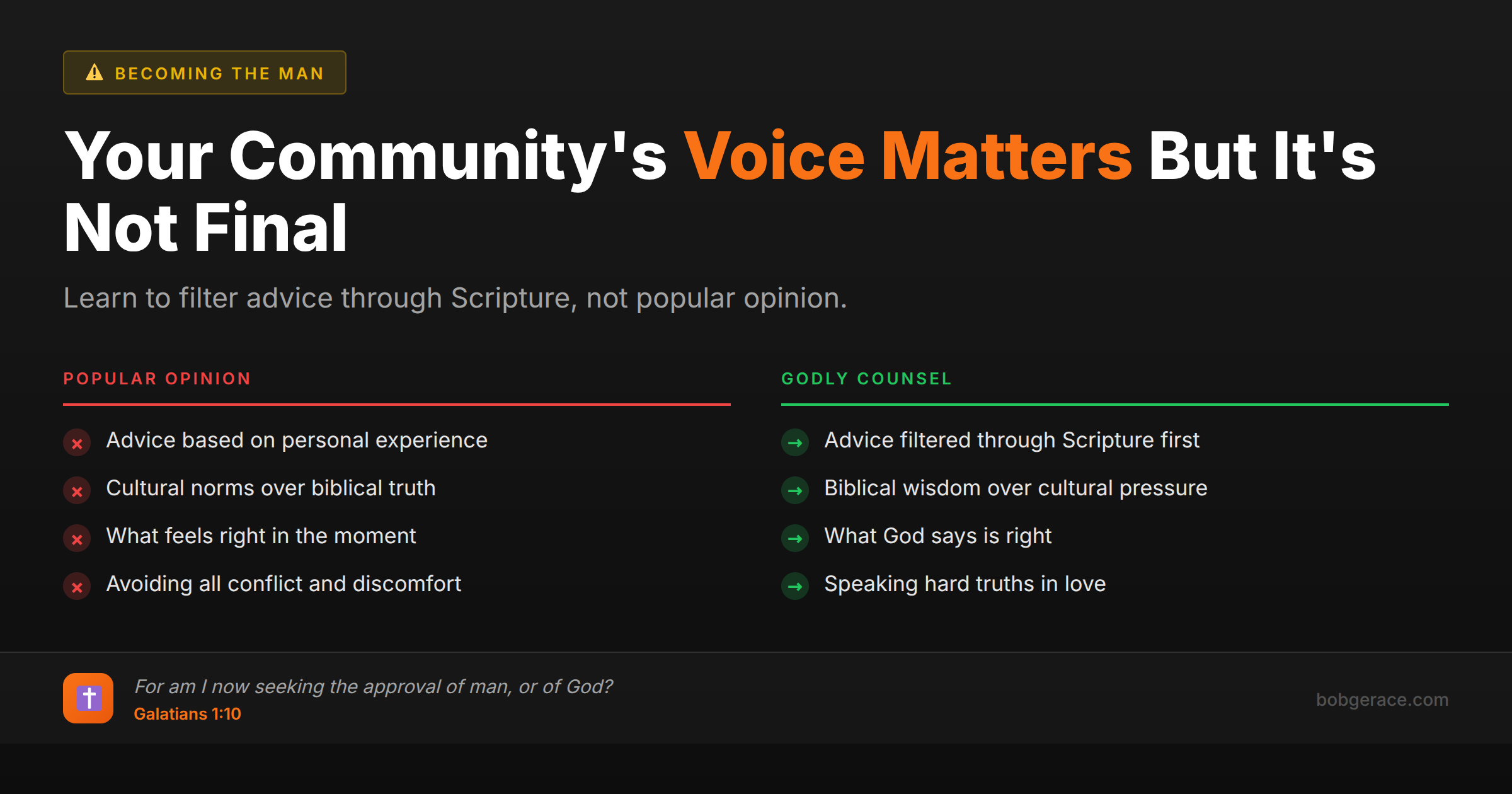
Your community's voice matters, but it shouldn't be the final authority in your marriage. Well-meaning friends, family, and even church members often give advice based on their own experiences, cultural norms, or incomplete information rather than biblical truth. While community support is valuable and God-designed, you need discernment to distinguish between godly counsel and popular opinion. The most important question isn't what your community says, but what God says. Sometimes your community will encourage you to stay in harmful situations or enable unhealthy patterns because they misunderstand biblical submission or conflict resolution. Other times, they may push you toward decisions that seem right but lack spiritual wisdom. Your job is to filter every piece of advice through Scripture and seek counsel from mature believers who prioritize God's Word over cultural expectations.
The Full Picture
Community voices can be both a blessing and a burden in marriage. On one hand, God designed us for fellowship and accountability. The church is meant to provide wisdom, support, and guidance during difficult seasons. Proverbs tells us there's safety in a multitude of counselors, and we're not meant to navigate life alone.
But here's what many women discover: not all community voices carry equal weight or wisdom. Your book club friends, your extended family, even your small group members may mean well, but their advice often reflects their own unprocessed pain, cultural conditioning, or limited understanding of your situation.
The problem deepens when community pressure conflicts with biblical truth. Maybe they're telling you to "just submit more" when you're dealing with abuse or addiction. Perhaps they're encouraging you to "keep the peace" when God is calling you to lovingly confront sin. Or they might be pushing you toward divorce when restoration is still possible.
Then there's the fear factor. Many women stay trapped in unhealthy patterns because they're terrified of what their community will think. Will the church judge you for setting boundaries? Will your family blame you if the marriage struggles? Will people think you're not spiritual enough if you seek professional help?
This is where discernment becomes crucial. Not every voice in your community speaks with divine authority. Not every opinion carries biblical weight. Some voices are shaped more by worldly wisdom, past hurts, or cultural expectations than by Scripture.
The goal isn't to isolate yourself from community input, but to become wise about which voices deserve influence in your decisions. You need people who will point you toward God's Word, encourage biblical responses, and support your growth in Christ—even when it's uncomfortable or countercultural.
What's Really Happening
From a therapeutic standpoint, community influence on marriage decisions creates complex psychological dynamics that many couples don't recognize. What I observe clinically is that women often experience what we call "social cognitive dissonance"—the internal conflict between what they instinctively know is right and what their social network is telling them to do.
This creates several problematic patterns. First, many women develop what I term "external validation dependency," where they can't make marriage decisions without community approval. This undermines their ability to think clearly, pray independently, and respond to the Holy Spirit's guidance. Second, community pressure often reinforces codependent behaviors by framing enabling as "supporting your husband" or "being a good wife."
The neuroscience is fascinating here. When we're constantly seeking community approval, our brains actually become less capable of independent moral reasoning. The prefrontal cortex, which handles complex decision-making, gets overridden by the limbic system's need for social acceptance. This is why many intelligent, capable women find themselves making marriage decisions that seem obviously unwise to outside observers.
Additionally, community voices often carry transgenerational trauma patterns. Advice from older women may reflect their own unhealed wounds or outdated understanding of healthy relationships. What sounds like wisdom may actually be trauma responses passed down through generations.
The key therapeutic intervention is helping women develop what I call "integrated discernment"—the ability to value community input while maintaining clear personal boundaries and biblical priorities. This involves learning to tolerate the discomfort of potentially disappointing others in service of obeying God and protecting their own emotional health.
What Scripture Says
Scripture gives us clear guidance about community counsel while establishing God's Word as our ultimate authority.
Proverbs 27:6 reminds us that "faithful are the wounds of a friend, but deceitful are the kisses of an enemy." True community will sometimes tell you hard truths, not just what you want to hear. But this works both ways—sometimes your community needs to hear hard truths about their advice too.
Galatians 1:10 asks a piercing question: "For am I now seeking the approval of man, or of God? Or am I trying to please man? If I were still trying to please man, I would not be a servant of Christ." Your primary concern cannot be community approval; it must be obedience to Christ.
Acts 5:29 shows the apostles declaring, "We must obey God rather than men." When community pressure conflicts with biblical principles, Scripture is clear about which voice takes precedence. This applies whether your community is pushing you toward unbiblical submission or unbiblical rebellion.
1 John 4:1 commands us to "test the spirits to see whether they are from God." Not every piece of spiritual-sounding advice comes from the Holy Spirit. You have a responsibility to evaluate all counsel—including from pastors, mentors, and friends—against Scripture.
Proverbs 19:20-21 provides beautiful balance: "Listen to advice and accept instruction, that you may gain wisdom in the future. Many are the plans in the mind of a man, but it is the purpose of the Lord that will stand." Seek wise counsel, but remember that God's purposes ultimately prevail.
Isaiah 55:8-9 reminds us that God's ways and thoughts are higher than ours—and higher than our community's. Sometimes following Christ means disappointing people you love, but it's better to please God than man.
What To Do Right Now
-
1
Identify which voices in your community carry the most influence over your marriage decisions and evaluate their biblical foundation
-
2
Find 2-3 mature believers who prioritize Scripture over cultural expectations to serve as your primary advisors
-
3
Practice saying 'I need to pray about that' when receiving unsolicited marriage advice instead of immediately accepting or rejecting it
-
4
Study what Scripture actually says about the issues your community is advising you on—don't just take their word for it
-
5
Set boundaries around sharing intimate marriage details with people who aren't equipped to give biblical counsel
-
6
Develop the courage to disappoint people when obedience to God requires it, remembering that their approval isn't your ultimate goal
Related Questions
Ready to Navigate Community Pressure with Biblical Wisdom?
Don't let well-meaning voices drown out God's voice in your marriage. Get the clarity and confidence you need.
Get Support →