What is redemptive discipline vs. punitive discipline?
6 min read
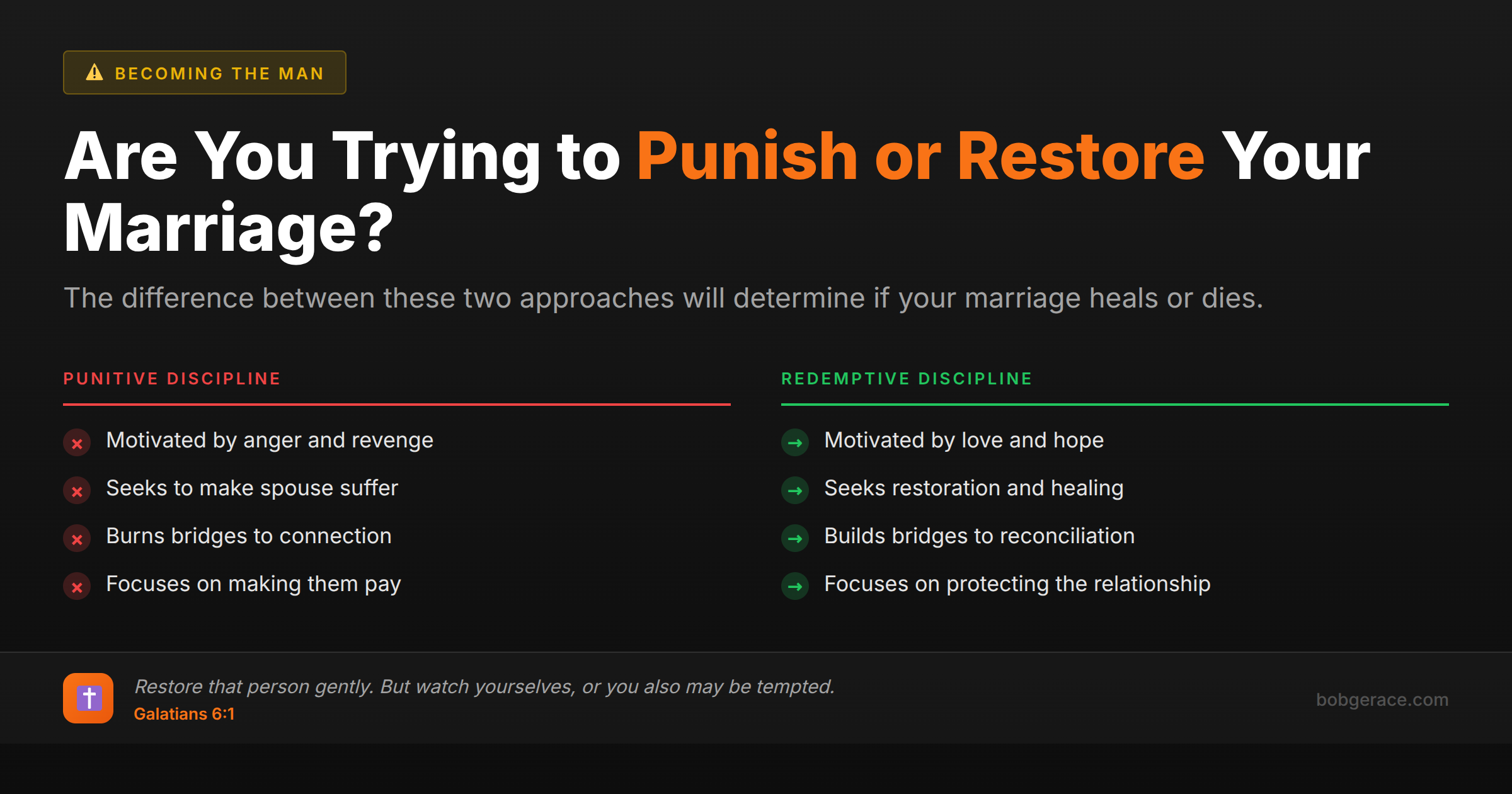
Redemptive discipline focuses on restoration and healing, while punitive discipline seeks to inflict pain or punishment. In marriage, redemptive discipline sets boundaries with the goal of protecting the relationship and encouraging your spouse toward positive change. It's motivated by love and hope for reconciliation. Punitive discipline, on the other hand, is driven by anger, hurt, or a desire for revenge—it aims to make your spouse suffer for their actions. The key difference lies in your heart motivation and ultimate goal. Redemptive discipline says, 'I'm setting this boundary because I love you and want our marriage to heal.' Punitive discipline says, 'I'm going to make you pay for what you've done.' One builds bridges toward restoration; the other burns them down.
The Full Picture
When your spouse has betrayed you with another person, your natural response is often a mixture of protective instinct and desire for justice. This is where understanding the difference between redemptive and punitive discipline becomes crucial for your marriage's survival.
Redemptive discipline is boundary-setting with a restoration mindset. It's saying 'no' to destructive behaviors while keeping the door open for healing. This might look like requiring your spouse to end all contact with the other person, attend counseling, or temporarily separate while they do the hard work of change. The motivation is protection—of yourself, your marriage, and ironically, your spouse from further destructive choices.
Punitive discipline is punishment designed to inflict emotional pain. It's driven by hurt and anger, seeking to make your spouse suffer as much as you have. This might manifest as public humiliation, withholding affection as a weapon, or creating consequences that have no constructive purpose except to cause pain.
The tricky part? Both can involve the exact same actions. Separation can be redemptive (creating space for healing) or punitive (designed to punish). The difference isn't in the boundary itself—it's in your heart motivation and whether the consequence serves the goal of restoration.
Redemptive discipline requires incredible strength and maturity. It means acting from your values rather than your emotions. It means setting firm boundaries while refusing to let bitterness poison your heart. Most importantly, it means believing that change is possible, even when you can't see evidence of it yet.
This doesn't mean being weak or naive. Redemptive discipline can be incredibly firm. Sometimes the most loving thing you can do is refuse to enable destructive behavior, even when it's painful for everyone involved.
What's Really Happening
From a clinical perspective, the distinction between redemptive and punitive approaches fundamentally affects the neurobiological response in both partners. When discipline is punitive, it activates the threat detection system in the brain, triggering fight-or-flight responses that actually make positive change less likely. The betraying spouse becomes focused on self-protection rather than genuine remorse and transformation.
Redemptive discipline, however, creates what we call 'optimal stress'—enough discomfort to motivate change without overwhelming the system. This approach maintains what researchers call 'secure functioning' even in crisis, where consequences are predictable, fair, and connected to the ultimate goal of relationship repair.
I often see couples where the betrayed spouse unconsciously sabotages their own healing by choosing punitive responses. While these provide temporary emotional relief, they typically reinforce the very disconnection that contributed to the affair initially. The betraying spouse learns to manage the punishment rather than address the underlying issues.
Redemptive discipline requires what we call 'differentiation'—the ability to stay connected to your own values and long-term goals even when flooded with intense emotions. This isn't about suppressing your anger or pain; it's about channeling those emotions into actions that serve your actual objectives.
The most successful outcomes I've witnessed involve betrayed spouses who can hold two truths simultaneously: 'What you did was unacceptable and has consequences' AND 'I'm willing to work toward healing if you do the necessary work.' This paradoxical stance often becomes the catalyst for genuine transformation in the relationship.
What Scripture Says
Scripture provides clear guidance on how to approach discipline within relationships, always with the goal of restoration rather than revenge.
Galatians 6:1 instructs us: *"Brothers and sisters, if someone is caught in a sin, you who live by the Spirit should restore that person gently. But watch yourselves, or you also may be tempted."* This verse establishes restoration as the primary goal, while acknowledging our own vulnerability to sin.
Matthew 18:15-17 outlines Jesus' approach to addressing wrongdoing: *"If your brother or sister sins, go and point out their fault, just between the two of you. If they listen to you, you have won them over."* The language here is significant—'won them over'—indicating the goal is reconciliation, not punishment.
Ephesians 4:15 calls us to *"speak the truth in love."* Redemptive discipline embodies this principle—it doesn't minimize the severity of betrayal, but addresses it from a foundation of love rather than vengeance.
Romans 12:19 specifically warns against punitive motivations: *"Do not take revenge, my dear friends, but leave room for God's wrath, for it is written: 'It is mine to avenge; I will repay,' says the Lord."* This doesn't mean avoiding consequences, but rather ensuring our motivations align with God's heart for restoration.
Hebrews 12:11 reminds us that *"No discipline seems pleasant at the time, but painful. Later on, however, it produces a harvest of righteousness and peace for those who have been trained by it."* The key phrase is 'trained by it'—discipline should be educational and transformative, not merely punitive.
The biblical model consistently points toward discipline that serves love, promotes growth, and seeks the ultimate good of both individuals and the relationship. This requires tremendous faith—believing that God can work through firm boundaries to bring about genuine heart change.
What To Do Right Now
-
1
Examine your heart motivation before setting any consequence or boundary—ask yourself if this serves restoration or revenge
-
2
Establish non-negotiable boundaries that protect you and the marriage while leaving room for your spouse to choose change
-
3
Communicate consequences clearly and calmly, focusing on the behavior that needs to change rather than attacking their character
-
4
Seek counsel from mature believers who can help you discern between appropriate boundaries and punitive reactions
-
5
Pray specifically for God to give you His heart for your spouse—this doesn't mean accepting betrayal, but approaching discipline from love
-
6
Create accountability for yourself to ensure your responses remain redemptive even when you're triggered by your spouse's choices
Related Questions
- What does loving confrontation look like biblically?
- When does grace become enabling sin?
- How do I pursue reconciliation while refusing to participate in sin?
- What does 'speaking truth in love' look like?
- How do I hold boundaries without hardening my heart?
- What is restitution and do I owe it?
- What boundaries should I set?
- What's the difference between boundary and ultimatum?
- What does biblical forgiveness require of me?
- What's the difference between forgiveness and reconciliation?
Also find Bob on
Subscribe for weekly videos on Christian marriage.
Need a Coach on Your Specific Boundary
Setting redemptive boundaries in your marriage isn't theory—it's calibrated to her history, your patterns, what's actually happening right now. Bob works with men one-on-one to figure out what firm looks like in your situation.
Talk to Bob →