What is the '180' approach and does it work?
6 min read
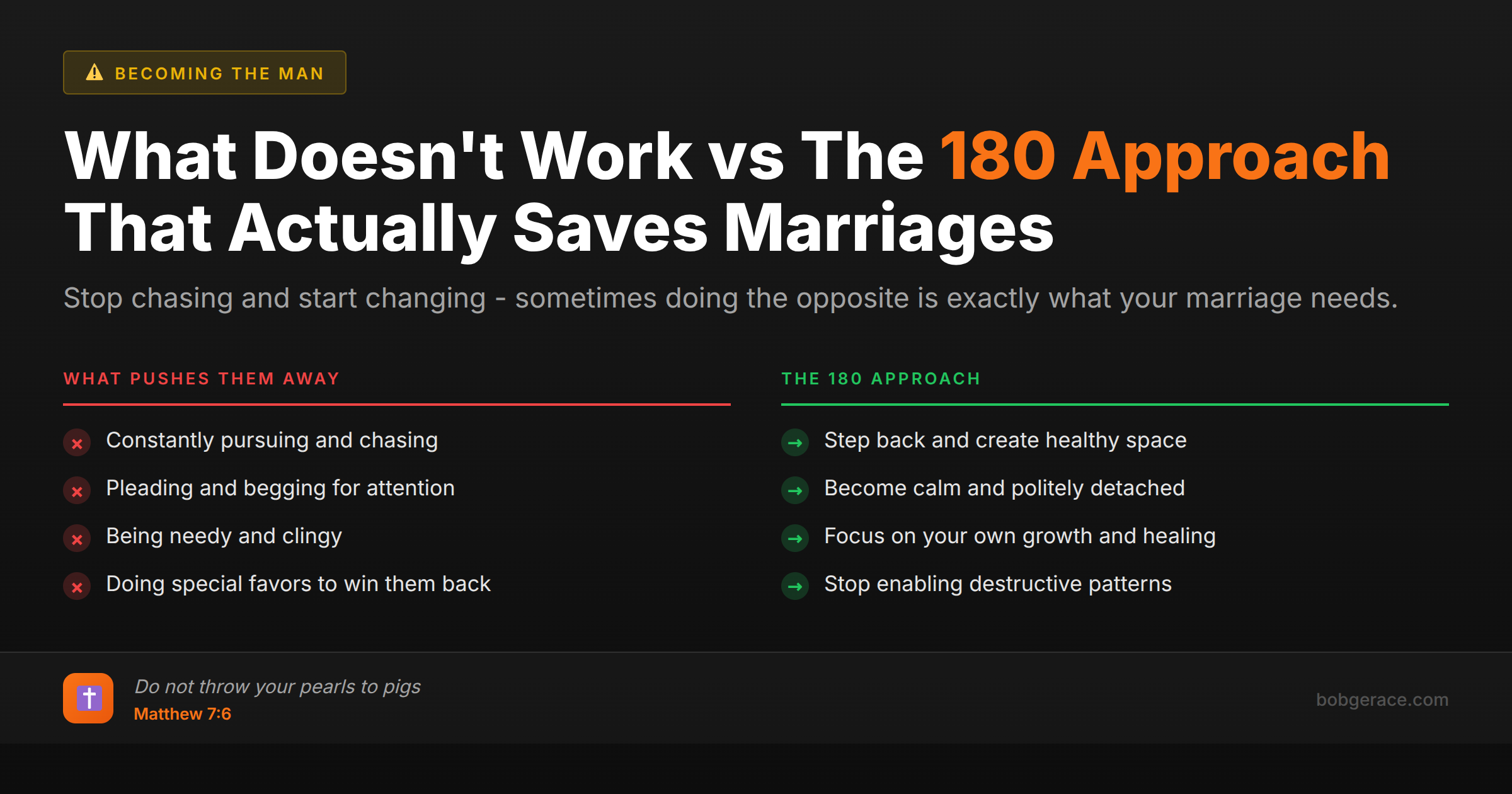
The '180' approach is a complete reversal of behaviors that aren't working in your marriage - essentially doing the opposite of what you've been doing. Instead of pursuing, you step back. Instead of pleading, you become calm. Instead of being needy, you focus on your own growth. This isn't about manipulation or games; it's about creating healthy boundaries and breaking destructive patterns. Does it work? Yes, when applied correctly with the right heart attitude. It works because it stops enabling destructive behaviors, creates space for both spouses to think clearly, and often sparks curiosity in the wayward spouse who suddenly sees a different version of you.
The Full Picture
The 180 approach gets its name from the geometric concept of a complete reversal - turning 180 degrees from your current direction. In marriage crisis, especially when there's another person involved, many betrayed spouses fall into predictable patterns: pursuing harder, pleading more desperately, monitoring obsessively, and essentially rewarding bad behavior with increased attention.
The 180 flips this script entirely. If you've been chasing, you stop. If you've been checking up constantly, you pull back. If you've been making their life easier while they're destroying your marriage, you stop enabling. This isn't about being cold or vindictive - it's about creating healthy boundaries and refusing to participate in your own destruction.
Here's what the 180 looks like in practice: You become polite but not pursuing. You focus on your own healing and growth. You stop doing special favors for someone who's betraying you. You become mysteriously busy with your own life. You respond rather than react. You essentially become the person you were before desperation took over.
Many people misunderstand the 180, thinking it's a manipulation tactic to "win back" their spouse. That's not its primary purpose. The real goal is to stop the destructive dance you've been doing together. When you change your steps, they can't keep dancing the same dance. It forces a new dynamic.
The 180 works because it addresses several psychological realities: it stops rewarding bad behavior, creates mystery and space, demonstrates self-respect, and often triggers curiosity in the other person who suddenly sees a version of you they haven't seen in a long time.
What's Really Happening
From a clinical perspective, the 180 approach addresses what we call 'pursuer-distancer dynamics' - a destructive cycle where one person's pursuit triggers the other's withdrawal, which then triggers more pursuit. This cycle actually pushes people further apart while feeling like you're trying to bring them closer.
When someone is involved with another person, they're often living in what I call 'fantasy fog' - a neurochemical state where reality is distorted by dopamine and other feel-good chemicals. Your pursuit actually feeds this fantasy by making you the 'heavy' in their story. You become the obstacle to their happiness rather than the person they chose to marry.
The 180 breaks this dynamic by removing yourself from the role of pursuer. Suddenly, there's no one to run from, no one making their choices feel justified through desperate behavior. This creates what we call 'cognitive dissonance' - their actions no longer align with a clear narrative, forcing them to confront reality.
Neurologically, the 180 also helps your own brain heal. Constant pursuit keeps you in a state of hypervigilance and anxiety. When you step back and focus on your own life, your nervous system can begin to regulate again. You start making decisions from wisdom rather than panic.
However, the 180 must be implemented with the right motivation. If it's purely manipulative - just another way to control the outcome - it often backfires. The most effective 180 comes from a genuine place of self-respect and boundary-setting, not from trying to trick someone into loving you again.
What Scripture Says
Scripture gives us a clear framework for the 180 approach through principles of wisdom, boundaries, and self-respect. Proverbs 27:14 warns us: *'Whoever blesses their neighbor with a loud voice in the early morning will be counted as cursing.'* Sometimes our 'blessings' and pursuit actually push people away.
Matthew 7:6 teaches us about appropriate boundaries: *'Do not give dogs what is sacred; do not throw your pearls to pigs. If you do, they may trample them under their feet, and turn and tear you to pieces.'* This isn't about calling people names - it's about recognizing when someone isn't in a position to receive what you're offering.
Proverbs 25:17 gives us wisdom about space: *'Seldom set foot in your neighbor's house - too much of you, and they will hate you.'* Even in marriage, there's wisdom in not overwhelming someone with your presence when they're pulling away. Sometimes love means giving space, not pursuing harder.
The principle of sowing and reaping from Galatians 6:7 applies here: *'Do not be deceived: God cannot be mocked. A person reaps what they sow.'* When we enable destructive behavior by making life comfortable for someone who's betraying us, we're actually interfering with the natural consequences that might bring them to repentance.
1 Corinthians 13:4-5 reminds us that love *'is not self-seeking'* and *'is not easily angered.'* True love sometimes means stepping back and allowing someone to experience the consequences of their choices rather than desperately trying to shield them from reality. The 180 can actually be the most loving thing you can do.
What To Do Right Now
-
1
Stop all pursuing behaviors immediately - no more texts asking where they are, no more surprise visits, no more 'checking in' constantly
-
2
Become politely detached - respond when spoken to, but don't initiate conversations about the relationship or their activities
-
3
Focus on your own life and healing - start exercising, reconnect with friends, pursue hobbies you've neglected, invest in your own growth
-
4
Stop doing special favors - no more cooking their favorite meals, doing their laundry, or making their life easier while they're destroying your marriage
-
5
Develop your own social life - spend time with supportive friends and family, but don't bad-mouth your spouse to everyone
-
6
Respond rather than react - when they try to engage in conflict or drama, stay calm and don't take the bait
Related Questions
- What boundaries should I set?
- What's the difference between boundary and ultimatum?
- What makes boundaries effective vs. empty threats?
- How do I stay connected while enforcing boundaries?
- How do I not pursue while also not abandoning?
- What does 'detach with love' actually mean?
- Should I give her space or fight for her?
- How much space is too much?
- If I give space, won't she think I don't care?
- What's the difference between pursuing and chasing?
Also find Bob on
Subscribe for weekly videos on Christian marriage.
You Need a Coach Who Knows Your Marriage
The 180 works when it's calibrated to your actual situation—not a script from a forum. A coach helps you see what to do Monday when your wife does the thing you didn't expect.
Talk to Bob →