What's the difference between anger and rage?
6 min read
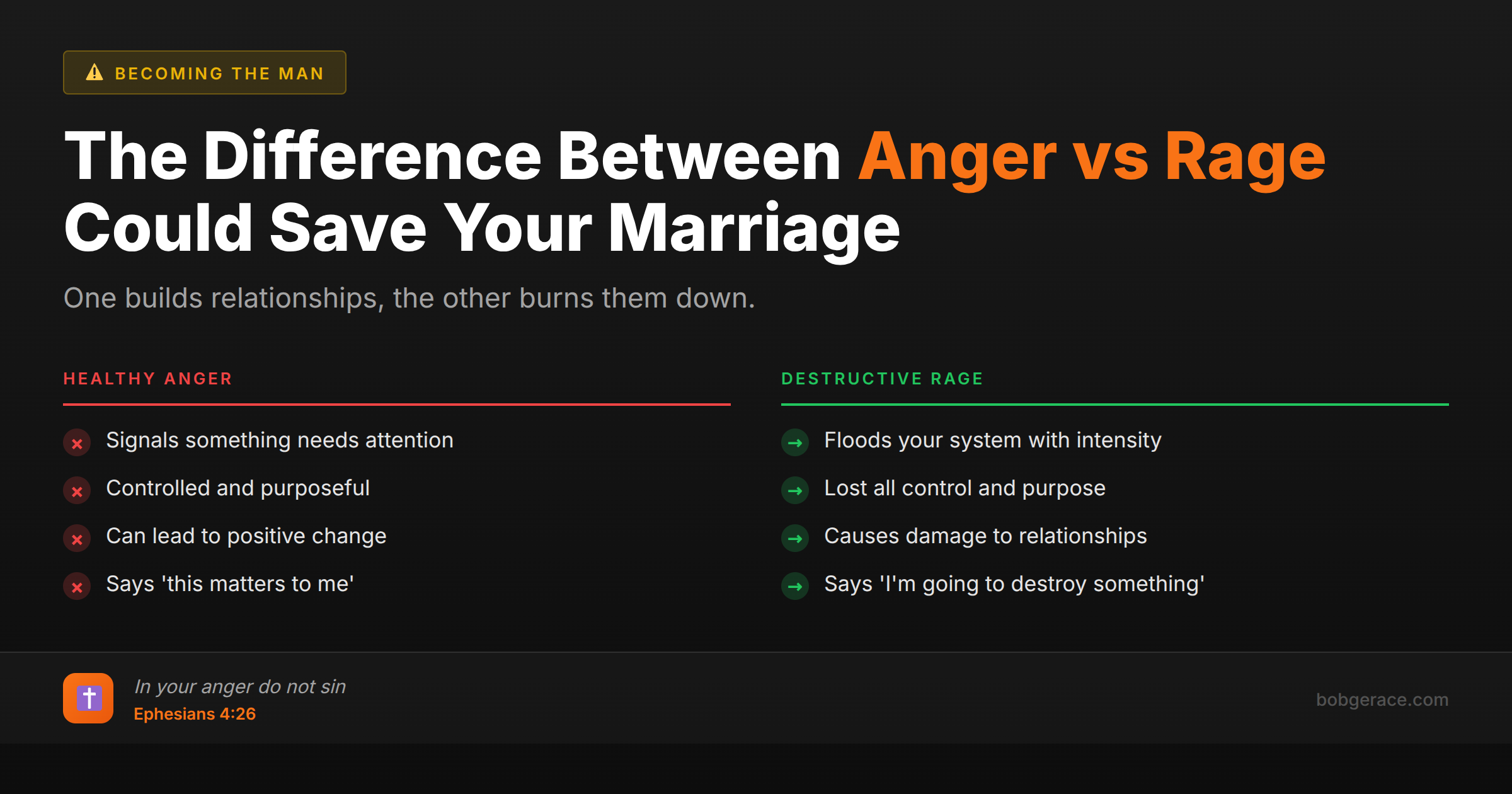
Anger is a normal human emotion that signals something needs attention - it's controlled, purposeful, and can lead to positive change. Rage is anger that's lost all control, flooding your system with intensity that often causes damage to relationships and yourself. Think of anger as a warning light on your car's dashboard - it's information you can act on. Rage is like that warning light exploding and taking out your whole electrical system. Anger says 'this matters to me.' Rage says 'I'm going to destroy something.' The difference isn't just intensity - it's about control, purpose, and outcome. One builds; the other burns down.
The Full Picture
Here's what most people miss: anger isn't the enemy in your marriage - uncontrolled anger is. I've worked with thousands of couples, and this distinction changes everything.
Anger is actually designed to protect what you value. When your spouse dismisses your concerns, anger signals that respect matters to you. When they break a promise, anger says trust is important. It's information wrapped in intensity. Healthy anger has boundaries - it knows when to start and when to stop.
Rage is different. It's anger that's been hijacked by your nervous system. Your brain's alarm center (the amygdala) floods your body with stress hormones, shutting down your prefrontal cortex - the part that thinks clearly and makes good decisions. You literally can't think straight.
The key markers that separate anger from rage:
- Control: Anger can be channeled; rage takes over - Purpose: Anger seeks resolution; rage seeks destruction - Memory: You remember angry conversations; rage often creates blackouts - Recovery: You bounce back from anger quickly; rage leaves emotional wreckage - Physical response: Anger energizes; rage overwhelms your system
In marriage, anger can actually strengthen your relationship when handled well. It shows your spouse what matters to you and creates opportunities for deeper understanding. Rage does the opposite - it traumatizes, intimidates, and erects walls that take years to tear down.
The tragic part? Most people experiencing rage think they're just 'really angry.' They minimize the impact because it feels like the same emotion, just stronger. But your spouse experiences it completely differently. To them, rage feels dangerous, unpredictable, and relationship-threatening.
What's Really Happening
From a neurological standpoint, anger and rage activate completely different brain systems. Healthy anger engages your prefrontal cortex alongside your limbic system - you feel the emotion but retain executive function. You can still problem-solve, consider consequences, and choose your words carefully.
Rage triggers what we call 'amygdala hijack.' Your brain's threat detection center becomes hyperactive, flooding your system with cortisol and adrenaline while simultaneously shutting down higher-order thinking. This is why people often say 'I wasn't myself' after a rage episode - neurologically, they're right.
The physiological markers are distinct. Anger might raise your heart rate to 90-100 BPM - energizing but manageable. Rage can spike you to 160+ BPM, creating tunnel vision, muscle tension, and fight-or-flight responses that can last hours.
Here's what's crucial for marriages: rage creates trauma responses in your spouse. Even if you never touch them, their nervous system registers rage as a threat. Over time, this can develop into hypervigilance, emotional numbing, or chronic anxiety around conflict.
The good news? Your brain is plastic. You can literally rewire these patterns through consistent practice. Mindfulness-based interventions, somatic therapy, and cognitive behavioral techniques all show strong efficacy in helping people recognize the early warning signs and interrupt the rage cycle before it takes over.
The key is learning to catch yourself in the 'yellow zone' - when anger is building but hasn't yet hijacked your system. This is your window of opportunity to make a different choice.
What Scripture Says
Scripture makes this distinction clear. God experiences anger - it's mentioned over 400 times in the Bible - but His anger is always righteous, controlled, and purposeful. 'In your anger do not sin: Do not let the sun go down while you are still angry' (Ephesians 4:26). This verse acknowledges anger as normal while warning against letting it control us.
The difference between godly anger and destructive rage is spelled out beautifully: 'Human anger does not produce the righteousness that God desires' (James 1:20). When anger becomes about our pride, our need to be right, or our desire to punish, it's crossed into dangerous territory.
Look at Jesus in the temple. 'He made a whip out of cords, and drove all from the temple courts' (John 2:15). This was intense, purposeful anger against injustice. But notice - He didn't lose control. He didn't say things He'd regret later. His anger had a righteous purpose and clear boundaries.
Contrast this with Cain's rage: 'Cain was very angry, and his face was downcast' (Genesis 4:5). God warned him: 'Sin is crouching at your door; it desires to have you, but you must rule over it' (Genesis 4:7). Cain let his anger become rage, and it led to murder.
Proverbs gives us the clearest guidance: 'Whoever is patient has great understanding, but one who is quick-tempered displays folly' (Proverbs 14:29). And 'Better a patient person than a warrior, one with self-control than one who takes a city' (Proverbs 16:32).
The biblical model isn't to eliminate anger - it's to steward it wisely, letting it inform us without letting it control us.
What To Do Right Now
-
1
Learn your warning signs - Track physical sensations like heart rate, muscle tension, or breathing changes before you lose control
-
2
Create a rage circuit breaker - Develop a 10-minute cooling off protocol you implement the moment you feel yourself escalating beyond healthy anger
-
3
Practice the 6-second rule - Neurochemical rage floods last about 6 seconds; if you can avoid reacting for that long, you regain choice
-
4
Distinguish your triggers - Write down what makes you angry vs. what sends you into rage; look for patterns and deeper wounds
-
5
Apologize specifically - If you've raged at your spouse, own it completely: 'I went into rage and that was wrong' not 'I got a little heated'
-
6
Get professional help - If rage is a pattern, work with a therapist who understands trauma and nervous system regulation
Related Questions
Ready to Transform Your Anger Into Strength?
Don't let rage continue damaging your marriage. Get the tools and support you need to channel your emotions in ways that build rather than destroy.
Get Help Now →