What's underneath the anger — fear, shame, hurt?
6 min read
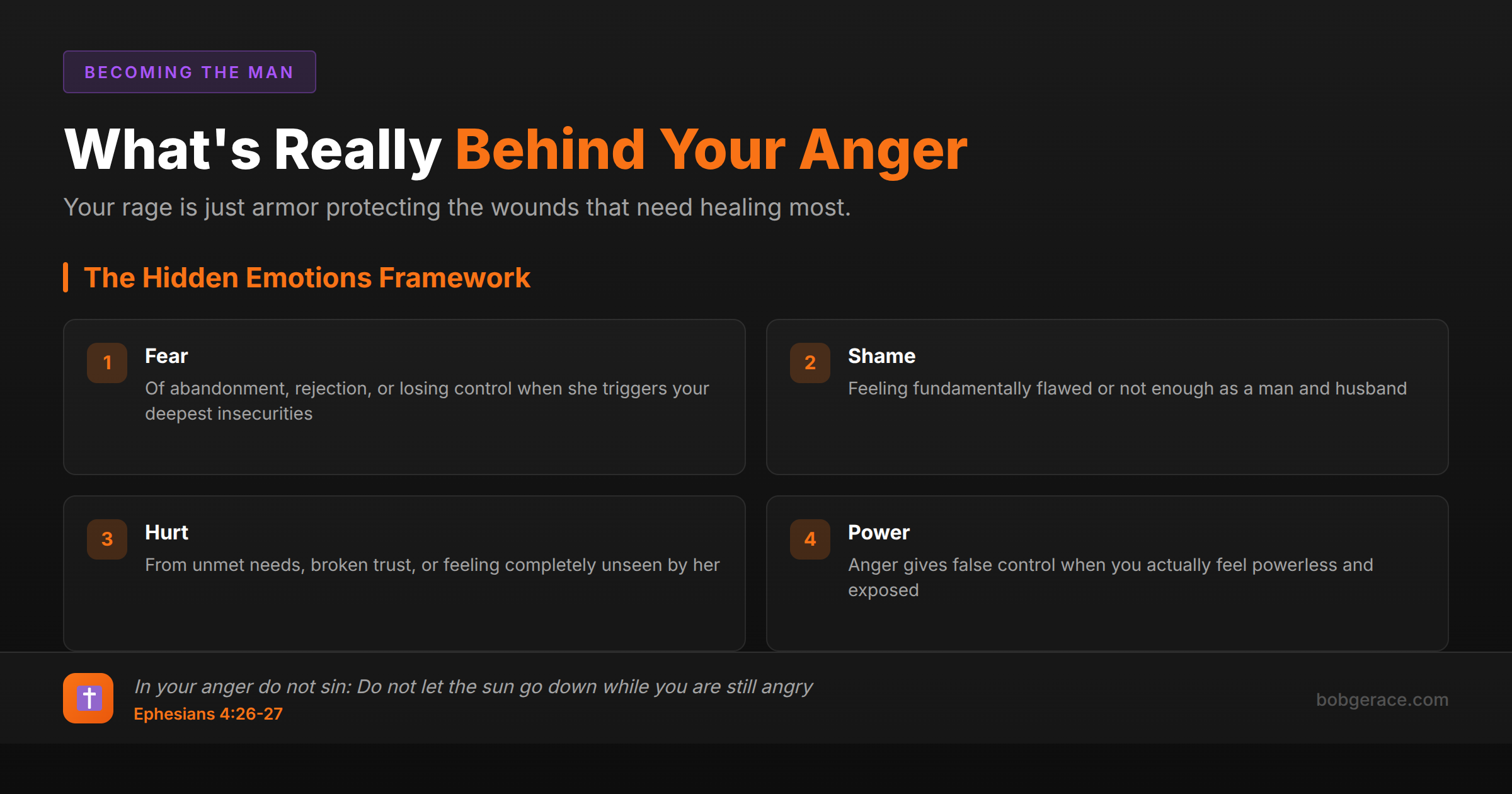
Anger is almost never the primary emotion—it's a protective shield covering deeper wounds. Underneath that explosive fury are typically three core emotions: fear (of abandonment, rejection, or losing control), shame (feeling fundamentally flawed or not enough), and hurt (from unmet needs, broken trust, or feeling unseen). When your spouse triggers these vulnerable feelings, anger becomes your armor, giving you a sense of power and control when you actually feel powerless and exposed. The problem is that anger pushes away the very person you need most. Your spouse sees the rage but misses the pain underneath. They respond to your anger defensively, which confirms your fears and deepens your hurt, creating a vicious cycle that destroys intimacy and connection.
The Full Picture
Here's what most couples miss: anger is a secondary emotion. It's your emotional bodyguard, showing up to protect you when you feel threatened, hurt, or vulnerable. But it's terrible at actually solving problems or building connection.
Think about the last time you exploded at your spouse. What happened right before the anger hit? Did they dismiss your feelings? Forget something important to you? Make you feel small or criticized? That moment of pain—that's the real issue. The anger came rushing in to protect you from feeling that vulnerable emotion.
Fear drives most marital anger. You're afraid of: - Being abandoned or rejected - Losing control of your life or relationship - Not being good enough - Your needs never being met - Being hurt again like you were in the past
Shame fuels the explosion. When something triggers that deep belief that you're fundamentally flawed, broken, or unlovable, anger becomes your way of fighting back against that excruciating feeling.
Hurt is often the deepest layer. You're grieving unmet longings—to be cherished, understood, prioritized, or valued. When your spouse's actions communicate the opposite, that pain is almost unbearable.
The tragedy is that anger accomplishes the opposite of what you really want. You want connection, understanding, and love, but anger pushes your spouse away and makes them defensive. You want to feel powerful, but anger actually reveals how powerless and hurt you feel inside.
Your spouse isn't a mind reader. They see your rage and react to it, never seeing the wounded heart underneath. This creates a cycle where your deeper needs go unmet, confirming your worst fears and generating more anger.
What's Really Happening
From a clinical perspective, anger serves as what we call a 'protest emotion'—it's your nervous system's way of saying 'this isn't okay' when your fundamental needs for safety, connection, or significance are threatened. In attachment theory, we understand that anger often emerges when our attachment system is activated—when we perceive threat to our emotional bond with our spouse.
Neurologically, when you experience those underlying emotions—fear, shame, or hurt—your amygdala (the brain's alarm system) triggers a threat response. Anger floods your system with adrenaline and cortisol, giving you a temporary sense of power and control. It's your brain's attempt to regain equilibrium when you feel emotionally dysregulated.
The challenge is that anger activates your spouse's threat detection system too. When they see your anger, their brain interprets it as danger, triggering their own defensive responses. This creates what we call 'negative cycles'—predictable patterns where both partners' attachment fears get triggered simultaneously.
Shame is particularly toxic because it attacks your core sense of self. Unlike guilt (which says 'I did something bad'), shame says 'I am bad.' When shame gets triggered in marriage, anger becomes a way to deflect that unbearable feeling and project it outward.
The good news is that once you understand these deeper emotions, you can learn to identify them before they escalate to anger. This creates space for vulnerability and connection instead of conflict and distance. When you can say 'I'm scared' instead of exploding, everything changes.
What Scripture Says
God's Word acknowledges the reality of difficult emotions while calling us to handle them wisely. Ephesians 4:26-27 gives us crucial guidance: *'In your anger do not sin: Do not let the sun go down while you are still angry, and do not give the devil a foothold.'* Notice it doesn't say 'don't get angry'—it says don't sin in your anger and don't let it fester.
Psalm 139:23-24 invites us into the deeper work: *'Search me, God, and know my heart; test me and know my anxious thoughts. See if there is any offensive way in me, and lead me in the way everlasting.'* God wants us to explore what's really happening in our hearts beneath the surface emotions.
Jesus himself experienced the full range of human emotions. John 11:35 tells us *'Jesus wept'* when he saw Mary's grief over Lazarus. He felt deeply and wasn't ashamed of his emotions. Mark 3:5 says he looked at the Pharisees *'with anger, deeply distressed at their stubborn hearts.'* Even Jesus experienced anger, but it was righteous anger focused on injustice, not self-protection.
1 Peter 5:7 offers the antidote to fear: *'Cast all your anxiety on him because he cares for you.'* When fear drives your anger, you can bring those fears to God instead of unleashing them on your spouse.
For shame, Romans 8:1 is transformative: *'Therefore, there is now no condemnation for those who are in Christ Jesus.'* Your identity isn't found in your performance or your spouse's approval—it's found in Christ's unchanging love.
Isaiah 53:3 reminds us that Jesus was *'despised and rejected by mankind, a man of suffering, and familiar with pain.'* He understands your hurt and offers healing for your deepest wounds.
What To Do Right Now
-
1
Practice the pause. When you feel anger rising, stop and ask: 'What am I really feeling underneath this anger? Am I scared, hurt, or ashamed?'
-
2
Name the deeper emotion. Say it out loud: 'I'm feeling scared that you don't care about me' instead of 'You never listen!'
-
3
Share your vulnerability. Tell your spouse about the fear, hurt, or shame instead of expressing the anger. This invites connection instead of defense.
-
4
Identify your triggers. What specific situations or words consistently lead to anger? Understanding your patterns helps you prepare differently.
-
5
Take responsibility. Apologize for any angry outbursts and explain what you were really feeling: 'I'm sorry I yelled. I was feeling hurt and scared.'
-
6
Seek professional help. If anger is damaging your marriage, find a qualified therapist who can help you process these deeper emotions safely.
Related Questions
- What is 'secondary emotion' and is anger covering something?
- Why does anger feel like the only accessible emotion?
- What role did my childhood play in my anger patterns?
- I can't control my anger
- What is 'amygdala hijack' and how do I interrupt it?
- How do I express need without rage?
- What is 'betrayal trauma' and do I have it?
- Why do I feel like I'm going to die?
- How do I not lose my mind right now?
Also find Bob on
Subscribe for weekly videos on Christian marriage.
Your Anger Has a Specific Story
A coach who knows your marriage can help you trace what's underneath—and teach your spouse to see the hurt instead of just the explosion.
Talk to Bob →