What's the difference between thinking and feeling?
6 min read
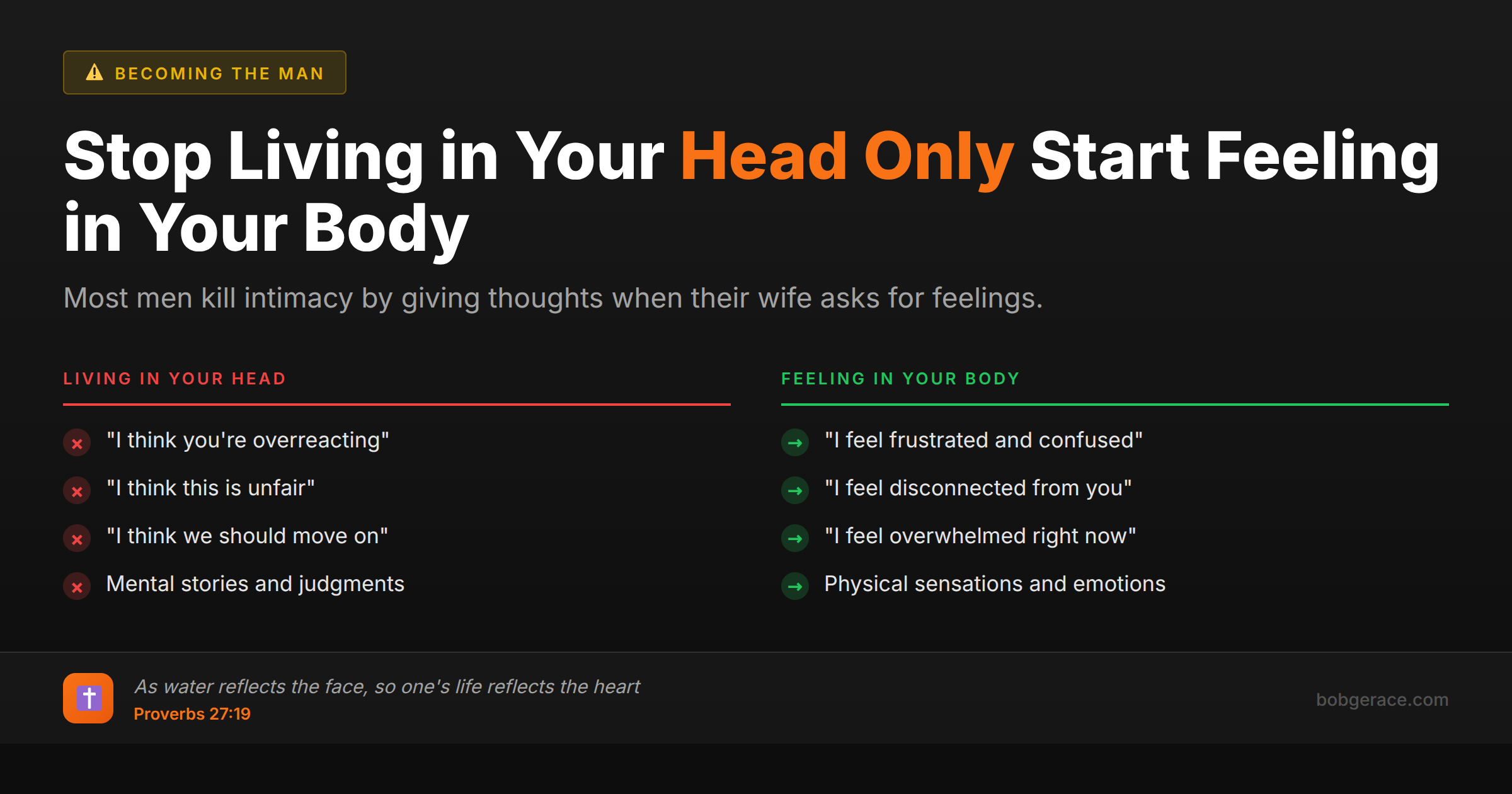
Here's the straight truth: thinking happens in your head, feeling happens in your body. Thoughts are the stories you tell yourself about what's happening - your interpretations, judgments, and mental chatter. Feelings are the physical sensations and emotional responses that arise in your chest, stomach, and throughout your body. Most men confuse the two because we've been taught to live in our heads. When your wife asks "How do you feel?" and you respond with "I think you're being unreasonable," you're giving her a thought, not a feeling. A feeling would be "I feel frustrated" or "I feel disconnected." This distinction isn't just semantics - it's the foundation of emotional intelligence and the key to deeper intimacy in your marriage.
The Full Picture
The Head vs. Heart Reality
Let me break this down in a way that actually matters for your marriage. Your thoughts are like a running commentary in your mind - they analyze, judge, interpret, and create stories about everything happening around you. When traffic is bad, you think "This always happens when I'm running late" or "That driver is an idiot." These are thoughts.
Your feelings, however, are the emotional and physical responses happening in your body. In that same traffic situation, you might feel tension in your shoulders, a knot in your stomach, or heat rising in your chest. You might feel anxious, frustrated, or angry. These are feelings.
Why This Matters in Marriage
Your wife isn't asking for your analysis when she wants to know how you feel. She's asking for emotional connection. When you respond to "How do you feel about us?" with "I think we need to communicate better," you've just intellectualized the conversation. What she needs to hear is "I feel scared that we're drifting apart" or "I feel grateful for what we have but worried about our future."
The Physical Component
Feelings have a physical component that thoughts don't. Anxiety sits in your chest. Anger heats your face. Sadness weighs down your shoulders. Fear tightens your stomach. Learning to recognize these physical sensations is crucial because they're your early warning system for what's really happening emotionally.
The Story vs. The Experience
Thoughts create stories about your experience. Feelings ARE the experience. Both are important, but they serve different functions. Thoughts help you problem-solve and make decisions. Feelings help you connect with others and understand what matters to you. A mature man needs both, but he knows which one to lead with in different situations.
What's Really Happening
From a neurological perspective, thoughts and emotions originate in different areas of the brain and follow distinct pathways. Thoughts primarily emerge from the prefrontal cortex - your brain's executive center responsible for reasoning, analysis, and decision-making. Emotions, however, are processed in the limbic system, particularly the amygdala and hippocampus, which are much more primitive and connected to your body's autonomic nervous system.
This explains why emotions feel so immediate and physical while thoughts feel more controllable and abstract. When you experience an emotion, your brain is literally sending chemical signals throughout your body, triggering physical responses like increased heart rate, muscle tension, or changes in breathing patterns.
What's particularly important for men to understand is that emotional suppression - trying to think your way out of feelings - actually increases cortisol levels and creates chronic stress. The research is clear: men who can identify and express emotions have better cardiovascular health, stronger immune systems, and significantly better relationship satisfaction.
The clinical term for confusing thoughts with feelings is "intellectualization" - a defense mechanism where we avoid emotional discomfort by staying in our analytical mind. While this might feel safer in the short term, it creates distance in relationships because authentic connection requires emotional vulnerability, not just intellectual sharing.
In marriage therapy, I often see couples where the husband has become so disconnected from his emotional experience that he genuinely doesn't know the difference between thinking and feeling. This isn't a character flaw - it's often the result of cultural conditioning that taught him emotions were dangerous or weak. The good news is that emotional intelligence can be developed at any age with practice and intentionality.
What Scripture Says
Scripture beautifully demonstrates the integration of both thinking and feeling in the life of faith. Proverbs 27:19 tells us *"As water reflects the face, so one's life reflects the heart."* This verse acknowledges that our inner emotional life - our heart - is reflected in how we live and relate to others.
Philippians 4:7 speaks of *"the peace of God, which transcends all understanding, will guard your hearts and your minds in Christ Jesus."* Notice that Paul distinguishes between hearts and minds, recognizing both as needing God's protection and care. This isn't about choosing one over the other, but about surrendering both to Christ.
Jesus himself modeled the full range of human emotion. John 11:35 simply states *"Jesus wept."* He didn't analyze the situation or give a theological discourse - he felt the pain of loss and expressed it. Earlier in the same chapter, John 11:33 tells us Jesus was *"deeply moved in spirit and troubled."* The Son of God experienced and expressed genuine emotion.
Proverbs 4:23 instructs us to *"Above all else, guard your heart, for everything you do flows from it."* Your heart - your emotional and spiritual center - is the wellspring of your life. This doesn't diminish the importance of the mind, but it establishes the heart as central to who you are.
Romans 12:2 calls us to be *"transformed by the renewing of your mind."* God wants to transform our thinking patterns, but this transformation includes learning to honor our emotions as part of how He created us. The goal isn't to become purely rational beings, but to become integrated men who think clearly and feel deeply, all under the lordship of Christ.
A godly man learns to steward both his thoughts and his emotions, using his mind to honor God and his emotional capacity to love others well.
What To Do Right Now
-
1
Practice the body scan: Three times today, stop and notice what you're physically feeling in your chest, shoulders, and stomach without trying to fix or change anything.
-
2
Use the feeling wheel: Download an emotion wheel and spend 5 minutes identifying specific emotions you experienced today beyond just "good," "bad," or "fine."
-
3
Separate thoughts from feelings: When someone asks how you feel, catch yourself if you start with "I think" and rephrase using "I feel" with an actual emotion word.
-
4
Have one emotional check-in: Ask your wife how she's feeling today and listen without trying to solve, fix, or give advice - just acknowledge her emotional experience.
-
5
Journal the difference: Write down one situation from today describing both what you thought about it and what you felt about it as two separate things.
-
6
Practice emotional vocabulary: Choose three new emotion words you don't normally use and try to identify when you experience them over the next week.
Related Questions
- How do I identify what I'm feeling?
- What is emotional intelligence and why does it matter?
- What is 'alexithymia' and do I have it?
- How do I build emotional vocabulary?
- How do I notice feelings in my body?
- What is emotional granularity?
- Why do I feel physically sick?
- What's happening to my nervous system right now?
- What does betrayal do to the brain?
- How do I not lose my mind right now?
Also find Bob on
Subscribe for weekly videos on Christian marriage.
Ready to apply this to your marriage?
Understanding the concept is one thing. Knowing how to use it when your wife is upset and you're stuck in your head — that's where coaching comes in.
Talk to Bob →