Can I talk to you directly about concerns?
5 min read
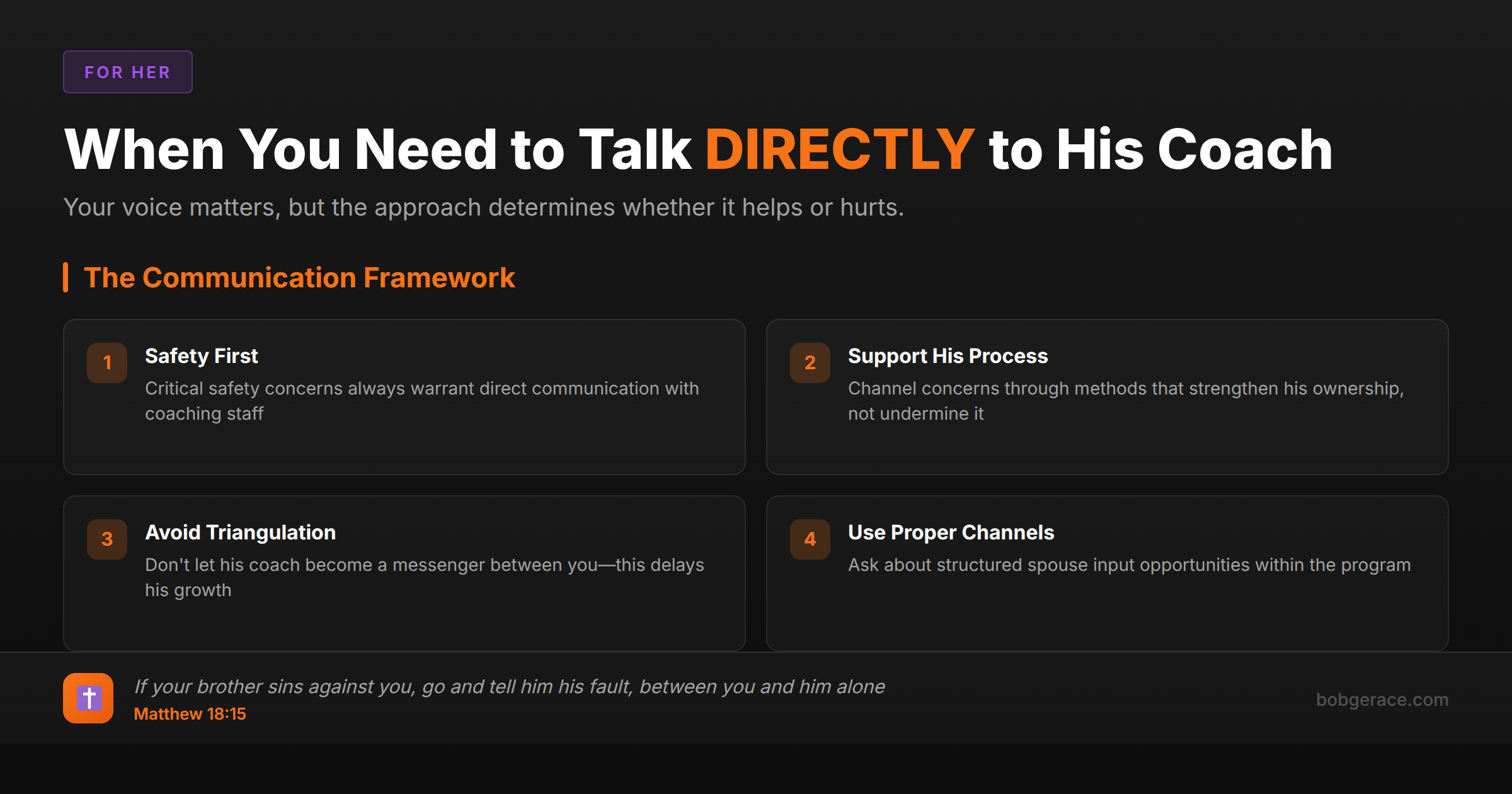
Your desire to communicate directly is completely understandable—you're invested in your marriage and want to make sure the coaching process accounts for reality as you've experienced it. Here's how we handle this thoughtfully. Direct communication between a wife and her husband's coach requires careful navigation. In most cases, coaching effectiveness depends on your husband owning his process completely. If his coach becomes a messenger between you, it can undermine the very independence he needs to develop. That said, your perspective matters enormously. There are appropriate channels for sharing concerns, and there are situations where direct communication serves the marriage well. The key is ensuring any contact supports his transformation rather than creating triangulation that delays it. If you have serious concerns—safety issues, information his coach needs to know, or questions about the process—there are ways to communicate that honor everyone involved. Your voice isn't excluded; it's channeled appropriately.
Why Communication Channels Matter
The instinct to reach out directly to your husband's coach makes complete sense. You've been living with the reality of your marriage while he's been describing it to someone else. You might worry that important context is missing, that he's presenting a selective version of events, or that his coach doesn't understand what you've actually been through. Those concerns are legitimate.
Here's why we navigate direct communication carefully: your husband is learning to take full ownership of his marriage, his behavior, and his transformation. When his coach becomes a conduit for messages between you, it can inadvertently create dependency rather than developing his ability to hear and respond to you directly. Part of his growth involves learning to receive your perspective himself—not filtered through a third party.
There's also a dynamic we actively avoid: triangulation. This happens when communication flows through a third person rather than directly between the two people who need to resolve something. While triangulation feels safer in the moment, it ultimately prevents the direct communication your marriage needs to heal.
That said, there are situations where direct contact is appropriate and helpful. If there are safety concerns that his coach needs to know about, that information should absolutely be shared. If there's critical context about the marriage history that would help his coach support him better, that can be communicated. If you have questions about the coaching process itself—what to expect, how long things take, what you might see—those questions deserve answers.
Many coaching programs offer structured ways for wives to provide input. This might include periodic check-ins, written correspondence that becomes part of his coaching context, or specific sessions designed for spousal perspective. These structured channels provide your voice a place while maintaining the boundaries that make coaching effective.
The goal isn't to exclude you—it's to ensure that communication supports transformation rather than substituting for it. Your husband needs to develop the capacity to hear hard truths directly from you. Building that muscle is part of what coaching accomplishes. When that capacity develops, you won't need to go through his coach anymore. You'll be able to go directly to him.
The Psychology of Triangulation
Family systems theory identifies triangulation as a primary dysfunction in struggling relationships. When two people in conflict involve a third party rather than addressing issues directly, it provides temporary relief but prevents genuine resolution. The third party absorbs anxiety that belongs in the primary relationship, allowing core issues to remain unaddressed.
In coaching contexts, triangulation can manifest as the wife communicating concerns through the coach, the coach becoming a translator between spouses, or the husband using coaching language to deflect direct conversation with his wife. Each pattern delays the direct communication that healing ultimately requires.
The therapeutic concept of "differentiation" is relevant here. Differentiation describes the ability to maintain your own identity and perspective while staying emotionally connected to another person. Your husband is developing this capacity—learning to hear your pain without becoming defensive, to acknowledge your experience without losing himself. If his coach manages that communication for him, he doesn't develop the differentiation muscle himself.
Research on successful couples therapy shows that lasting change requires couples to develop new communication patterns together, not just understand concepts intellectually. The coach's role is to build his capacity for direct engagement with you, not to serve as a permanent intermediary. This is why communication boundaries, while sometimes frustrating, serve the long-term health of your marriage.
Direct Communication in Scripture
Scripture consistently emphasizes direct communication between spouses. When God addressed the first marriage conflict, He spoke to Adam and Eve individually and directly (Genesis 3). He didn't send messages through intermediaries or allow them to speak about each other rather than to each other.
Matthew 18:15 establishes the principle of direct address: "If your brother sins against you, go and tell him his fault, between you and him alone." While this verse addresses church conflict specifically, the principle applies to marriage: direct communication is the primary path to reconciliation. Third parties have roles, but they don't replace direct engagement.
The Song of Solomon models intimate communication between husband and wife—direct, vulnerable, honest. "My beloved speaks and says to me" (Song of Solomon 2:10). The language is first person, face to face. This is the communication pattern your marriage is being rebuilt toward.
We see your husband's coach as serving the role described in Proverbs 27:17: "Iron sharpens iron, and one man sharpens another." The coach sharpens your husband so that he can engage you directly with wisdom, humility, and strength. The goal is never permanent mediation but temporary equipping for direct relationship.
Appropriate Ways Forward
-
1
For safety concerns or critical information, direct communication with coaching staff is always appropriate and welcomed.
-
2
For general concerns about the process, ask your husband to share relevant portions of his coaching resources with you directly.
-
3
Consider keeping a journal of questions that you can discuss with your husband as he progresses in his journey.
-
4
Inquire about structured spouse input opportunities that may be available through the coaching program.
-
5
Practice bringing concerns directly to your husband first—his developing capacity to receive them is part of his transformation.
-
6
Trust that your perspective is being honored even when communication flows through appropriate channels.
Related Questions
- What does he hear about me in your coaching?
- How do I heal from what's happened?
- What should I expect during this process?
- What's my role in his transformation?
- What is this program actually teaching him?
- What if he's only doing this to keep me from leaving?
- How do I know if he's really changing?
- What are the markers of genuine behavior change?
- What should change in his communication?
- How involved should I be in his process?
Also find Bob on
Subscribe for weekly videos on Christian marriage.
Think This Could Help Your Husband?
If you believe your husband could benefit from the structured transformation process we offer, share this with him. Real change is possible when men commit to the work.
Learn About the Program →