What if he's only doing this to keep me from leaving?
6 min read
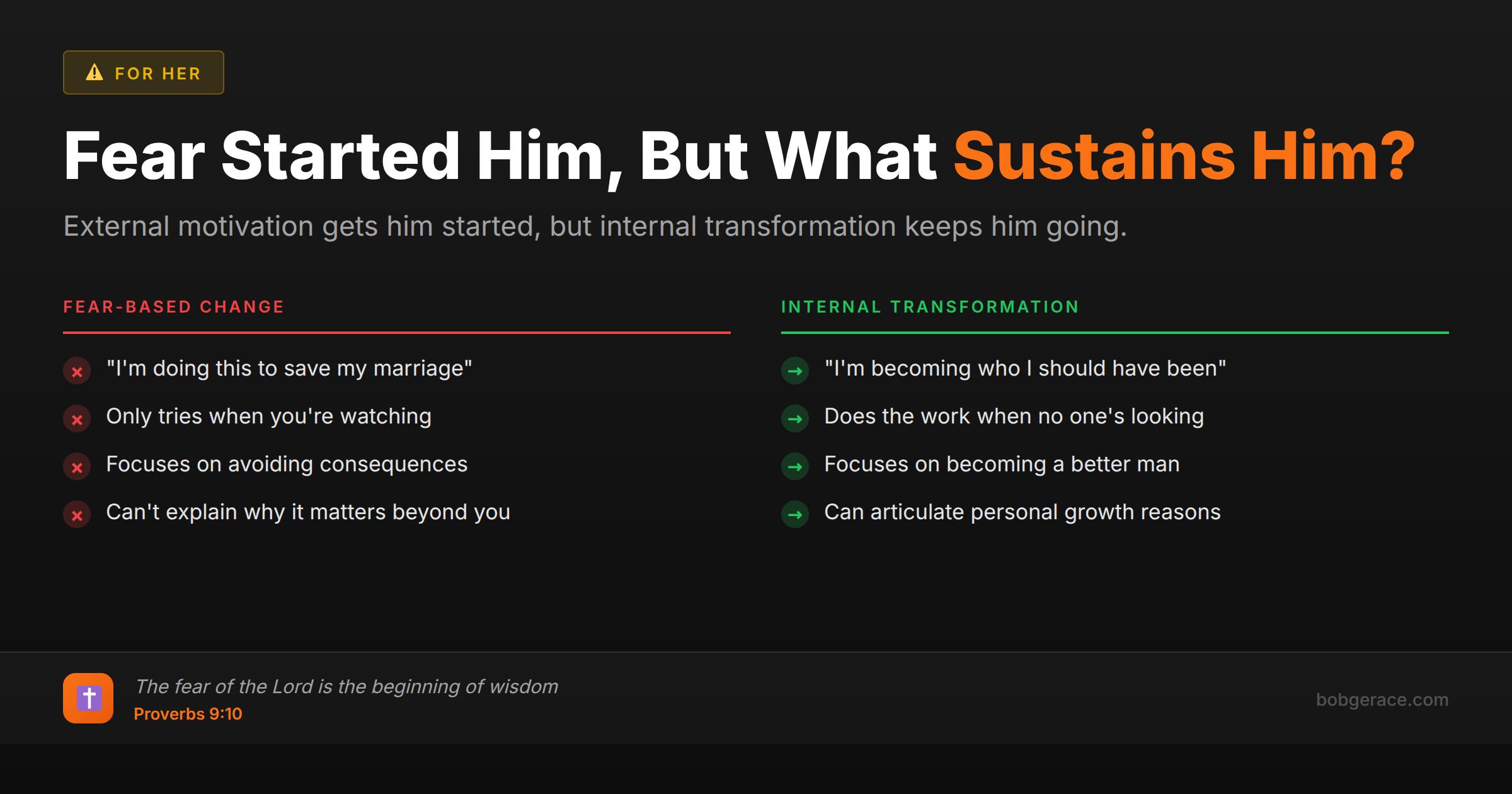
Let's be honest: yes, the fear of losing you probably is part of what got him here. And that's not automatically a bad thing. Fear of loss is often the only force strong enough to break through years of denial and avoidance. The question isn't whether fear started him—it's whether something deeper sustains him. Here's what the program teaches him: external motivation (fear of divorce, fear of consequences) might get someone started, but it can't sustain transformation. Within weeks of beginning, the work shifts from 'doing this to save my marriage' to 'becoming the man I should have been all along.' If that shift doesn't happen, the change won't last. If it does, you'll see evidence of it.
The Full Picture
Your concern makes complete sense. You've probably seen this before—a crisis hits, he suddenly becomes attentive and motivated, then once the immediate threat passes, everything slides back. It's natural to wonder if this is just another performance until you stop threatening to leave.
The truth is more nuanced than 'fear-based change is fake' or 'fear-based change is real.' Fear can be the catalyst for genuine transformation, or it can be the fuel for temporary performance. The difference lies in what happens after the initial crisis response.
In the first few weeks of crisis, almost everyone is motivated by fear. That's normal and even necessary—sometimes fear is the only thing powerful enough to break through walls of denial. The man who isn't afraid of losing you when facing divorce might have a different problem entirely.
But fear is an exhausting motivator. It can't sustain long-term change because the nervous system can't maintain crisis-level alertness indefinitely. Eventually, the acute fear subsides—either because things seem safer or because he simply can't maintain the intensity.
This is the critical transition point. If his motivation remains external—keeping you, avoiding divorce, managing your emotions—the change will fade when the fear fades. But if something shifts inside him, if he begins doing the work because of who he's becoming rather than what he's avoiding, that's the foundation for lasting change.
The program is designed to facilitate exactly this shift. Within the first weeks, the focus moves from 'saving your marriage' to 'becoming who you were meant to be.' The daily work isn't framed as 'do this or she'll leave'—it's framed as 'this is who you're becoming.' The brotherhood doesn't ask 'is your wife happy yet?' but 'are you becoming a man of integrity?'
You can observe this shift by watching what motivates his consistency. Is he checking in with other men because you might find out if he doesn't? Or because he's genuinely invested in his own growth? Does he talk about the program in terms of keeping you, or in terms of who he's becoming?
The fear of losing you may have opened the door. What matters now is what he's finding on the other side.
What's Really Happening
Motivation research distinguishes between extrinsic motivation (behavior driven by external rewards or punishments) and intrinsic motivation (behavior driven by internal satisfaction or identity alignment). Your intuition is correct: extrinsic motivation alone doesn't sustain long-term behavioral change.
However, the relationship between these motivation types is more complex than simply 'intrinsic good, extrinsic bad.' Research on self-determination theory shows that extrinsic motivation can internalize over time through a process called internalization.
The process works like this: Initial behavior may be purely externally motivated (compliance to avoid negative outcomes). Through consistent engagement and positive experiences, the motivation progressively internalizes—first as introjected regulation (doing it to avoid guilt), then identified regulation (doing it because he recognizes its value), and finally integrated regulation (doing it because it aligns with his core identity).
The program structure facilitates this internalization process. Daily engagement creates consistent experience with the new behaviors. The brotherhood provides social reinforcement for identity shifts. The Four Theater progression provides visible evidence of growth, which reinforces internal motivation.
The key clinical indicator is whether his language and focus shift from relationship outcomes ('keeping you') to identity outcomes ('becoming a better man'). This shift typically occurs within the first 4-8 weeks if real internalization is happening.
External motivation starting the process isn't a red flag—it's developmentally normal. The absence of internalization after sustained engagement would be the concerning pattern.
What Scripture Says
Scripture recognizes that transformation often begins with crisis and fear, but must mature into something deeper.
"The fear of the Lord is the beginning of wisdom" (Proverbs 9:10). Notice: it's the *beginning*, not the destination. Fear opens the door to wisdom, but the relationship must deepen beyond fear to reach maturity. The same principle applies to human transformation—fear can start it, but something more substantial must sustain it.
"There is no fear in love. But perfect love drives out fear" (1 John 4:18). This verse describes the trajectory of growth. Beginning with fear and growing into love isn't failure—it's the normal path of development. The question is whether growth along that path is actually occurring.
"Godly sorrow brings repentance that leads to salvation and leaves no regret, but worldly sorrow brings death" (2 Corinthians 7:10). Worldly sorrow is sorry about consequences—it fears the loss. Godly sorrow grieves the offense itself. You can observe which type is operating by watching what he's actually grieved about—the impact on you, or the impact on himself if you leave.
"Create in me a pure heart, O God, and renew a steadfast spirit within me" (Psalm 51:10). David's prayer after his greatest failure wasn't 'help me avoid consequences' but 'transform me from the inside.' This is the shift from external to internal motivation that marks genuine transformation.
Fear of losing you may have brought him to his knees. What he's praying for now reveals whether something deeper is emerging.
What This Means for You Right Now
-
1
Listen to his language — Does he talk about 'saving the marriage' and 'keeping you,' or about 'becoming the man I should be' and 'growing into who God made me'? The shift in language signals the shift in motivation.
-
2
Watch what happens when you're not watching — Real internalization means he does the work whether you're observing or not. If the effort only shows up when you might notice, it's still external.
-
3
Notice whether he can articulate why this matters beyond you — Can he explain what he's becoming and why that matters to him personally? Or is every answer ultimately about keeping you?
-
4
Don't artificially create safety to test him — You don't need to pretend things are fine to see if he'll slack off. Just live your life and observe his consistency over time.
-
5
Give the shift time to occur — Internal motivation typically emerges 4-8 weeks into consistent work. Expecting it immediately isn't realistic.
-
6
Your doubt protects you appropriately — Wondering about his motivation isn't cynicism. It's wisdom. Continue observing without pressure to decide prematurely.
Related Questions
- Is he manipulating me or actually different?
- How do I tell performance from genuine change?
- He's said he'll change before — why believe him now?
- What if he's just scared I'll leave?
- Is he just learning to manipulate me better?
- How will I know if it's actually working?
- What are markers of genuine remorse vs. guilt?
- What distinguishes remorse from guilt?
- What is 'white-knuckling' vs. internalized change?
- What is 'performative remorse'?
Also find Bob on
Subscribe for weekly videos on Christian marriage.
Think This Could Help Your Husband?
If you believe your husband could benefit from the structured transformation process we offer, share this with him. Real change is possible when men commit to the work.
Learn About the Program →