What if I'm the one who's been hurt - why is HE the focus?
6 min read
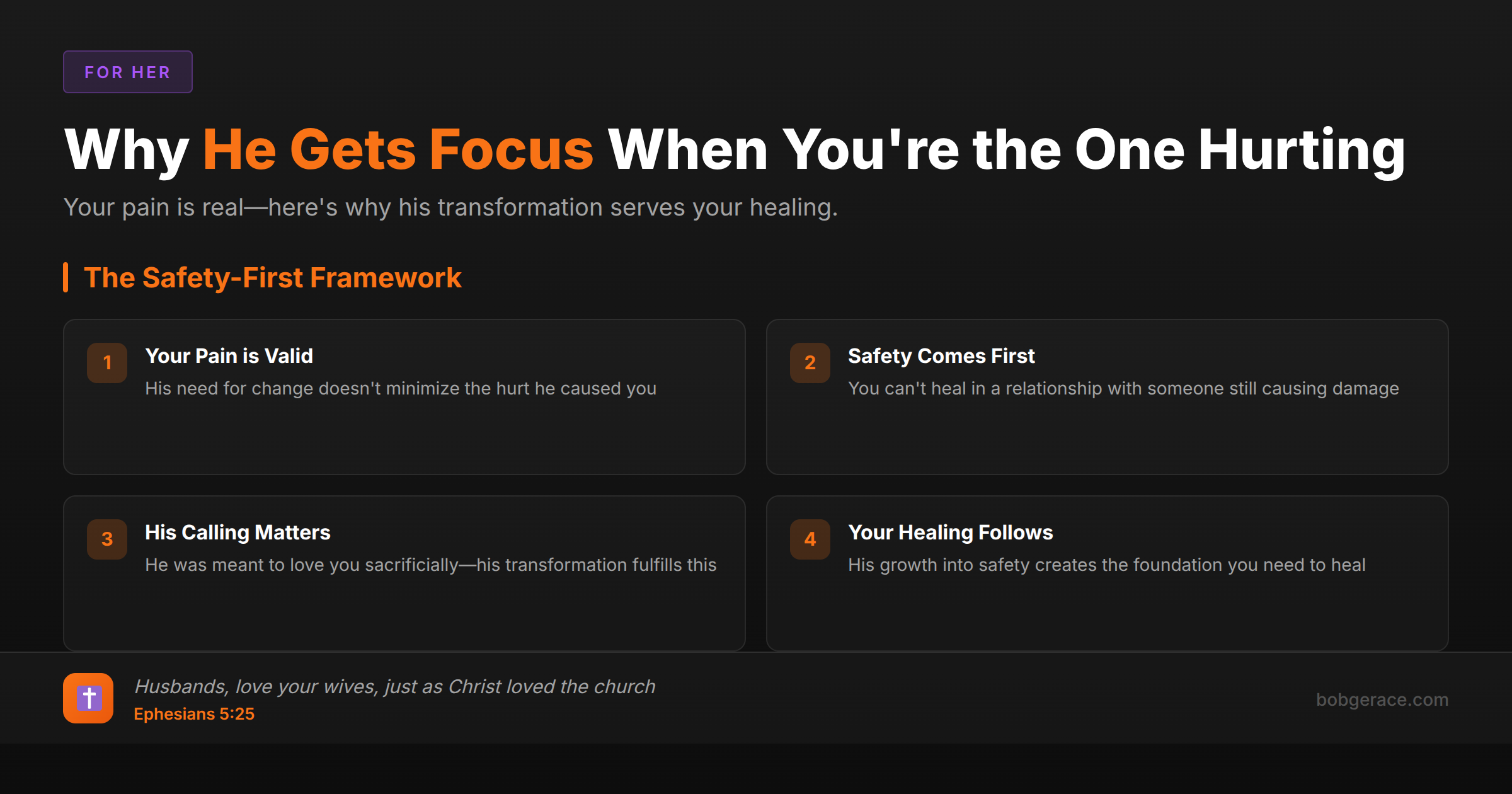
Your pain is real, and this question is absolutely fair. You're the one who's been wounded by his behavior, and it can feel backwards—even insulting—that he's getting all this support and attention while you're carrying the hurt he caused. Here's the logic, and it's not about dismissing your pain: if he doesn't become a safe person first, nothing else works. You can't heal inside a relationship with someone who's still causing damage. Couples therapy fails when one partner isn't yet capable of being a reliable partner. Your healing matters immensely—but it requires a foundation of safety that only his transformation can create.
The Full Picture
Let's acknowledge something that doesn't get said clearly enough: you have been hurt, and that hurt is legitimate. Whatever he did or failed to do—whether it was betrayal, emotional absence, anger, neglect, or chronic disappointment—you're carrying wounds that weren't your fault. Watching him receive intensive support while you're still bleeding can feel profoundly unfair.
Your question isn't selfish. It's honest. And it deserves an honest answer.
The focus on his transformation first isn't because your healing matters less. It's because of the order that actually works. Think of it like this: if someone is drowning and there's a leak in the boat, you don't start bailing water while the leak is still open. You fix the leak first—not because bailing doesn't matter, but because bailing won't work until the leak is fixed.
He's the leak. Until he stops being the source of ongoing harm, everything else is complicated by continued damage. Couples therapy while he's still dysregulated leads to sessions that retraumatize rather than heal. Working on your own healing while living with an unsafe person means trying to recover while still getting hurt.
This program exists because traditional approaches often fail. The typical path—go to couples therapy, work on communication, address both partners equally—sounds balanced but often doesn't work. Why? Because if one partner lacks the emotional regulation, self-awareness, and fundamental character to be a safe partner, no amount of communication skills will fix it. He has to become someone capable of being partnered with before partnership work can succeed.
That's what this program addresses: transforming him into someone who can be a safe, reliable partner. Someone who regulates his own emotions. Someone who takes responsibility. Someone who can engage in the deeper work that marriages require.
Once that foundation exists, everything changes. Couples work becomes productive instead of traumatic. Your healing can proceed without ongoing reinjury. Rebuilding becomes possible because you're building with someone who can actually hold up their side.
Your pain matters. Your healing matters. The sequence exists to make that healing actually possible.
What's Really Happening
The clinical rationale for individual work before couples work is well-established, though not always explained clearly to the partner who's been hurt.
The concept of 'therapy readiness' applies to relationship work. Couples therapy requires both partners to have certain capacities: emotional regulation, perspective-taking, non-defensive listening, accountability, and collaborative problem-solving. If one partner lacks these capacities, couples therapy often does more harm than good—sessions become battlegrounds rather than healing spaces.
Research on treatment sequencing shows that when one partner has significant individual issues (emotional dysregulation, character pathology, addiction), addressing those first improves outcomes for subsequent couples work dramatically. The reverse sequence—couples work first—often leads to treatment failure and partner retraumatization.
The distinction between 'victim' and 'patient' in relational trauma is relevant here. You're the victim of his behavior—your pain is real and deserves acknowledgment. He's the one whose dysfunction created the problem—he needs intervention. Effective treatment addresses the source of the dysfunction, which enables healing for the person who was harmed.
This doesn't mean your healing waits indefinitely. Rather, it means your healing can proceed on more solid ground. Trauma recovery research shows that a sense of safety is prerequisite for processing trauma. Trying to heal while the source of danger remains unchanged keeps the nervous system in protective mode, which inhibits healing. His transformation creates the safety your nervous system needs to begin its own recovery.
The sequential approach isn't about dismissing your pain—it's about creating conditions where your pain can actually be addressed effectively.
What Scripture Says
Scripture validates your pain while also illuminating why transformation of the offender serves the healing of the wounded.
"Husbands, love your wives, just as Christ loved the church and gave himself up for her" (Ephesians 5:25). The focus on his transformation is asking him to finally fulfill what was always his calling. He was meant to love you sacrificially. His failure to do so created your wounds. His growth into that calling is both his responsibility and part of your healing.
"If your brother or sister sins against you, rebuke them; and if they repent, forgive them" (Luke 17:3). Notice the sequence: repentance precedes forgiveness. The focus on his transformation is the process of genuine repentance—not just words, but actual change. This isn't bypassing your pain; it's creating the conditions where healing and forgiveness become possible.
"He heals the brokenhearted and binds up their wounds" (Psalm 147:3). God cares about your broken heart. The healing process isn't ignoring you—it's establishing the foundation on which your heart can actually mend. God's healing often works through changed circumstances, and his transformation changes your circumstances.
"Bear one another's burdens, and so fulfill the law of Christ" (Galatians 6:2). Eventually, marriage involves mutual burden-bearing. But that's only possible when both partners are capable of bearing weight. His work right now is becoming someone capable of carrying his share—and eventually, carrying some of yours.
Your pain is seen. The sequence isn't about deserving or priority—it's about what actually leads to wholeness for both of you.
What This Means for You Right Now
-
1
Name your pain without minimizing it — His need for transformation doesn't reduce the legitimacy of your hurt. Both things are true: he needs to change, and you've been wounded.
-
2
Recognize that your healing matters — The sequence isn't 'he matters, you don't.' It's 'his transformation creates safety for your healing.' You're not forgotten or dismissed.
-
3
Consider whether you have your own support — While the program focuses on him, you may benefit from your own counselor, support group, or trusted confidantes who can hold space for your experience.
-
4
Watch for real change as evidence your pain is being taken seriously — His sustained effort is proof that the damage he caused matters. If he's not working, that tells you something. If he is, that's acknowledgment in action.
-
5
Understand the sequence without accepting indefinite delay — His transformation should create increasing safety for you over time. If months pass without meaningful change, the sequence isn't working.
-
6
Your healing will have its time — This isn't permanent deprioritization. As he becomes safer, space opens for your healing, for couples work, for restoration. The foundation being built now is for you too.
Related Questions
- What does he hear about me in your coaching?
- How do I heal from what's happened?
- What's my role in his transformation?
- What if he's only doing this to keep me from leaving?
- Is he just learning to manipulate me better?
- Do I need my own support?
- How do I protect myself emotionally?
- What support do I need?
- What does healing timeline look like?
Also find Bob on
Subscribe for weekly videos on Christian marriage.
Think This Could Help Your Husband?
If you believe your husband could benefit from the structured transformation process we offer, share this with him. Real change is possible when men commit to the work.
Learn About the Program →