How do I hear her without defending myself?
6 min read
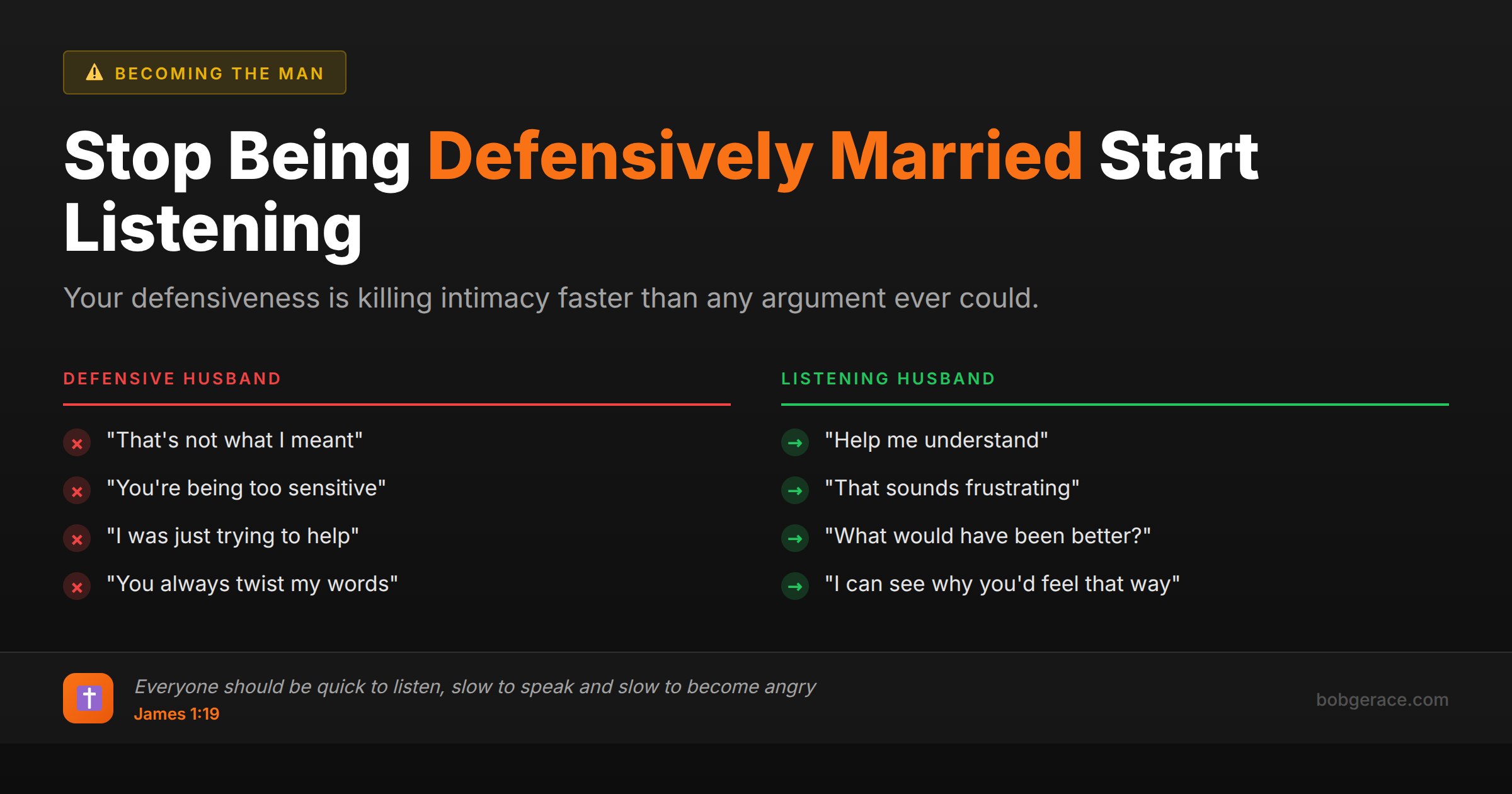
The key to hearing your wife without defending yourself is to shift from protecting your ego to protecting your marriage. Start by taking three deep breaths when you feel that defensive reaction rising. Remind yourself that her feelings aren't an attack on your character—they're information about her experience. Your job isn't to prove she's wrong; it's to understand what she's going through. Practice this simple framework: Listen first, validate second, discuss solutions third. When she shares something difficult, resist the urge to explain, justify, or correct. Instead, say something like, 'Help me understand what that felt like for you' or 'I can see why that would be frustrating.' Your defensiveness is killing intimacy. Choose curiosity over self-protection.
The Full Picture
Here's what's really happening when your wife tries to talk to you about something important: She's taking a risk. She's choosing vulnerability over silence, hoping you'll meet her with understanding rather than resistance. But when you immediately jump into defense mode, you're essentially telling her that protecting your reputation is more important than understanding her heart.
Defensiveness is a relationship killer. It shuts down communication faster than almost anything else because it sends a clear message: "Your feelings don't matter as much as my need to be right." Every time you defend instead of listen, you're building a wall between you and your wife.
The brutal truth? Your defensiveness usually stems from shame, not strength. You feel attacked because part of you believes what she's saying might be true, and that terrifies you. So instead of facing that possibility with courage, you deflect, minimize, or counterattack.
But here's the game-changer: When you learn to listen without defending, something miraculous happens. Your wife feels heard, understood, and valued. She starts approaching you with problems instead of avoiding difficult conversations. Intimacy grows because she trusts you with her heart.
This isn't about becoming a doormat or accepting false accusations. It's about having enough emotional maturity to hear difficult things without immediately protecting your ego. Strong men can handle their wife's emotions without falling apart or fighting back.
The goal isn't to never feel defensive—that's natural. The goal is to recognize that defensive feeling and choose a different response. When you feel your shoulders tense up or that "but actually" forming in your throat, that's your cue to slow down, breathe, and choose connection over self-protection.
What's Really Happening
Defensiveness triggers what we call the "fight-or-flight" response in your nervous system. When your wife shares something that feels like criticism, your brain interprets it as a threat to your identity and activates your sympathetic nervous system. Your heart rate increases, stress hormones flood your system, and your prefrontal cortex—the part responsible for rational thinking and empathy—goes offline.
This physiological response is why logical arguments feel so compelling when you're defensive. Your brain is literally trying to survive what it perceives as an attack. But here's the problem: your wife isn't actually attacking you. She's trying to connect with you, share her experience, or solve a problem together.
The antidote to defensiveness is emotional regulation. This means learning to notice your physiological arousal before it hijacks your response. Simple techniques like deep breathing, progressive muscle relaxation, or even taking a brief pause can help you stay in your thinking brain instead of your reactive brain.
Research shows that couples who master this skill have significantly higher relationship satisfaction. When one partner can remain emotionally regulated during difficult conversations, it actually helps regulate the other partner's nervous system too. You become a calming presence instead of an escalating one.
The most effective approach is what we call "reflective listening." Instead of formulating your defense while she talks, focus entirely on understanding her perspective. Repeat back what you heard, validate her emotions, and ask clarifying questions. This isn't weakness—it's emotional intelligence in action.
What Scripture Says
Scripture calls us to a radically different way of responding to difficult conversations. James 1:19 instructs us: "My dear brothers and sisters, take note of this: Everyone should be quick to listen, slow to speak and slow to become angry." This isn't just good advice—it's a divine blueprint for healthy communication.
When you immediately defend yourself, you're being quick to speak and quick to anger. You're violating God's design for how His children should interact with each other, especially with the wife He's given you.
Proverbs 18:13 warns us: "To answer before listening—that is folly and shame." Every time you interrupt your wife's concerns with your justifications, you're demonstrating this exact folly. You're answering before you've truly heard her heart.
Jesus himself modeled non-defensive listening. When the woman at the well shared her story, He didn't defend God's reputation or correct her theology first. He listened, showed compassion, and created space for real dialogue. Philippians 2:3-4 calls us to "do nothing out of selfish ambition or vain conceit. Rather, in humility value others above yourselves, not looking to your own interests but each of you to the interests of the others."
1 Peter 3:7 specifically instructs husbands to "be considerate as you live with your wives, and treat them with respect as the weaker partner and as heirs with you of the gracious gift of life, so that nothing will hinder your prayers." Defensiveness is the opposite of consideration and respect.
God wants your marriage to be a reflection of Christ's love for the church. Christ didn't get defensive when we brought our complaints and struggles to Him. He listened, He understood, and He acted in love. That's your calling as a husband.
What To Do Right Now
-
1
Practice the 3-breath rule: When you feel defensive, take three deep breaths before responding. This gives your prefrontal cortex time to come back online.
-
2
Use the phrase 'Help me understand': Instead of explaining why she's wrong, ask questions like 'Help me understand what that felt like for you' or 'What would have been more helpful?'
-
3
Validate first, discuss later: Before addressing any factual disagreements, acknowledge her emotions: 'I can see why that would be frustrating' or 'That sounds really difficult.'
-
4
Take breaks when needed: If you feel overwhelmed, say 'I want to hear you, but I need a 10-minute break to calm down so I can listen better.' Then actually come back.
-
5
Practice reflective listening: Repeat back what you heard in your own words: 'So what I'm hearing is...' This shows you're trying to understand, not just waiting for your turn to talk.
-
6
Ask for forgiveness when you blow it: When you inevitably get defensive again, own it quickly: 'I got defensive there. Can we start over? I want to hear what you're saying.'
Related Questions
Ready to Transform How You Communicate?
Learning to listen without defending takes practice and personalized guidance. Let me help you develop the skills to hear your wife's heart and strengthen your marriage.
Work With Me →