What regulates the system before defensiveness kicks in?
6 min read
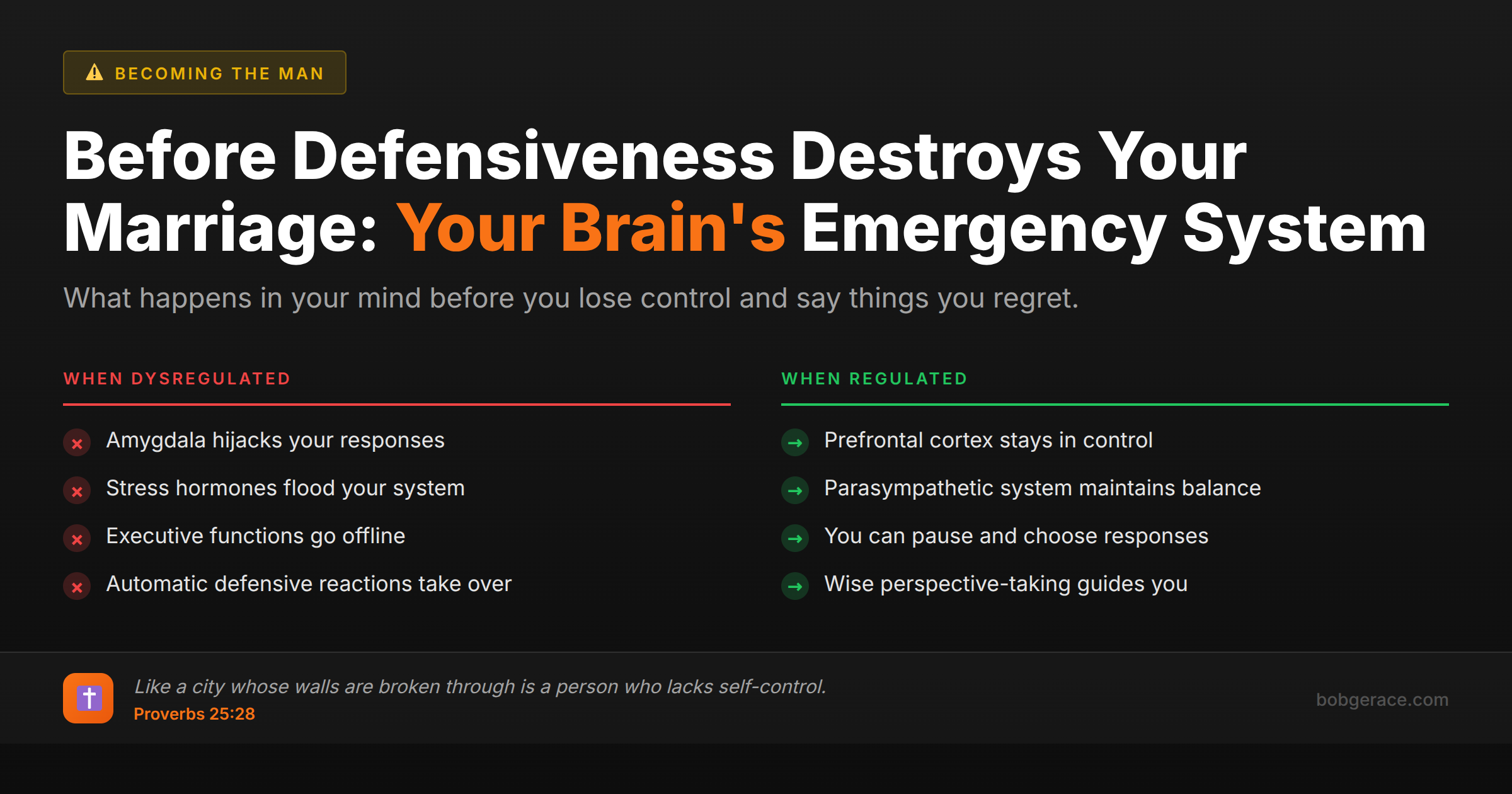
Before defensiveness kicks in, your prefrontal cortex acts as the primary regulator, working alongside your parasympathetic nervous system to maintain emotional balance. This sophisticated system includes your executive functions - decision-making, impulse control, and perspective-taking abilities that help you stay present and responsive rather than reactive. When functioning properly, this regulatory system allows you to pause, breathe, and choose your response instead of automatically defending. It's like having a wise counselor in your head who can assess the situation objectively. However, when stress hormones spike or you feel emotionally flooded, this regulatory system goes offline, and your amygdala takes over, triggering the defensive responses that damage your marriage.
The Full Picture
Understanding what regulates your emotional system before defensiveness takes over is like learning about the circuit breakers in your home - you need to know how they work before the power goes out.
Your Prefrontal Cortex: The CEO of Regulation
Your prefrontal cortex serves as your brain's executive center, managing emotional responses through several key functions. It maintains working memory, allowing you to hold multiple perspectives simultaneously during conflict. It provides impulse control, giving you that crucial pause between trigger and response. Most importantly, it enables cognitive flexibility - the ability to see your spouse's point of view even when you disagree.
This region also houses your capacity for empathy and emotional intelligence. When it's functioning well, you can recognize your spouse's emotional state, understand their underlying needs, and respond with wisdom rather than reactivity.
The Parasympathetic Nervous System: Your Internal Calm
Working alongside your prefrontal cortex, your parasympathetic nervous system maintains the physiological conditions necessary for healthy emotional regulation. It keeps your heart rate steady, your breathing deep, and your stress hormones at manageable levels.
When this system is activated, you experience what researchers call "social engagement" - you make eye contact, your voice remains warm, and you stay physically relaxed. This creates the perfect conditions for productive conversation and conflict resolution.
The Window of Tolerance
Psychologists describe a "window of tolerance" - the zone where you can handle stress and strong emotions without becoming overwhelmed or shutting down. When you're within this window, your regulatory systems work optimally. You can listen, think clearly, and respond with intention rather than reaction.
What's Really Happening
In my practice, I see couples who've lost touch with their natural regulatory abilities. They've become so accustomed to reactive patterns that they've forgotten they have a choice in how they respond.
The key insight is this: regulation happens in layers. Your nervous system is constantly scanning for safety or threat. When you feel safe with your spouse - emotionally, physically, and relationally - your regulatory systems remain online. But when that safety is compromised, even in small ways, your system begins preparing for defense.
The Role of Co-Regulation
What many couples don't realize is that we regulate each other. Your nervous system actually syncs with your spouse's. If they're calm and grounded, it helps you stay regulated. If they're anxious or reactive, it can dysregulate you quickly. This is why taking responsibility for your own emotional state isn't just about you - it's a gift to your marriage.
Early Warning Signs
Before full defensiveness kicks in, your body gives you signals: tension in your shoulders, changes in your breathing, a slight acceleration in heart rate, or that familiar knot in your stomach. These are your regulatory system's attempts to alert you that you're approaching the edge of your window of tolerance.
The couples who thrive are those who learn to recognize these early signals and take action to support their regulatory systems before defensiveness takes over. This might mean taking a deep breath, softening their voice, or simply acknowledging internally that they're starting to feel triggered.
What Scripture Says
Scripture consistently calls us to emotional regulation and wise responses, recognizing that our reactions affect not just ourselves but those we love most.
The Call to Self-Control
*"Like a city whose walls are broken through is a person who lacks self-control."* - Proverbs 25:28. God designed us with the capacity for self-regulation because He knew we'd need it. When we lose control of our emotions, we become vulnerable to damage - both giving and receiving it.
*"Above all else, guard your heart, for everything you do flows from it."* - Proverbs 4:23. The "heart" in Hebrew encompasses our emotions, thoughts, and will. Guarding it means maintaining healthy boundaries and regulatory practices that keep us centered in God's peace.
The Power of Pause
*"In your anger do not sin: Do not let the sun go down while you are still angry."* - Ephesians 4:26. Notice Paul doesn't say "don't get angry." He acknowledges that anger happens, but calls us to regulate our response to it. This requires the very prefrontal cortex functions we've discussed.
*"Everyone should be quick to listen, slow to speak and slow to become angry."* - James 1:19. This verse is essentially a neurological prescription for healthy regulation: activate your listening centers, engage your executive function before speaking, and maintain emotional control.
Peace as Regulation
*"Let the peace of Christ rule in your hearts, since as members of one body you were called to peace."* - Colossians 3:15. The word "rule" here means to act as an umpire or judge. Christ's peace becomes our internal regulatory system, helping us make wise decisions in moments of tension.
*"You will keep in perfect peace those whose minds are steadfast, because they trust in you."* - Isaiah 26:3. A mind fixed on God remains regulated even under pressure, maintaining the clarity needed for loving responses.
What To Do Right Now
-
1
Practice the 4-7-8 breathing technique daily: inhale for 4, hold for 7, exhale for 8. This trains your parasympathetic nervous system.
-
2
Identify your personal early warning signs of dysregulation - tension spots, breathing changes, or emotional shifts.
-
3
Create a simple regulation ritual: three deep breaths, a quick prayer, or touching your spouse's hand before responding to conflict.
-
4
Establish a daily practice of gratitude and prayer to strengthen your baseline emotional regulation.
-
5
Learn to recognize when your spouse is becoming dysregulated and consciously choose to remain calm to help co-regulate them.
-
6
Schedule regular check-ins with your spouse about emotional temperature - catch dysregulation before it becomes defensiveness.
Related Questions
- What is 'amygdala hijack' and how do I interrupt it?
- How do I widen the gap between stimulus and response?
- What does 'pause before responding' do neurologically?
- How do I stay in prefrontal cortex during conflict?
- What happens in my brain when I feel criticized?
- How do I stay connected when my body wants to fight?
- What is 'window of tolerance' and how do I widen mine?
- How do I regulate when my body is in fight-or-flight?
- What does nervous system regulation look like?
- What's happening in my nervous system right now?
Also find Bob on
Subscribe for weekly videos on Christian marriage.
Your Marriage Needs Your Specific Wiring
Knowing the neuroscience doesn't mean you can execute it when your wife is actually upset. A coach who knows your story helps you build regulation that works in your real conflicts.
Talk to Bob →