Why should I trust this when nothing else has worked?
6 min read
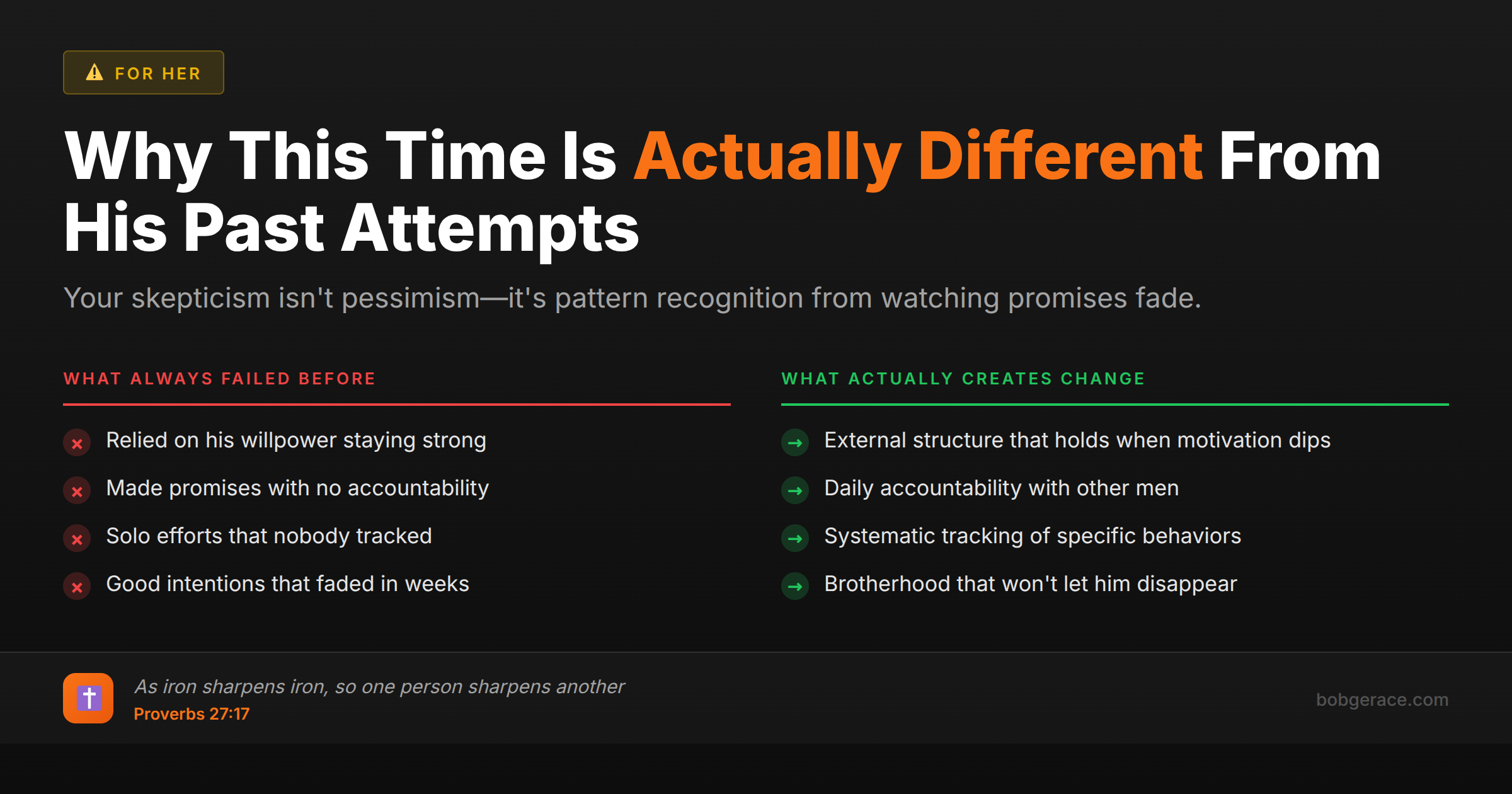
Your skepticism isn't pessimism—it's pattern recognition. You've watched him read books, make promises, maybe even go to counseling, only to watch everything revert to normal within weeks. That experience has taught you something important: motivation fades, willpower exhausts, and good intentions don't survive real life. What makes this different isn't enthusiasm or commitment—he's probably had plenty of both before. The difference is architecture. This program doesn't rely on his willpower staying strong. It builds external structures—daily accountability with other men, systematic tracking of specific behaviors, staged progression that prevents him from skipping steps. When his motivation inevitably dips, the structure holds him. When he wants to quit, other men won't let him disappear.
The Full Picture
You've probably noticed a pattern in his previous attempts at change. There's usually an initial burst of energy—he's reading, he's talking about what he's learning, he's making promises about how different things will be. For a few weeks, maybe even a couple of months, things actually seem better.
Then something happens. Stress at work. A disagreement that triggers old patterns. The initial enthusiasm wears off. And gradually—sometimes so slowly you don't notice until it's already happened—everything slides back to where it was. Or worse.
This isn't a character flaw unique to your husband. It's how human change actually works. Research on behavior change consistently shows that motivation is unreliable. Willpower depletes. Good intentions crumble under pressure. Any approach that relies primarily on his desire to change is an approach that will fail.
The architecture of this program is designed around that reality. Rather than depending on sustained motivation, it creates external structures that hold the change in place even when motivation falters.
Daily accountability isn't optional. Every day, he's checking in with specific metrics—not vague 'how are you doing' conversations, but concrete behavioral tracking. Did he do what he said he would? The data doesn't lie, and he can't hide from it.
Brotherhood means other men are watching. This isn't a solo journey where he can quietly fade out when things get hard. Other men in the program know his goals, see his progress, and will call him out when he starts slipping. Disappearing isn't an option.
The Four Theater system prevents shortcuts. He can't skip from crisis to romance because he's feeling better. The staging requirement means he has to demonstrate sustained change at each level before advancing. This is why previous attempts failed—he tried to jump to the end without building the foundation.
Identity transformation goes deeper than behavior modification. Most programs teach techniques. This program transforms who he sees himself to be. When his identity shifts, behaviors follow naturally rather than requiring constant effort.
You have every right to remain skeptical until you see sustained evidence. But understand: the structure itself is different from anything he's tried before.
What's Really Happening
Behavioral science has identified why most change attempts fail and what differentiates successful transformation from temporary improvement.
The pattern you've witnessed—initial enthusiasm followed by gradual regression—has a name: the extinction burst followed by baseline return. When someone tries to change through willpower alone, they're fighting against deeply ingrained neural pathways. The brain prefers familiar patterns, even dysfunctional ones. Without structural reinforcement, the old pathways eventually reassert themselves.
Research by Prochaska and DiClemente on the Stages of Change model shows that lasting transformation requires progression through specific phases: precontemplation, contemplation, preparation, action, and maintenance. Most failed attempts jump straight to action without adequate preparation, then lack the maintenance structures to sustain gains.
The daily accountability component leverages what behavioral scientists call implementation intentions and commitment devices. When someone publicly commits to specific behaviors and has external verification, follow-through rates increase dramatically compared to private intentions.
The brotherhood element addresses a critical factor in male change: peer accountability. Research consistently shows that men change most effectively in the context of other men who hold them to standards. Isolation maintains dysfunction; community disrupts it.
The identity-based approach reflects research showing that identity change predicts behavioral sustainability far better than motivation or knowledge. When someone sees themselves differently, they act accordingly without requiring willpower.
Your previous experiences weren't failures of his character—they were failures of approach. Approaches that relied on elements research shows are insufficient for lasting change.
What Scripture Says
Scripture acknowledges the difficulty of genuine change and points to the structures that make it possible.
"As iron sharpens iron, so one person sharpens another" (Proverbs 27:17). The brotherhood component isn't optional fellowship—it's the biblical model for how men grow. Isolation keeps men stuck. Community with other men pursuing growth creates the friction that produces change.
"Two are better than one... if either of them falls down, one can help the other up. But pity anyone who falls and has no one to help them up" (Ecclesiastes 4:9-10). This directly addresses why solo attempts fail. When he stumbles—and he will—the question is whether anyone is there to help him back up or whether he falls alone and stays down.
"Therefore confess your sins to each other and pray for each other so that you may be healed" (James 5:16). The daily accountability structure isn't just behavioral tracking—it's the confession and community that Scripture identifies as the path to healing. Private struggles stay stuck. Brought into the light with trusted brothers, they lose their power.
"Whoever isolates himself seeks his own desire; he breaks out against all sound judgment" (Proverbs 18:1). The pattern of failed attempts often involves isolation—trying to change alone, hiding struggles, avoiding accountability. The program's structure directly counters this tendency.
The difference isn't his sincerity this time versus before. The difference is whether he's finally operating within the structures God designed for transformation.
What This Means for You Right Now
-
1
Protect yourself from premature hope — You don't need to believe this will work yet. Give yourself permission to wait and watch without pressure to feel optimistic.
-
2
Ask about the structure, not his feelings — Instead of 'Are you committed?' ask 'What's your daily accountability look like? Who's checking on you?' Structure reveals more than intentions.
-
3
Notice whether he's alone or connected — Is he actually engaging with other men, or is this another solo project? Brotherhood involvement is a key differentiator from past attempts.
-
4
Watch for stage-appropriate behavior — If you're in crisis and he's trying romance, the structure isn't working. Correct staging shows he's actually following the system.
-
5
Track patterns over weeks, not days — Single good days don't mean much. Look for sustained patterns across multiple weeks before adjusting your assessment.
-
6
Your skepticism is an asset — Don't feel guilty for not believing yet. Earned trust requires earned evidence. Your caution protects you while he proves the change is structural, not emotional.
Related Questions
- What is this program actually teaching him?
- Why is this approach different from other things we've tried?
- How long does real change actually take?
- What if he's only doing this to keep me from leaving?
- Is he just learning to manipulate me better?
- How will I know if it's actually working?
- What does real transformation look like?
- What makes change sustainable vs. temporary?
- How do I tell performance from genuine change?
- What are markers of genuine remorse vs. guilt?
Also find Bob on
Subscribe for weekly videos on Christian marriage.
Think This Could Help Your Husband?
If you believe your husband could benefit from the structured transformation process we offer, share this with him. Real change is possible when men commit to the work.
Learn About the Program →