Is he just learning to manipulate me better?
6 min read
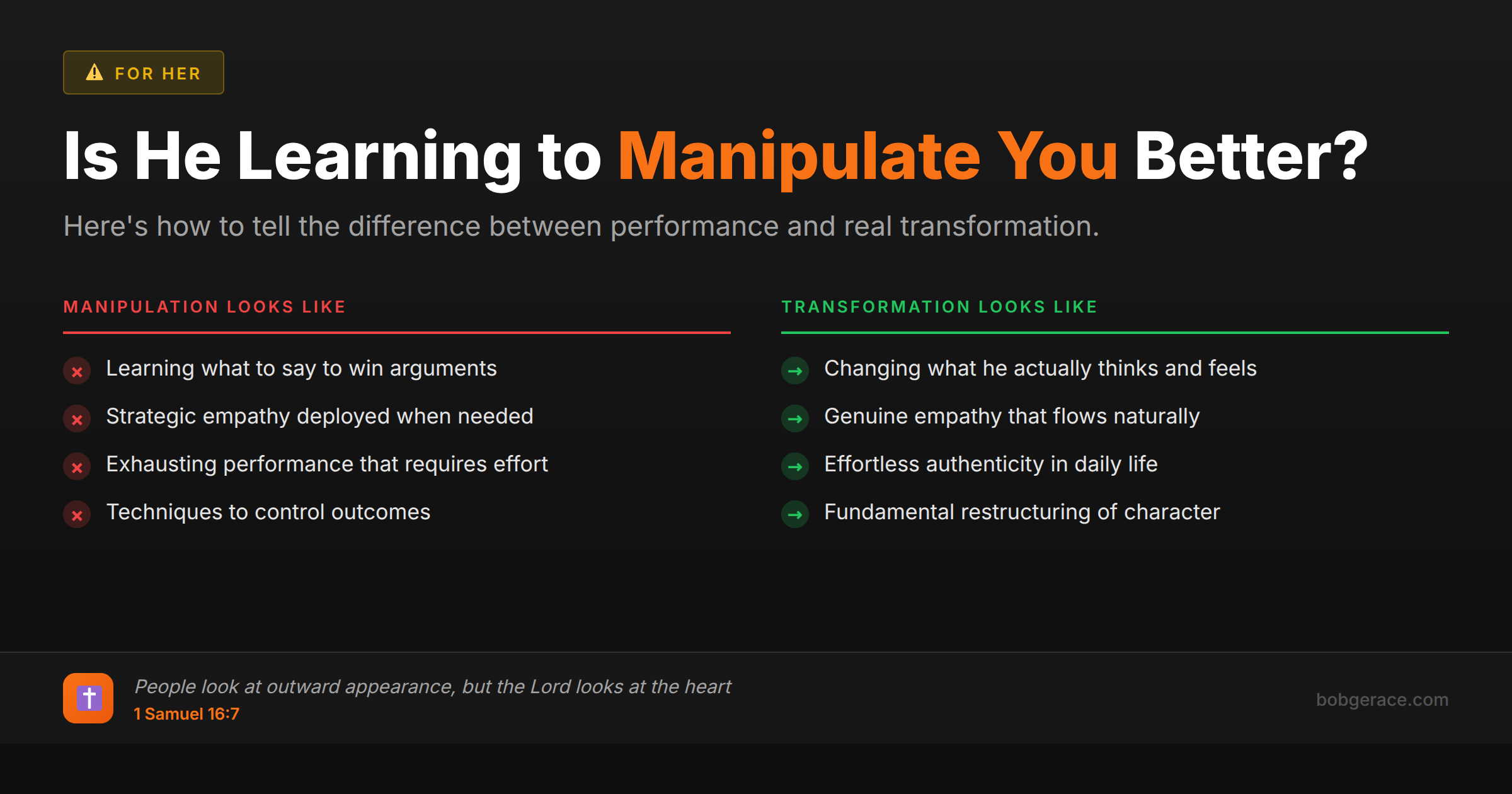
This fear makes sense, especially if you've experienced manipulation before. Some programs do teach techniques that can be weaponized—communication 'skills' that become tools for winning arguments, 'empathy' that's deployed strategically rather than felt genuinely. Here's the distinction: manipulation is about controlling outcomes. Transformation is about becoming different. The first learns what to say; the second changes what he thinks and feels. The first is exhausting to maintain because it requires constant performance; the second becomes effortless because it's authentic. What he's learning isn't a set of techniques to deploy on you. It's a fundamental restructuring of how he sees himself, regulates his emotions, and relates to others. You can't fake that kind of change for long.
The Full Picture
Your concern reveals hard-earned wisdom. You've probably seen him learn something—maybe from a book, a counselor, or a previous program—and then use it in ways that felt manipulative rather than genuine. Maybe he learned 'active listening' and now repeats your words back at you in arguments as a technique rather than actually hearing you. Maybe he learned about 'validating feelings' and now says the right words while clearly not meaning them.
This pattern is real, and your wariness is appropriate. Some approaches do teach surface techniques without addressing the underlying character. A man can learn to say 'I hear that you're feeling frustrated' without developing actual empathy. He can learn to apologize in the 'right' way without experiencing genuine remorse.
But here's what manipulation requires: constant vigilance and energy. A manipulator has to remember what to say, manage his presentation, track what's working. It's exhausting performance art. This is why manipulation eventually slips—no one can maintain the performance indefinitely.
Genuine transformation works differently. When someone's internal reality changes, their external behavior follows naturally without effort. A man who has actually developed empathy doesn't need to remember empathetic phrases—he genuinely feels concern and it shows automatically. A man who has internalized respect doesn't need techniques for 'showing respect'—respect naturally flows from how he sees you.
The program focuses on this internal transformation rather than behavioral techniques. The daily work isn't 'practice these communication skills'—it's confronting the pride, fear, and selfishness that drive dysfunction. The brotherhood doesn't coach 'what to say to your wife'—it challenges the character deficits that make healthy relating impossible.
You can distinguish manipulation from transformation by watching for these markers:
Manipulation is situational—it shows up when he wants something or when conflict requires management. Transformation is consistent—it shows up in how he treats everyone, including people who can't do anything for him.
Manipulation is fragile—it breaks down under stress, fatigue, or when he forgets to perform. Transformation is resilient—it may be imperfect, but it holds up when life gets hard.
Manipulation creates unease in you—something feels off even if you can't articulate it. Transformation creates a gradual settling—things begin to feel different in your body, not just your mind.
Trust your gut. If something feels like performance, it probably is. If something feels different at a level deeper than words, pay attention to that too.
What's Really Happening
The distinction you're identifying maps onto what psychologists call surface compliance versus deep change. Surface compliance involves learning and performing expected behaviors without underlying shifts in cognition, emotion, or character. Deep change involves restructuring of neural pathways, emotional responses, and self-concept.
Research on authentic versus inauthentic behavior shows that the nervous system can detect the difference, often before conscious awareness. This is why you might feel uneasy around performed behavior even when you can't explain why—your body is picking up subtle cues of incongruence between his words and his underlying state.
Manipulative use of therapeutic techniques is a documented phenomenon sometimes called therapy-assisted manipulation or weaponized psychology. It occurs when someone learns the language of emotional intelligence without developing actual emotional capacity. The result is sophisticated manipulation rather than genuine connection.
Key differentiators between manipulation and transformation:
Consistency across contexts. Manipulation is typically deployed strategically—in conflict, when he wants something, or when he's being observed. Transformation shows up uniformly, including in low-stakes situations and with people who can't benefit him.
Response to confrontation. When manipulation is named, the manipulator typically becomes defensive, denies, or escalates. When a genuinely transforming person is called out (accurately or not), they can engage non-defensively because their identity isn't threatened.
Nervous system regulation. Manipulation requires cognitive load—remembering the performance, tracking responses, adjusting tactics. This creates subtle signs of stress. Transformation is neurologically more relaxed because the behavior matches the internal state.
The program's focus on daily accountability and brotherhood observation helps because manipulation is difficult to maintain under sustained, multi-perspective scrutiny. Performance art works in isolated interactions; it breaks down when multiple observers are tracking patterns over time.
What Scripture Says
Scripture speaks directly to the difference between external performance and internal transformation.
"The Lord does not look at the things people look at. People look at the outward appearance, but the Lord looks at the heart" (1 Samuel 16:7). You're asking the right question—not just 'is he doing the right things?' but 'is his heart actually changing?' This discernment honors how God himself evaluates.
"These people honor me with their lips, but their hearts are far from me" (Matthew 15:8). Jesus named exactly the pattern you fear—right words with unchanged hearts. He took this seriously, which validates taking it seriously now.
"By their fruit you will recognize them" (Matthew 7:16). Jesus gave you the evaluative method: watch the fruit over time. Not the performance in a single moment, but the consistent pattern of what emerges from his life. Good trees produce good fruit; bad trees produce bad fruit. What is consistently emerging from him?
"But the fruit of the Spirit is love, joy, peace, forbearance, kindness, goodness, faithfulness, gentleness and self-control" (Galatians 5:22-23). Notice these are called fruit, not performance. Fruit grows naturally from a healthy tree—it can't be faked. If you're seeing these qualities emerge consistently and naturally (not performed on demand), that's evidence of genuine spiritual transformation.
"Create in me a pure heart, O God" (Psalm 51:10). David's prayer wasn't 'help me behave better' but 'change my heart.' The program's focus on internal transformation rather than behavioral techniques reflects this biblical priority.
Manipulation can mimic transformation temporarily. It cannot sustain the fruit that genuine change produces.
What This Means for You Right Now
-
1
Watch how he treats people who can't benefit him — His behavior toward waitstaff, strangers, people with less power reveals character more accurately than how he treats you when motivated.
-
2
Notice what happens under stress — Performance breaks down when cognitive load increases. Real transformation holds, though imperfectly, because it doesn't require effort to maintain.
-
3
Trust your body's signals — If something feels off even when words seem right, that's information. Your nervous system detects incongruence before your mind can explain it.
-
4
Look for changed thinking, not just changed words — Does he explain situations differently? Does he see his own behavior more clearly? Changed perspective indicates changed processing, not learned scripts.
-
5
Ask unexpected questions — Scripted responses only work for anticipated topics. Genuine transformation handles novel situations because it's not performing from a script.
-
6
Give yourself permission to stay uncertain — You don't need to decide 'manipulation or transformation' yet. Continue observing without pressure. Time and sustained observation will reveal the truth.
Related Questions
- What if he's only doing this to keep me from leaving?
- What does he hear about me in your coaching?
- What if I see effort but not results yet?
- What is this program actually teaching him?
- Why should I trust this when nothing else has worked?
- How do I tell performance from genuine change?
- What are the markers of genuine behavior change?
- Is he manipulating me or actually different?
- What distinguishes remorse from guilt?
Also find Bob on
Subscribe for weekly videos on Christian marriage.
Think This Could Help Your Husband?
If you believe your husband could benefit from the structured transformation process we offer, share this with him. Real change is possible when men commit to the work.
Learn About the Program →