What does giving up look like vs. regulating?
6 min read
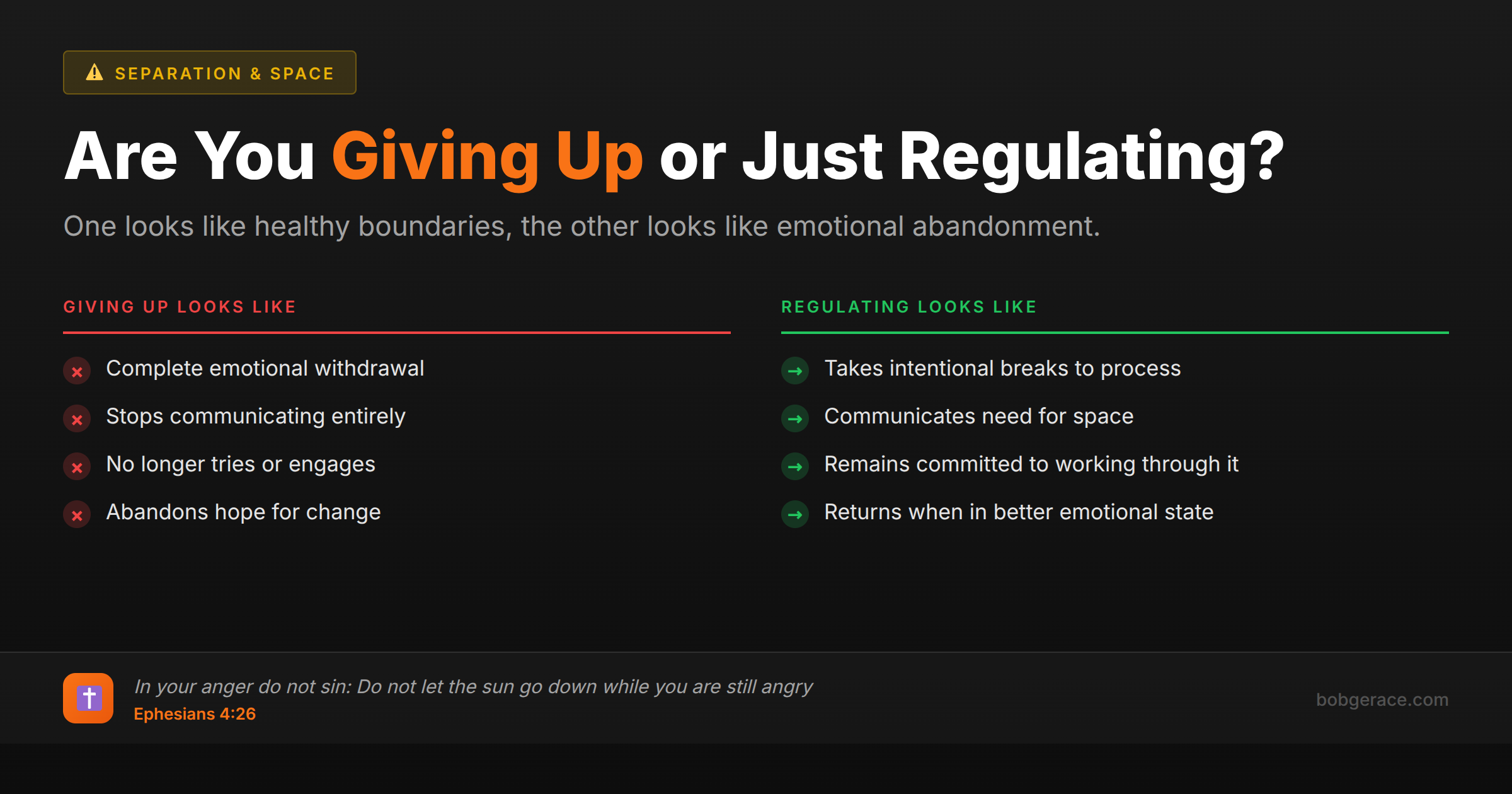
The difference between giving up and regulating is crucial but often misunderstood. When someone is regulating, they're taking intentional breaks to manage their emotions while remaining committed to the relationship. They communicate their needs, set healthy boundaries, and return to engage when they're in a better state. Giving up, however, involves complete emotional withdrawal - they stop trying, stop communicating, and disengage from the marriage entirely. A regulating spouse might say 'I need some space to process this, but I'm committed to working through it.' A spouse who's given up simply stops participating in the marriage altogether, often without explanation or hope for change.
The Full Picture
Understanding the difference between emotional regulation and giving up can save your marriage. These two responses often look similar on the surface - both involve some form of withdrawal - but they come from completely different places and lead to vastly different outcomes.
Emotional regulation is a healthy coping mechanism. When your spouse is regulating, they recognize they're overwhelmed, triggered, or unable to engage productively. They make a conscious choice to step back, not to punish or abandon, but to return in a better state. This is actually a sign of emotional maturity.
Regulating spouses typically: - Communicate their need for space - Set a timeframe for re-engagement - Continue basic relationship maintenance - Show signs of internal processing - Return to conversations when calmer - Maintain hope for resolution
Giving up, on the other hand, represents a fundamental shift in commitment. The person has moved from 'how do we fix this?' to 'I'm done trying.' This isn't a temporary withdrawal - it's an emotional divorce that often precedes the legal one.
Spouses who have given up typically: - Stop communicating about problems - Withdraw from all meaningful interaction - Show no interest in solutions - Appear emotionally flat or indifferent - Make unilateral decisions - Express hopelessness about the marriage
The key difference is intent and timeline. Regulation is temporary and purposeful. Giving up feels permanent and hopeless. Recognizing which one you're dealing with determines your entire approach to restoration.
What's Really Happening
From a clinical perspective, these represent two completely different neurological and psychological states. When someone is emotionally regulating, their prefrontal cortex - the brain's executive center - is actively engaged. They're making conscious decisions about their emotional state and behavior.
Emotional regulation activates what we call the 'wise mind' - the intersection of emotional and rational thinking. The person recognizes their emotional state, acknowledges its validity, but chooses not to act impulsively. This is actually a learned skill that indicates emotional intelligence and relationship investment.
Giving up, however, often represents what I call 'emotional exhaustion syndrome' in marriages. The person has moved into a state of learned helplessness where they no longer believe their efforts will produce positive change. Neurologically, this can look similar to depression - decreased activity in areas associated with motivation and hope.
The critical clinical difference is agency. A regulating spouse maintains their sense of personal agency - they believe their choices matter and can influence outcomes. A spouse who has given up has lost that sense of agency. They've moved from 'I can influence this situation' to 'nothing I do matters.'
This is why intervention timing matters so much. Regulation can be supported and encouraged. But once someone has truly given up, we're dealing with a much more complex psychological state that requires intensive intervention to restore hope and agency. The good news is that even 'giving up' isn't permanent - but it requires understanding that you're now dealing with a trauma response, not just relationship conflict.
What Scripture Says
Scripture gives us clear guidance on both regulation and perseverance in difficult seasons. The Bible doesn't call us to be doormats, but it also doesn't give us permission to give up on covenant relationships.
On Emotional Regulation: *'In your anger do not sin: Do not let the sun go down while you are still angry'* (Ephesians 4:26). This verse actually supports healthy emotional regulation - acknowledge the anger, but don't let it drive sinful behavior or become a permanent state.
*'Above all else, guard your heart, for everything you do flows from it'* (Proverbs 4:23). Guarding your heart isn't about building walls - it's about wise stewardship of your emotional and spiritual state.
On Not Giving Up: *'Love bears all things, believes all things, hopes all things, endures all things. Love never ends'* (1 Corinthians 13:7-8). This doesn't mean tolerating abuse, but it does mean maintaining hope and commitment even in difficult seasons.
*'Let us not become weary in doing good, for at the proper time we will reap a harvest if we do not give up'* (Galatians 6:9). God calls us to persistence, especially in covenant relationships.
On Restoration: *'The God of all grace, who called you to his eternal glory in Christ, after you have suffered a little while, will himself restore you and make you strong, firm and steadfast'* (1 Peter 5:10).
*'He heals the brokenhearted and binds up their wounds'* (Psalm 147:3). Even when someone has given up, God specializes in restoration and renewal.
The biblical model is clear: regulate when you need to, but never give up on what God has joined together.
What To Do Right Now
-
1
Honestly assess which category you're in - are you regulating (taking healthy space while remaining committed) or have you given up entirely?
-
2
If your spouse appears to be regulating, respect their space but ask for a timeline: 'I understand you need space. When can we reconnect?'
-
3
If your spouse has given up, recognize this is now a crisis situation requiring immediate professional intervention - don't try to handle this alone
-
4
Stop pursuing someone who has emotionally checked out - pursuit often pushes them further away and confirms their decision to withdraw
-
5
Focus on your own emotional regulation first - you can't help restore a marriage while you're in crisis mode yourself
-
6
Seek professional help immediately if giving up is involved - this requires skills and strategies beyond typical marriage advice
Related Questions
- Why did she stop fighting?
- What is 'stonewalling' and why does she do it?
- What's the difference between stonewalling and self-protection?
- What does 'emotional flooding' feel like for her?
- What is 'emotional fatigue' in marriage?
- Is she protecting herself or punishing me?
- She stopped fighting — is that worse?
- She's indifferent — not angry, just empty
- What is 'deactivation' and did I cause it?
- Why does indifference feel worse than anger?
Also find Bob on
Subscribe for weekly videos on Christian marriage.
If She's Already Shut Down
You need someone who's seen your exact situation—affair, shutdown, papers filed—and knows what moves next. Bob coaches men through active crisis every day.
Talk to Bob →