What does 'emotional flooding' feel like for her?
6 min read
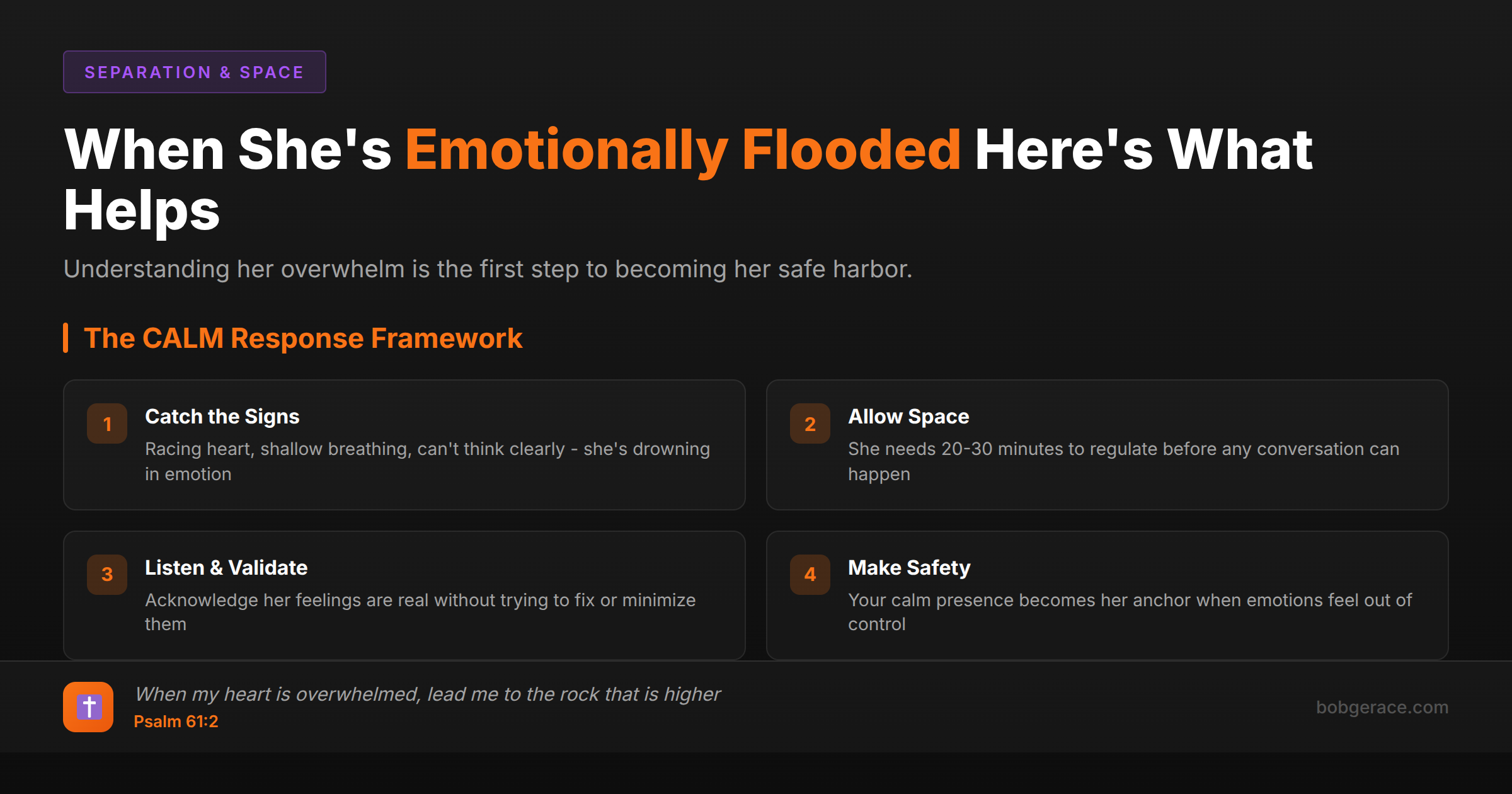
Emotional flooding feels like being completely overwhelmed by a tidal wave of emotions that she can't control or process. It's not just feeling upset—it's a full-body experience where her nervous system becomes hijacked by intense feelings of anger, hurt, disappointment, or despair all hitting at once. Physically, she might experience a racing heart, shallow breathing, muscle tension, or even nausea. Mentally, she feels like she's drowning, unable to think clearly or articulate what's happening inside her. This overwhelming state often leads to either explosive reactions or complete emotional shutdown as her brain's survival mechanisms kick in to protect her from the intensity.
The Full Picture
When your wife experiences emotional flooding, she's not just having a bad day or being dramatic. This is a legitimate physiological response where her nervous system becomes completely overwhelmed by emotional stimuli.
The Physical Experience: - Heart racing or pounding - Difficulty breathing or feeling like she can't catch her breath - Muscle tension, especially in shoulders, neck, and jaw - Nausea or stomach upset - Feeling hot, flushed, or dizzy - Trembling or shaking
The Mental Experience: - Racing thoughts that jump from one hurt to another - Inability to focus or think clearly - Feeling like she's going crazy or losing control - Memory problems—either can't remember details or remembers everything vividly - Catastrophic thinking where everything feels hopeless
The Emotional Experience: - Multiple intense emotions hitting simultaneously - Feeling like she's drowning in her own feelings - Complete overwhelm where she can't identify individual emotions - Alternating between rage and despair within minutes - Feeling completely alone and misunderstood
What Triggers the Flood: It's rarely one single event. Instead, it's usually the result of accumulated emotional stress, unresolved conflicts, feeling unheard, or repeated patterns of hurt that finally breach her emotional dam. The trigger might seem small to you, but it's the final drop that causes the overflow.
Understanding this helps explain why she might seem to "overreact" to situations or why logical discussions become impossible when she's in this state.
What's Really Happening
From a clinical perspective, emotional flooding occurs when the brain's emotional center (the limbic system) becomes hyperactivated and overwhelms the prefrontal cortex—the area responsible for rational thinking and emotional regulation.
The Neurological Reality: When flooding occurs, stress hormones like cortisol and adrenaline flood her system. Her brain literally shifts into survival mode, prioritizing immediate emotional processing over logical reasoning. This is why trying to have rational conversations during flooding is not only ineffective but can actually make the situation worse.
The Trauma Connection: Repeated emotional flooding can actually rewire the brain, making her more susceptible to future flooding episodes. Each unresolved conflict or emotional hurt creates neural pathways that make flooding more likely and more intense over time. This is why wives who've "checked out" often seem to react more intensely to situations that previously wouldn't have bothered them.
The Recovery Process: It typically takes 20-30 minutes for stress hormones to metabolize and for the nervous system to return to baseline after a flooding episode. However, if the underlying issues aren't addressed, she remains in a state of hypervigilance, making her more vulnerable to future flooding.
Gender Differences: Women often experience flooding differently than men due to hormonal influences and socialization patterns. Women are more likely to internalize the flooding, leading to rumination and emotional withdrawal, while also being more sensitive to relational threats and disconnection.
The key understanding is that flooding isn't a choice or a character flaw—it's a genuine neurobiological response to chronic emotional stress.
What Scripture Says
God's Word acknowledges the reality of overwhelming emotions and provides both comfort and guidance for these intense experiences.
God Sees Her Overwhelm: *"You have kept count of my tossings; put my tears in your bottle. Are they not in your book?"* (Psalm 56:8). God doesn't dismiss or minimize emotional pain. He actually keeps track of every tear and every sleepless night she's experienced.
When Emotions Feel Too Much: *"When my heart is overwhelmed, lead me to the rock that is higher than I"* (Psalm 61:2). David himself experienced emotional overwhelm and knew where to turn. God provides a refuge when emotions feel too intense to handle.
God's Compassionate Response: *"The Lord is close to the brokenhearted and saves those who are crushed in spirit"* (Psalm 34:18). When she's flooding, she often feels completely alone. But Scripture promises that God draws near to those who are emotionally crushed.
The Call for Gentleness: *"A bruised reed he will not break, and a smoldering wick he will not snuff out"* (Isaiah 42:3). When someone is emotionally flooded, they're like a bruised reed—fragile and easily broken. Christ's approach is gentle restoration, not forceful correction.
Bearing One Another's Burdens: *"Bear one another's burdens, and so fulfill the law of Christ"* (Galatians 6:2). Her emotional flooding isn't just her problem to solve alone—Scripture calls us to help carry the weight of overwhelming emotions.
Hope for Restoration: *"He heals the brokenhearted and binds up their wounds"* (Psalm 147:3). God specializes in healing emotional wounds and can restore what feels completely broken. Her flooding is real, but it's not permanent when addressed with God's wisdom and your commitment to change.
What To Do Right Now
-
1
Recognize the signs - Learn to identify when she's approaching or experiencing flooding so you can respond appropriately rather than escalating
-
2
Create immediate safety - Stop trying to resolve the issue and focus on helping her feel emotionally safe through calm presence and validation
-
3
Give her space to regulate - Understand she needs 20-30 minutes to physiologically calm down before any productive conversation can happen
-
4
Validate her experience - Acknowledge that her feelings are real and overwhelming without trying to fix or minimize them
-
5
Address underlying issues - Work on the accumulated hurts and patterns that are causing the flooding rather than just managing the symptoms
-
6
Seek professional help - Consider counseling to learn healthy coping strategies and address the deeper emotional wounds contributing to flooding episodes
Related Questions
- What is 'stonewalling' and why does she do it?
- What's the difference between stonewalling and self-protection?
- Why did she stop fighting?
- What does giving up look like vs. regulating?
- What is 'emotional fatigue' in marriage?
- Why does indifference feel worse than anger?
- How do I regulate when my body is in fight-or-flight?
- What does nervous system regulation look like?
- What is triggered vs. legitimately upset?
Also find Bob on
Subscribe for weekly videos on Christian marriage.
You Can't Script This Alone
Understanding flooding doesn't tell you what to do when she's in it—in your kitchen, with your history. A coach who knows your marriage helps you read the moment and respond to her, not the theory.
Talk to Bob →