What is 'Pauline privilege'?
6 min read
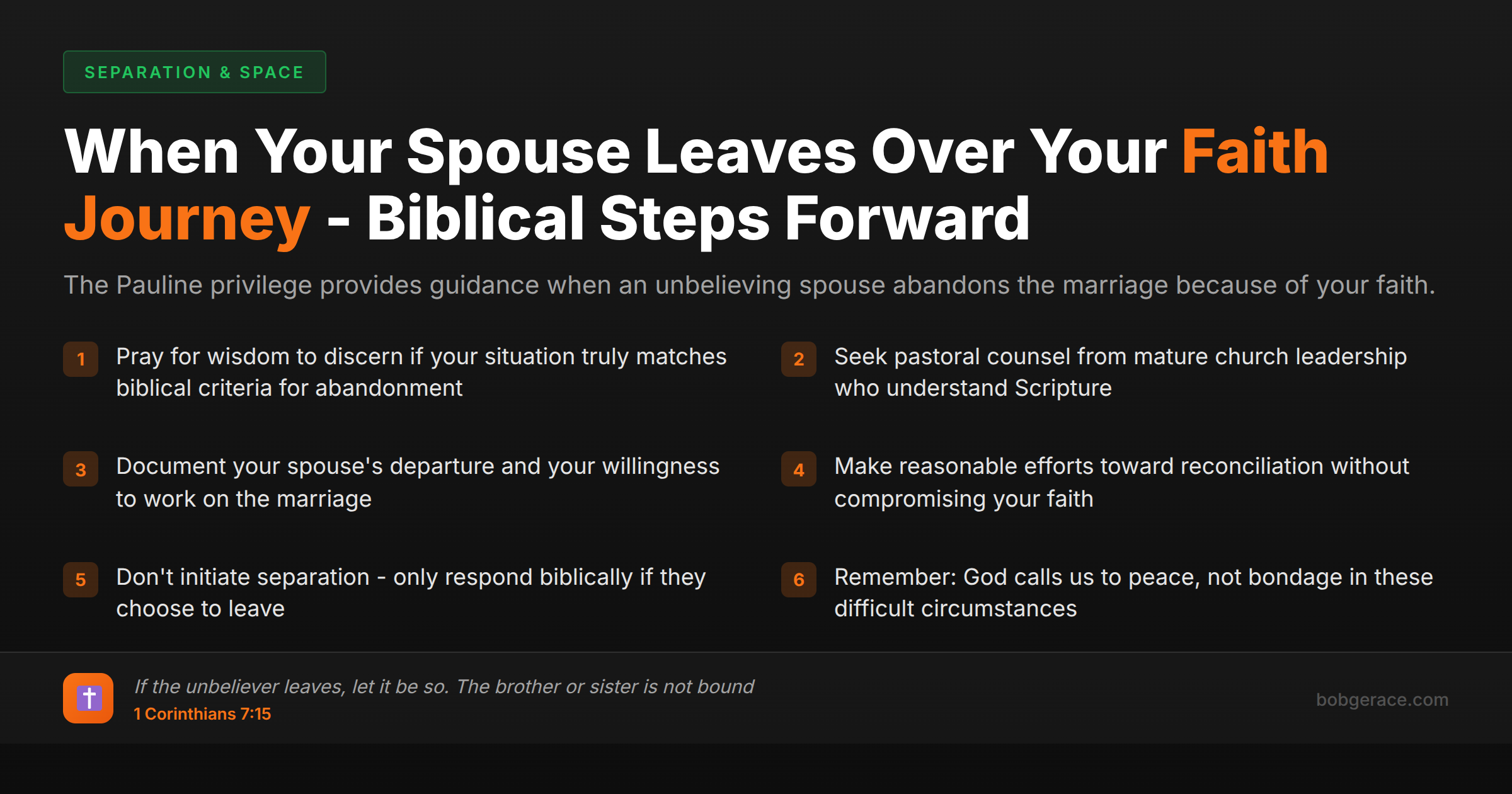
The Pauline privilege, named after the Apostle Paul, refers to the biblical principle found in 1 Corinthians 7:15 that allows a believing spouse to separate from an unbelieving spouse who chooses to leave the marriage. This is distinct from divorce in that it acknowledges a situation where the unbeliever has already broken the marriage covenant through abandonment. Paul writes that if an unbelieving spouse is willing to live peacefully with a believer, the believer should not initiate separation. However, if the unbeliever chooses to leave, 'the believing man or woman is not bound in such circumstances.' This provision recognizes that some marriages face unique challenges when one spouse comes to faith while the other remains opposed to Christianity, and provides biblical guidance for these difficult situations.
The Full Picture
The Pauline privilege emerges from Paul's practical wisdom in addressing real-world marriage challenges in the early church. In 1 Corinthians 7, Paul tackles the complex situation of mixed marriages - where one spouse becomes a Christian while the other remains an unbeliever.
This isn't about casual incompatibility or even serious disagreements about faith. The Pauline privilege specifically applies when an unbelieving spouse chooses to leave because they cannot or will not tolerate their partner's Christian faith. Paul's guidance recognizes that forced cohabitation in such circumstances serves no one well.
The key principle here is abandonment by the unbeliever. Paul doesn't give believers permission to leave their unbelieving spouses. Instead, he acknowledges the reality that sometimes unbelievers will choose to leave rather than remain married to someone whose faith they find intolerable.
Historically, this provision has been misunderstood and sometimes misapplied. Some have tried to broaden its scope beyond Paul's clear intent. Others have used it as justification for divorce in situations that don't match the biblical criteria.
The phrase 'not bound' in verse 15 has generated theological discussion. Most conservative scholars understand this to mean the believer is released from the obligation to maintain the marriage when the unbeliever chooses departure. This freedom isn't automatic - it requires the specific circumstances Paul outlines.
Understanding the Pauline privilege requires grasping Paul's heart for both marriage preservation and realistic pastoral care. He wants marriages to work, but he also recognizes that some situations become untenable through no fault of the believer.
What's Really Happening
From a therapeutic perspective, the Pauline privilege addresses what we'd recognize today as fundamental incompatibility combined with abandonment. When one spouse undergoes a significant spiritual transformation, it can create profound shifts in values, priorities, and daily life patterns that affect the entire marriage dynamic.
I've worked with couples where one partner's newfound faith becomes a source of intense conflict. The believing spouse may adopt new moral standards, change social circles, alter spending habits, or restructure priorities around spiritual growth. For an unbelieving partner who didn't sign up for these changes, the marriage can feel like a completely different relationship.
The psychological stress in these situations is enormous. The believer often experiences torn loyalties between faithfulness to God and preservation of the marriage. They may face ridicule, sabotage of their spiritual practices, or ultimatums about their faith. The unbelieving spouse might feel betrayed or abandoned by their partner's transformation, viewing it as rejection of their shared history and values.
What Paul recognizes - and what therapy confirms - is that marriages require mutual willingness to work. When one partner is fundamentally opposed to the other's core identity and values, and chooses to leave rather than adapt or accommodate, the relationship becomes unsustainable.
The Pauline privilege provides psychological permission for believers to stop carrying the full weight of responsibility for a marriage that the other party has chosen to abandon. This is therapeutically sound - it prevents the destructive cycle of self-blame and impossible efforts to single-handedly save a relationship the other person has rejected.
What Scripture Says
The foundation of the Pauline privilege rests in 1 Corinthians 7:12-16, where Paul provides specific guidance for mixed marriages:
*"If any brother has a wife who is not a believer and she is willing to live with him, he must not divorce her. And if a woman has a husband who is not a believer and he is willing to live with her, she must not divorce him"* (1 Corinthians 7:12-13).
Paul's first instruction prioritizes marriage preservation. Believers shouldn't initiate separation simply because their spouse doesn't share their faith.
*"But if the unbeliever leaves, let it be so. The brother or the sister is not bound in such circumstances. God has called us to live in peace"* (1 Corinthians 7:15).
This verse establishes the core principle - when the unbeliever chooses departure, the believer isn't bound to prevent or reverse that decision.
*"How do you know, wife, whether you will save your husband? Or, how do you know, husband, whether you will save your wife?"* (1 Corinthians 7:16).
Paul acknowledges the limits of influence - believers cannot guarantee their spouse's spiritual response and shouldn't carry that burden.
The broader biblical context emphasizes that God desires peace over forced unity. *"God has called us to live in peace"* suggests that some situations become so contentious that separation serves everyone better than continued conflict.
This principle aligns with Jesus' teaching about counting the cost (Luke 14:28) - following Christ sometimes involves difficult relational consequences that believers didn't initiate but must navigate with wisdom and grace.
What To Do Right Now
-
1
Pray for wisdom - Ask God for clarity about whether your situation truly matches the biblical criteria for Pauline privilege
-
2
Seek pastoral counsel - Meet with mature church leadership who can help you evaluate your circumstances biblically
-
3
Document the abandonment - If your spouse is leaving due to your faith, make clear your willingness to work on the marriage
-
4
Pursue reconciliation appropriately - Make reasonable efforts to restore the relationship without compromising your faith
-
5
Get professional guidance - Consult with a Christian attorney who understands both biblical principles and legal implications
-
6
Focus on spiritual growth - Use this difficult season to deepen your relationship with God and seek His peace
Related Questions
- What does Scripture say about divorce?
- What is Paul's teaching in 1 Corinthians 7?
- What about abandonment?
- Does adultery justify divorce?
- If I divorce, can I remarry?
- What are the main evangelical positions on divorce?
- Does God want me to stay in this marriage?
- What does biblical forgiveness require of me?
- What does faithfulness require when she won't reciprocate?
Also find Bob on
Subscribe for weekly videos on Christian marriage.
Your Marriage Isn't a Textbook Case
Biblical principles are clear. Your situation has layers. A coach who knows your story helps you apply what's true to what's real in your home.
Talk to Bob →