What is the 'unlawful marriage' interpretation?
6 min read
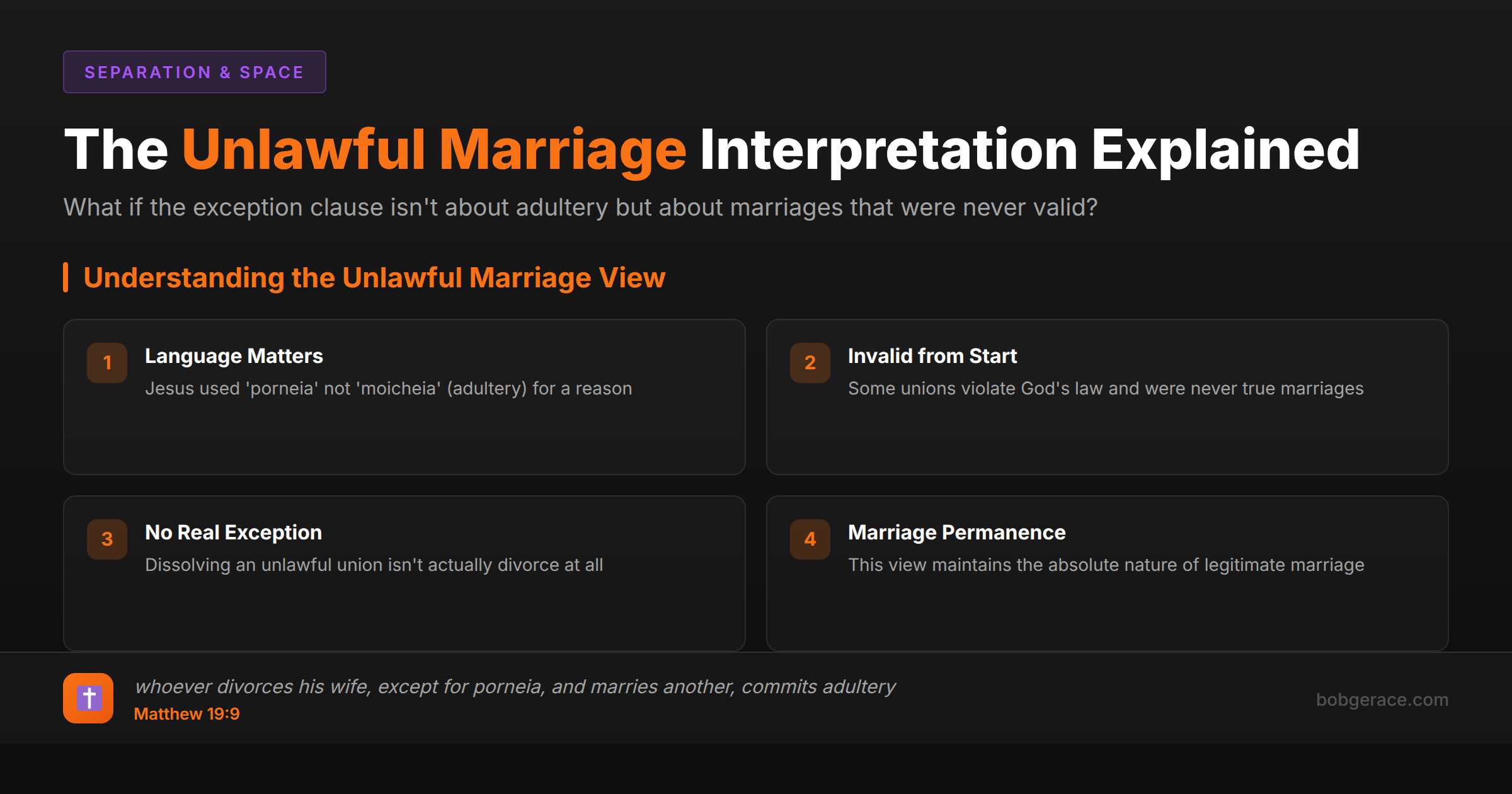
The 'unlawful marriage' interpretation suggests that the exception clause in Matthew 19:9 refers to marriages that were never valid in God's eyes to begin with - not to adultery during a legitimate marriage. Under this view, the Greek word 'porneia' doesn't mean general sexual immorality, but specifically refers to marriages that violate Old Testament law, such as unions between close relatives or marriages involving ritual prostitution. This interpretation argues that Jesus wasn't creating an exception for divorce due to adultery, but clarifying that dissolving an illegitimate union isn't actually divorce at all - since the marriage was unlawful from the start. Proponents believe this maintains the absolute nature of Jesus's teaching on marriage permanence while addressing practical questions about invalid unions.
The Full Picture
The unlawful marriage interpretation represents one of the most conservative approaches to understanding Jesus's words in Matthew 19:9. This view emerged from scholars who noticed that Jesus uses 'porneia' (sexual immorality) rather than 'moicheia' (adultery) in the exception clause - a distinction they believe is crucial.
The Core Argument Advocates argue that if Jesus meant adultery, He would have used the specific Greek word for it. Instead, 'porneia' in Jewish context often referred to forbidden sexual relationships outlined in Leviticus 18 - marriages between relatives, unions with temple prostitutes, or other relationships that violated God's design for marriage.
This interpretation suggests that when Jesus said 'except for porneia,' He wasn't giving permission to divorce an adulterous spouse. Rather, He was addressing the reality that some unions called 'marriage' were never legitimate marriages in God's eyes. Dissolving such a union wouldn't be divorce - it would be recognizing that a true marriage never existed.
Historical Context In Jesus's time, Gentile converts to Judaism often came from backgrounds where they were married to close relatives or involved in pagan religious practices involving sexual rituals. The early church faced practical questions: Could these converts remain in unions that violated biblical law? This interpretation sees Jesus addressing these specific situations, not creating a general exception for adultery.
Implications for Modern Marriage Under this view, the permanence of marriage remains absolute once a legitimate union is formed. However, it provides clarity for situations involving marriages that were fundamentally flawed from the beginning due to violations of God's design.
What's Really Happening
From a therapeutic standpoint, this interpretation can create both clarity and confusion for struggling couples. I've counseled many believers who find relief in understanding that Jesus wasn't necessarily creating a 'way out' of difficult marriages, but rather clarifying what constitutes a legitimate marriage in the first place.
Psychological Impact Couples dealing with infidelity often initially resist this interpretation because it doesn't provide the 'biblical permission' to divorce that they might be seeking. However, I've observed that it can actually strengthen commitment when spouses realize that their legitimate marriage has no biblical escape clause - it forces them to work harder at reconciliation.
The interpretation can be particularly healing for those who've been divorced and remarried, as it helps them understand that their current situation isn't necessarily living in ongoing sin if their previous union was fundamentally flawed from the beginning.
Pastoral Care Considerations This view requires careful application. I've seen it misused by people trying to retroactively declare their marriages 'unlawful' to justify divorce for incompatibility or other non-biblical reasons. True pastoral care requires discernment about what actually constitutes an unlawful marriage versus a difficult but legitimate one.
Healing and Restoration The interpretation often leads couples to deeper commitment because it removes the 'easy out' mentality. When spouses understand that their marriage is permanent in God's eyes, they're more likely to pursue intensive counseling, address root issues, and fight for their relationship rather than looking for biblical justification to quit.
What Scripture Says
Understanding this interpretation requires examining how Scripture uses different terms for sexual sin and marriage violations.
The Language Distinction *Matthew 19:9* - 'And I say to you: whoever divorces his wife, except for porneia, and marries another, commits adultery.' The use of 'porneia' rather than 'moicheia' (adultery) is significant to this interpretation.
*1 Corinthians 5:1* - 'It is actually reported that there is sexual immorality (porneia) among you, and of a kind that is not tolerated even among pagans: a man has his father's wife.' Here, 'porneia' clearly refers to an unlawful sexual relationship, not adultery in a legitimate marriage.
Old Testament Marriage Laws *Leviticus 18:6-18* provides the framework for what constitutes unlawful marriages - unions between close relatives that were common in pagan cultures but forbidden by God.
*Ezra 10:2-3* - 'We have been unfaithful to our God by marrying foreign women from the peoples around us. But in spite of this, there is still hope for Israel. Now let us make a covenant before our God to send away all these women and their children.' This shows precedent for dissolving unions that violated God's law.
Marriage Permanence *Mark 10:9* - 'Therefore what God has joined together, let no one separate.' This interpretation argues that God only 'joins together' legitimate marriages.
*Romans 7:2-3* - 'For example, by law a married woman is bound to her husband as long as he is alive, but if her husband dies, she is released from the law that binds her to him.' The emphasis on the binding nature of legitimate marriage supports the permanence principle while allowing that some unions may not be legitimate marriages at all.
What To Do Right Now
-
1
Study the biblical passages yourself, comparing different translations and examining the original Greek words used
-
2
Pray for wisdom to understand God's heart for marriage rather than looking for loopholes or easy answers
-
3
If you're in a difficult marriage, focus on what you can do to honor your commitment rather than seeking ways out
-
4
Consult with mature Christian leaders or counselors who can help you understand how this applies to your specific situation
-
5
If you're questioning the legitimacy of your marriage, seek pastoral counsel rather than making unilateral decisions
-
6
Commit to working on your current marriage with the assumption that it is legitimate and permanent in God's eyes
Related Questions
- What does Scripture say about divorce?
- What is 'porneia' and what does it include?
- Does the exception clause allow divorce or require it?
- What did Jesus say about divorce?
- What's the exception clause?
- What is the Deuteronomy 24 background?
- What does biblical forgiveness require of me?
- What's the difference between forgiveness and reconciliation?
- What does repentance look like for accumulated sin?
Also find Bob on
Subscribe for weekly videos on Christian marriage.
Bring This to Your Actual Marriage
Theology matters, but so does what you do Monday morning. A coach who knows your specific situation can help you apply what you're learning to the marriage you're actually in.
Talk to Bob →