Does the exception clause allow divorce or require it?
6 min read
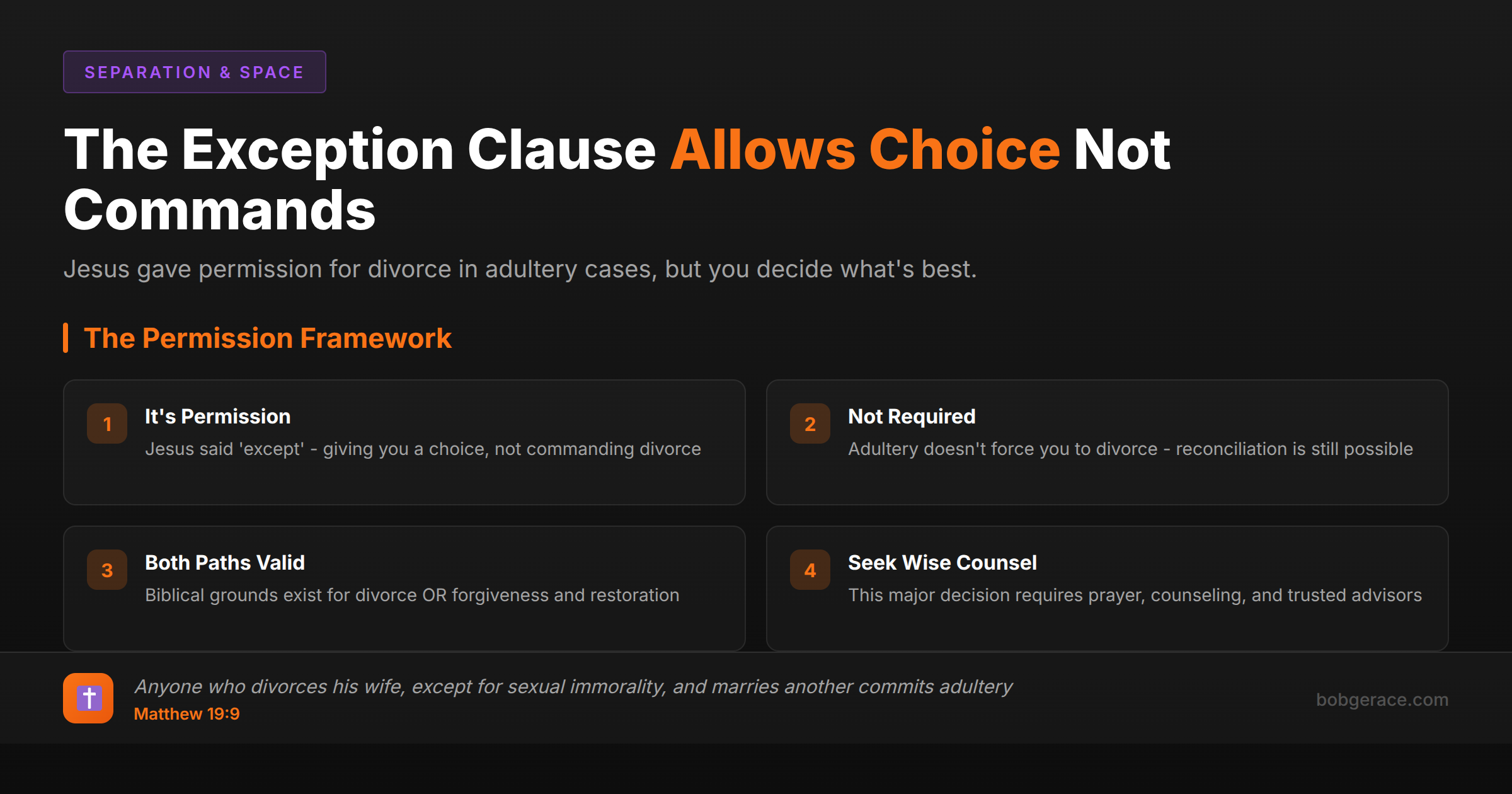
The exception clause in Matthew 19:9 allows divorce in cases of sexual immorality but does not require it. Jesus provided this as a permission, not a command. When He said 'except for sexual immorality,' He was acknowledging that adultery creates a legitimate ground for divorce while still upholding God's original design for lifelong marriage. This means you have a choice. If your spouse has committed adultery, you're not obligated to divorce them, nor are you required to stay married. The clause gives you biblical permission to pursue either path - reconciliation through forgiveness and restoration, or divorce followed by the possibility of remarriage. The decision should be made prayerfully, with wise counsel, and consideration of factors like repentance, safety, and the ability to rebuild trust.
The Full Picture
The exception clause appears in Matthew 19:9 when the Pharisees tested Jesus about divorce. They wanted a simple yes or no answer, but Jesus responded with both God's original intent and a merciful provision for humanity's brokenness.
Permission, Not Prescription When Jesus said 'except for sexual immorality,' He used permissive language, not imperative language. This is crucial. The Greek word used suggests allowance rather than requirement. It's similar to how speed limits give you permission to drive up to a certain speed - you're not required to drive that fast.
Two Valid Paths Forward The exception clause acknowledges two biblically sound responses to adultery:
1. The Path of Divorce: Recognizing that adultery fundamentally violates the marriage covenant, making divorce permissible and remarriage possible 2. The Path of Reconciliation: Choosing forgiveness and working toward restoration when there's genuine repentance
Both paths require wisdom, prayer, and often professional guidance. Neither path is 'more spiritual' than the other.
Context Matters Your decision shouldn't be made in isolation. Consider factors like: - Repentance: Is there genuine sorrow and changed behavior? - Safety: Are there patterns of abuse or ongoing deception? - Children: How will each path affect your family? - Support: Do you have the resources needed for either reconciliation or starting over?
The exception clause provides freedom to make the choice that best honors God given your specific circumstances. It's grace in action - not forcing you to stay in a broken covenant, but not pushing you toward divorce either.
What's Really Happening
From a therapeutic standpoint, the permission rather than requirement aspect of the exception clause is psychologically healthy. Forced reconciliation without genuine repentance often leads to further trauma and cycles of betrayal.
The Trauma Response When adultery occurs, the betrayed spouse experiences symptoms similar to PTSD - intrusive thoughts, hypervigilance, emotional numbness, and sleep disturbances. Healing requires safety and choice, not additional pressure to make a 'right' decision quickly.
Two Different Healing Journeys I've worked with couples who've successfully navigated both paths. Those who choose reconciliation need to rebuild trust gradually, often taking 2-5 years for full restoration. This requires the unfaithful spouse to demonstrate consistent transparency, accountability, and patience with the healing process.
Those who choose divorce also need time to heal from the betrayal before they're ready for future relationships. The exception clause's provision for remarriage acknowledges that divorce due to adultery doesn't carry the same restrictions as other circumstances.
The Pressure Problem Many people feel pressured by well-meaning church members to either 'forgive and move on' or 'get rid of the cheater.' Both extremes miss the nuanced wisdom of the exception clause. Your choice should be based on your specific situation, not others' expectations.
Making the Decision I encourage clients to take time before deciding. Don't rush into either reconciliation or divorce court. Seek individual counseling first to process the trauma, then explore your options with professional guidance. The exception clause gives you permission to take time and make the choice that's truly best for your situation.
What Scripture Says
Matthew 19:9 - *'I tell you that anyone who divorces his wife, except for sexual immorality, and marries another woman commits adultery.'* This is Jesus's direct statement providing the exception. The word 'except' (Greek: 'ei me') indicates an allowable exception, not a mandatory action.
1 Corinthians 7:10-11 - *'To the married I give this command (not I, but the Lord): A wife must not separate from her husband. But if she does, she must remain unmarried or else be reconciled to her husband.'* Paul reinforces that reconciliation is always an option, even after separation.
Hosea 3:1 - *'The Lord said to me, 'Go, show your love to your wife again, though she is loved by another man and is an adulteress. Love her as the Lord loves the Israelites.'* God's heart clearly leans toward reconciliation when possible, showing us His character of redemption.
Malachi 2:16 - *'The man who hates and divorces his wife,' says the Lord, the God of Israel, 'does violence to the one he should protect.'* God's design is clearly for permanent marriage, making divorce a last resort rather than a quick solution.
Ephesians 4:32 - *'Be kind and compassionate to one another, forgiving each other, just as in Christ God forgave you.'* Forgiveness is always commanded, but this doesn't necessarily mean staying married - you can forgive and still choose divorce.
Matthew 18:15-17 - The process of confrontation and restoration applies to marriage conflicts, including adultery. Sometimes this process leads to reconciliation; sometimes it confirms that divorce is necessary.
What To Do Right Now
-
1
Take time to process - Don't make major decisions while in emotional shock; seek individual counseling to work through trauma
-
2
Establish safety and boundaries - Separate if needed while you decide; require transparency and accountability from unfaithful spouse
-
3
Seek wise counsel - Talk to trusted pastors, counselors, and mature believers who understand both biblical truth and your situation
-
4
Evaluate genuine repentance - Look for sorrow over sin (not just consequences), changed behavior, and willingness to do whatever it takes
-
5
Consider all factors - Assess safety, children's wellbeing, patterns of behavior, support systems, and your capacity for either path
-
6
Make your decision prayerfully - Remember that both reconciliation and divorce are biblically permissible; choose based on wisdom and circumstances
Related Questions
- What does Scripture say about divorce?
- What is 'porneia' and what does it include?
- Does adultery justify divorce?
- If I divorce, can I remarry?
- What is the 'unlawful marriage' interpretation?
- What did Jesus say about divorce?
- What does biblical forgiveness require of me?
- What's the difference between forgiveness and reconciliation?
- Does forgiveness mean no consequences?
- How do I make this decision?
Also find Bob on
Subscribe for weekly videos on Christian marriage.
Your Marriage Isn't a Doctrine Question
You're not deciding what the Bible allows. You're deciding what to do in your actual situation, with your actual spouse. A coach who knows your story helps you see what you can't see alone.
Talk to Bob →