What micro-moments might begin to shift this?
5 min read
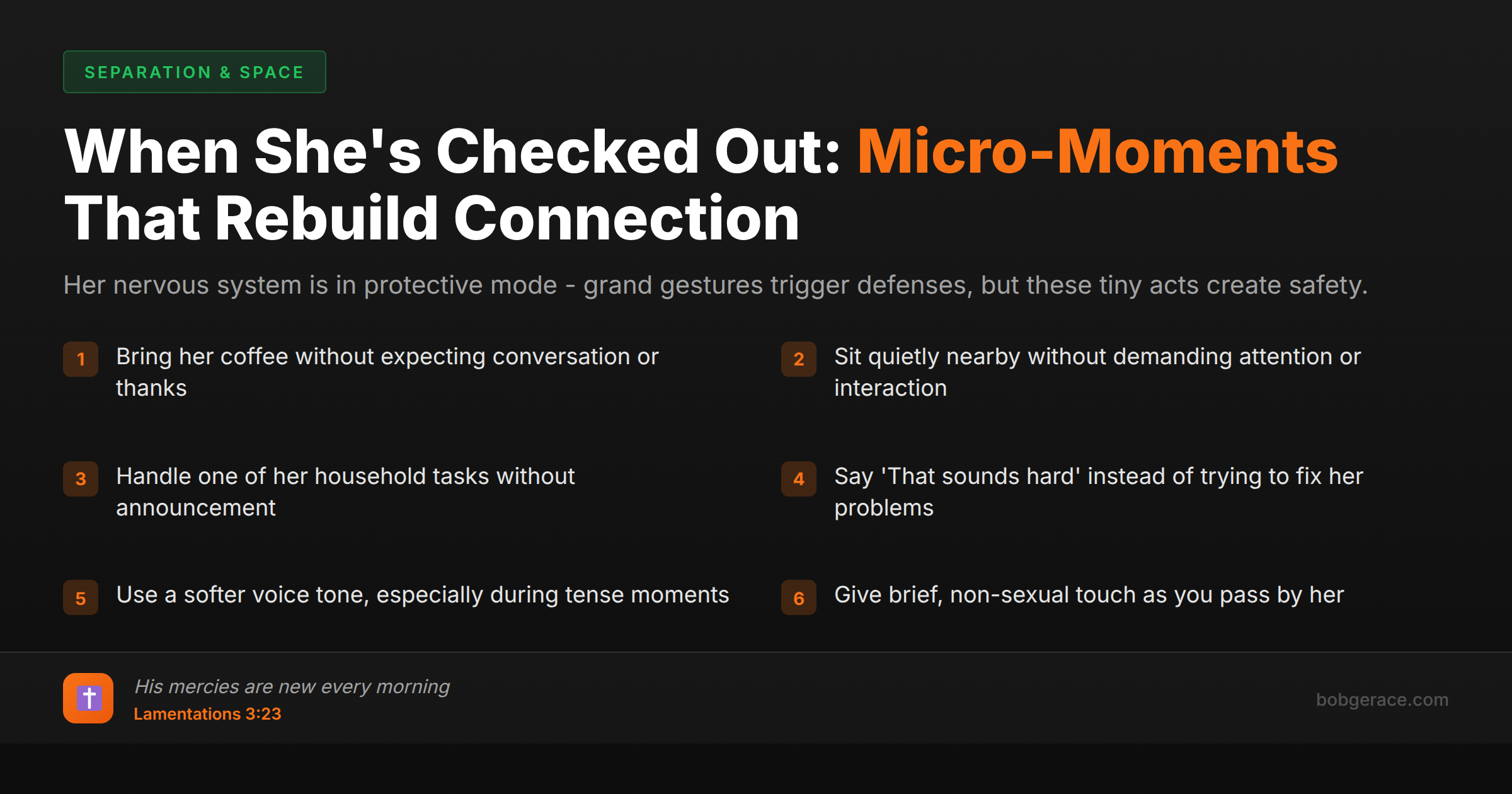
When your wife has checked out, her nervous system is in protective mode. The shift back begins with tiny moments of safety and co-regulation - not grand gestures. Think bringing her coffee without expecting conversation, sitting quietly nearby without demanding attention, or simply saying 'I see you're having a hard day' without trying to fix it. These micro-moments work because they don't trigger her defenses. Her nervous system can sense genuine care without pressure. A gentle touch on her shoulder as you pass by, remembering something she mentioned days ago, or creating space for her to breathe - these small acts begin rewiring her system from 'threat detected' back to 'maybe it's safe here.'
The Full Picture
Your wife's nervous system didn't shut down overnight, and it won't come back online with one conversation or romantic dinner. When someone is in dorsal vagal shutdown - that checked-out, emotionally unavailable state - their system is literally protecting them from what it perceives as ongoing threat.
The beautiful thing about micro-moments is they fly under the radar of her protective defenses. While her conscious mind might reject big gestures or deep talks, her nervous system is constantly scanning for safety cues. A genuine smile when she walks in the room. Handling a household task without being asked. Speaking softly instead of with intensity. These aren't manipulation tactics - they're co-regulation opportunities.
Think about it: when you're stressed or overwhelmed, what helps? Usually not someone trying to fix you or demanding emotional availability. It's someone being genuinely present without an agenda. Someone who can hold steady when you can't. Someone whose nervous system communicates safety through their actions, tone, and presence.
The key is consistency over intensity. Her system has been conditioned to expect disappointment, pressure, or emotional volatility. Micro-moments of genuine care, repeated over time, begin creating new neural pathways. Her nervous system starts to think, 'Maybe this person is actually safe. Maybe I can start to relax here.'
This isn't about walking on eggshells or becoming a doormat. It's about understanding that her withdrawal isn't personal rejection - it's nervous system protection. And the path back to connection runs through consistent, small acts of love that don't demand immediate reciprocation.
What's Really Happening
From a polyvagal perspective, when someone has 'checked out,' their dorsal vagal complex has taken over. This is the most primitive part of our autonomic nervous system, designed for survival through shutdown and withdrawal. The person isn't choosing to be disconnected - their nervous system has determined this is the safest response to chronic stress or perceived threat.
Micro-moments work because they engage the neuroception process - our unconscious detection of safety or danger. The dorsal vagal state is characterized by hypervigilance to threat cues, but it's equally responsive to genuine safety signals. These don't need to be grand gestures; in fact, big changes often trigger more defensive responses.
Consistent micro-moments of attunement activate the ventral vagal complex - our social engagement system. A soft voice tone, relaxed facial expression, or non-demanding presence all communicate safety at a nervous system level. Over time, these experiences help shift the person's window of tolerance, gradually expanding their capacity for connection.
The crucial element is co-regulation. When one person maintains nervous system stability in the presence of another's dysregulation, it creates an opportunity for the dysregulated person to 'borrow' that stability. This isn't about fixing or changing them - it's about being a regulated, safe presence that their nervous system can eventually attune to and mirror.
What Scripture Says
Scripture is full of micro-moments that demonstrate God's heart for gentle, consistent love. Lamentations 3:22-23 reminds us that 'His mercies are new every morning' - not grand, overwhelming displays, but fresh, daily expressions of faithfulness. This is the model for how we can love our spouses back to life.
1 Corinthians 13:4-7 describes love as patient and kind, not demanding or self-seeking. These aren't just character qualities - they're descriptions of how love actually functions in micro-moments. Love doesn't insist on its own way or keep a record of wrongs. It creates safety through consistent, gentle presence.
Jesus himself modeled this beautifully. When the disciples were exhausted and overwhelmed, Mark 6:31 shows Him saying, 'Come away by yourselves to a desolate place and rest a while.' He didn't demand they push through or lecture them about faith. He created space for their nervous systems to regulate.
In Isaiah 42:3, we see that 'a bruised reed he will not break, and a faintly burning wick he will not quench.' This is the heart of micro-moments - recognizing when someone is fragile and responding with gentleness rather than intensity. Galatians 6:2 calls us to 'bear one another's burdens,' which often means simply being present with someone's pain without trying to fix it.
The ultimate micro-moment is found in Romans 8:26 - the Spirit interceding for us 'with groanings too deep for words.' Sometimes the most powerful thing we can offer our spouse is simply being present in their struggle, without words, without solutions, just love.
What To Do Right Now
-
1
Bring her something she enjoys (coffee, tea, a snack) without expecting conversation or thanks
-
2
Sit in the same room reading or doing your own thing - be present without being demanding
-
3
Handle one household task she normally does, quietly, without announcement or recognition-seeking
-
4
When she shares something difficult, respond with 'That sounds hard' instead of trying to fix it
-
5
Use a softer voice tone, especially during any conflict or tense moments
-
6
Give a brief, non-sexual touch (hand on shoulder, quick hug) as you pass by, reading her response
Related Questions
- How do I become a safe person again?
- What would make her want to risk opening up?
- What does safety look like to her nervous system?
- How do I co-regulate with someone who won't engage?
- What signals threat to her nervous system?
- What would help her ventral vagal (social engagement)?
- How do I show love without activating her withdrawal?
- What does proactive repair look like?
- How do I not pursue while also not abandoning?
- What does 'holding space' actually mean?
Also find Bob on
Subscribe for weekly videos on Christian marriage.
When Micro-Moments Aren't Enough
A coach who knows your marriage can see what's actually happening between you two—and calibrate the next move to where she is right now.
Talk to Bob →