Why does indifference feel worse than anger?
6 min read
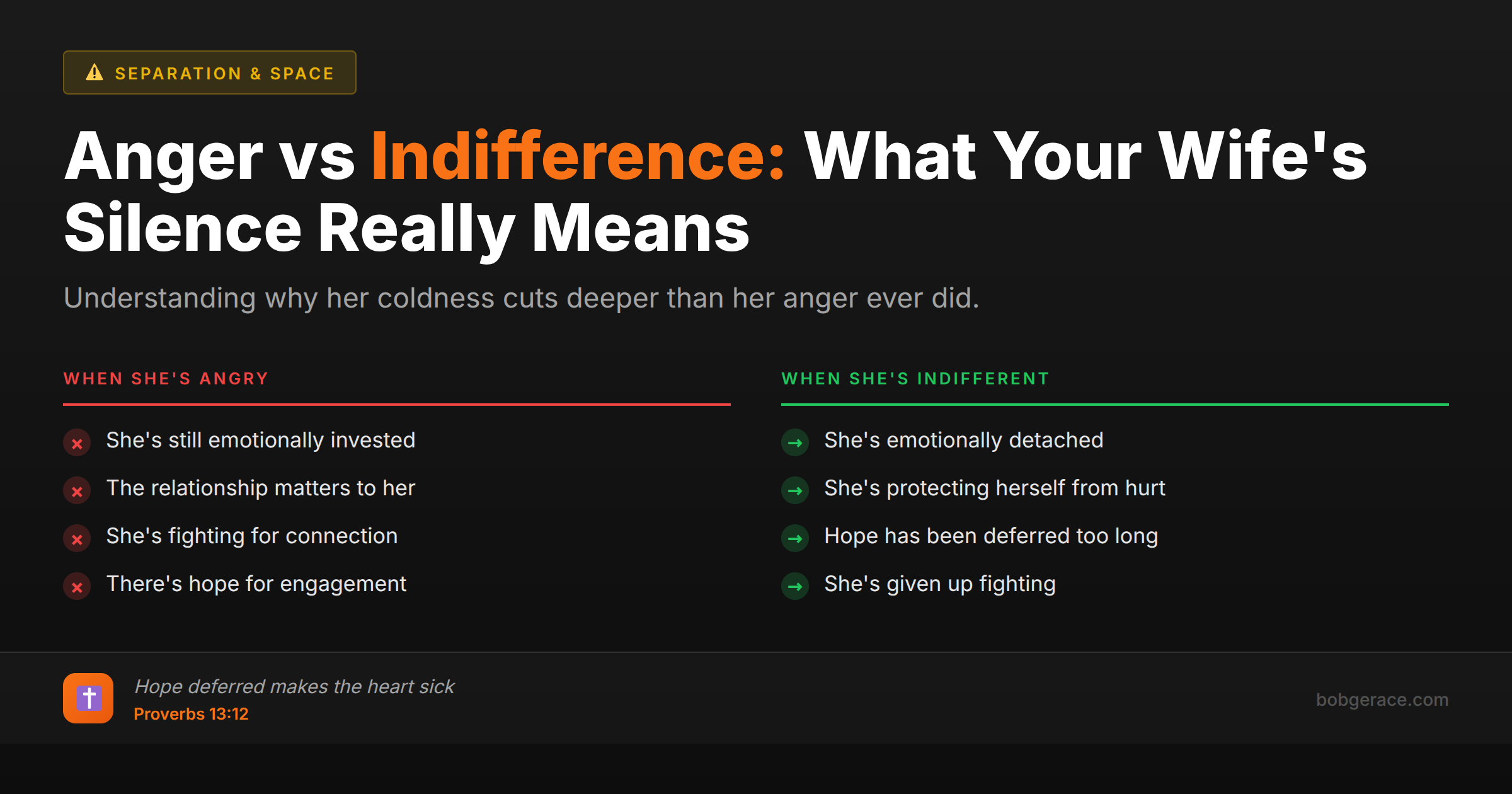
Indifference feels worse than anger because anger still contains connection and emotional investment. When your wife is angry, she's still engaged with you - she cares enough to feel something. Her emotions are activated, which means the relationship still matters to her on some level. Indifference, however, signals emotional detachment. It's the absence of feeling rather than the presence of negative feeling. This suggests she's moved beyond caring about the relationship's outcome. From a clinical perspective, indifference often represents a protective mechanism where she's emotionally withdrawn to avoid further hurt. The silence feels more threatening because it suggests she's given up hope that things can change.
The Full Picture
Here's what most men don't understand: anger is actually a secondary emotion. When your wife gets angry, there's always something underneath - hurt, fear, disappointment, or feeling unheard. But anger means she's still fighting for the relationship. She's expending emotional energy because she believes change is possible.
Indifference is different. It's what happens after anger has been exhausted without resolution. It's the emotional equivalent of her saying, "I'm done trying." This feels devastating because you instinctively recognize it as a more serious threat to your marriage.
The progression typically looks like this: - Stage 1: She expresses concerns directly - Stage 2: Frustration builds when concerns aren't addressed - Stage 3: Anger erupts as a last attempt to be heard - Stage 4: Emotional withdrawal and indifference set in
By the time you're experiencing her indifference, you're dealing with accumulated disappointment and unresolved issues. She's not trying to hurt you with silence - she's protecting herself from continued disappointment. This is why indifference feels so much more threatening than anger ever did.
The good news? Indifference isn't necessarily permanent. But it requires a fundamentally different approach than dealing with anger. You can't argue with indifference or defend against it. You have to demonstrate change through consistent action over time.
What's Really Happening
From a clinical perspective, indifference represents what we call 'emotional numbing' - a protective psychological mechanism. When someone has experienced repeated disappointment or emotional injury without resolution, the brain begins to shut down emotional responses to prevent further pain.
This process involves the limbic system's threat detection. Your wife's brain has essentially categorized the relationship as a source of potential harm, so it's reducing emotional investment as self-protection. This isn't conscious manipulation - it's an automatic survival response.
Anger, conversely, activates the sympathetic nervous system. It's an approach emotion - she's still moving toward resolution, even if it feels aggressive. The neurochemical activity during anger actually maintains neural pathways of connection, whereas indifference allows those pathways to weaken.
What this means practically: Her indifference isn't about not loving you. It's about her nervous system protecting her from hope followed by disappointment. The antidote isn't grand gestures or emotional appeals, but consistent, small actions that slowly rebuild safety and trust. This process rewires her brain's threat assessment of the relationship over time.
What Scripture Says
Scripture gives us profound insight into the human heart and the progression from engagement to withdrawal. Proverbs 13:12 tells us, "Hope deferred makes the heart sick, but a desire fulfilled is a tree of life." This perfectly describes what happens when repeated disappointments lead to emotional withdrawal.
The Bible also shows us that indifference often follows unheard cries. Proverbs 1:24-25 warns: "Because I called and you refused to listen, because I stretched out my hand and no one paid attention... you ignored all my counsel." This pattern - calling out, being ignored, then withdrawing - mirrors what many wives experience.
Ecclesiastes 3:7 reminds us there's "a time to be silent and a time to speak." Sometimes silence isn't rejection but self-preservation. Lamentations 3:28 says, "Let him sit alone in silence when it is laid on him" - acknowledging that withdrawal can be a necessary response to overwhelming circumstances.
But Scripture also offers hope. Hosea 2:14 shows God's approach to a withdrawn heart: "Therefore I will allure her, and bring her into the wilderness, and speak tenderly to her." Not with demands or arguments, but with patient, consistent love.
1 Peter 3:7 calls husbands to live with their wives "in an understanding way" - which means recognizing when silence is self-protection rather than rejection, and responding with patience rather than pressure.
What To Do Right Now
-
1
Stop taking her indifference as a personal attack - recognize it as self-protection, not manipulation
-
2
Remove pressure for emotional responses - don't demand she engage or explain her feelings right now
-
3
Focus on consistent, small actions - show change through behavior, not promises or explanations
-
4
Address the underlying issues she raised before she became indifferent - even if she's not talking about them now
-
5
Give her emotional space while remaining consistently present - don't withdraw yourself in response to her withdrawal
-
6
Seek professional help if indifference persists beyond 2-3 months despite consistent effort on your part
Related Questions
- What is 'stonewalling' and why does she do it?
- Why did she stop fighting?
- What does giving up look like vs. regulating?
- What is 'emotional disengagement'?
- What does it mean when contempt has replaced anger?
- What's the difference between her being withdrawn and being done?
- She seems happier when I'm not around
- She's physically present but emotionally gone
- She stopped fighting — is that worse?
- Nothing I do seems to matter to her
Also find Bob on
Subscribe for weekly videos on Christian marriage.
Your Marriage Isn't a Textbook Case
Indifference in your specific situation has a history and a context. A coach who knows your story can help you read what's actually happening and respond in ways that fit your marriage.
Talk to Bob →