Am I enabling divorce by agreeing to separation?
6 min read
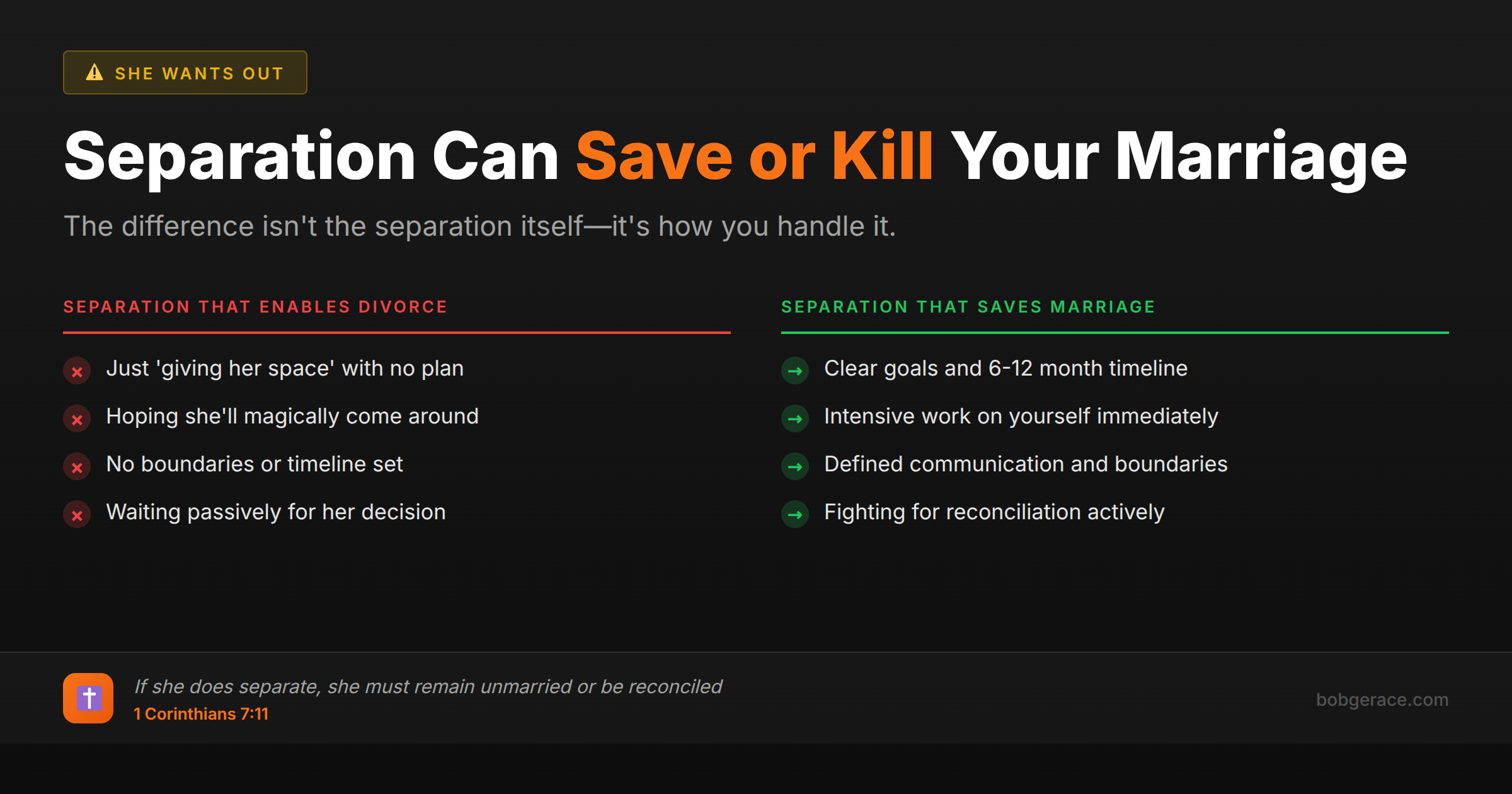
You're not necessarily enabling divorce by agreeing to separation, but you could be if you approach it without clear boundaries and purpose. The key difference is intentionality. A separation that's structured with specific goals, timelines, and accountability can actually prevent divorce by creating space for healing and growth. But a separation that's just "giving her space" with no plan often becomes a slow slide toward permanent separation. Here's what matters: Are you using this time to genuinely work on yourself and the marriage issues, or are you just hoping she'll "come around"? Are there clear expectations about communication, dating others, and working toward reconciliation? Your response to separation - not the separation itself - determines whether you're enabling divorce or fighting for your marriage.
The Full Picture
The fear of enabling divorce through separation is valid, but it's based on a misunderstanding of what "enabling" actually means. Enabling divorce happens when you make it easier for your wife to leave without consequences or accountability. Simply agreeing to separation doesn't automatically do this.
Consider these two scenarios:
Scenario 1: Enabling Separation • You agree to move out immediately with no discussion • There's no timeline or goals for the separation • You continue paying all bills while she enjoys single life • You're available whenever she needs something but get nothing in return • No marriage counseling or personal work is happening • She's free to date while you wait in limbo
Scenario 2: Strategic Separation • You negotiate terms: timeline, financial arrangements, communication rules • Both parties commit to individual therapy or coaching • Clear boundaries about dating others • Regular check-ins to assess progress • Specific issues being addressed (anger, addiction, communication) • Consequences if agreements are broken
The difference is structure and accountability. A well-planned separation can actually shock a spouse into recognizing the reality of losing the marriage. It can provide the emotional space needed for both parties to work on their issues without the daily triggers of living together.
The real danger isn't separation itself - it's passive separation. When you become a doormat who agrees to anything hoping she'll change her mind, you're not fighting for your marriage. You're making divorce easier by removing yourself from her daily reality while maintaining all the benefits of marriage (financial support, emotional availability, childcare help) without any of the commitment.
What's Really Happening
From a therapeutic standpoint, the concept of "enabling" in marriage comes from addiction recovery principles. In relationships, enabling occurs when one partner's actions make it easier for the other to continue destructive patterns without facing natural consequences.
Research on marital separation reveals a complex picture. Studies show that approximately 80% of separations end in divorce, but this statistic includes all separations - planned and unplanned, structured and chaotic. The separations that lead to reconciliation typically have several key characteristics: clear time limits (usually 6-12 months), ongoing professional support, and mutual agreement on specific issues to address.
The psychological dynamics at play are crucial. When a wife requests separation, she's often in what we call "emotional divorce" - she's already mentally ended the marriage and is seeking physical confirmation. Your response to this request sends a powerful psychological message. If you immediately comply without any negotiation or boundaries, you may be confirming her belief that the marriage lacks value and that you don't fight for what matters.
Conversely, structured separation can serve as a "pattern interrupt." It disrupts the negative cycle of daily conflict while maintaining enough structure to prevent complete emotional disconnection. The key is what therapists call "therapeutic separation" - a planned intervention with specific goals rather than an escape route.
The attachment theory perspective is particularly relevant here. Many men respond to separation requests with anxious attachment behaviors - becoming more accommodating, available, and self-sacrificing. Paradoxically, this often pushes their wives further away. A boundaried response to separation can actually activate healthy attachment responses and force both parties to confront the real possibility of loss.
What Scripture Says
Scripture provides clear guidance on marriage, separation, and our response to marital crisis. The Bible acknowledges that separation can occur while maintaining the covenant of marriage.
1 Corinthians 7:10-11 states: *"To the married I give this command (not I, but the Lord): A wife must not separate from her husband. But if she does, she must remain unmarried or else be reconciled to her husband. And a husband must not divorce his wife."* This passage acknowledges that separation happens, even when it shouldn't, but maintains that the marriage covenant remains intact.
Matthew 19:6 reminds us: *"So they are no longer two, but one flesh. Therefore what God has joined together, let no one separate."* This doesn't mean you fight separation with passive compliance. It means you fight for the covenant with wisdom and strength.
Nehemiah 4:13-14 provides a model for defending what God has established: *"Therefore I stationed some of the people behind the lowest points of the wall at the exposed places, posting them by families, with their swords, spears and bows... Don't be afraid of them. Remember the Lord, who is great and awesome, and fight for your families."* Sometimes protecting your marriage requires strategic positioning, not just surrender.
Proverbs 27:5 teaches us: *"Better is open rebuke than hidden love."* Agreeing to separation without boundaries or accountability might feel loving, but it can actually be a form of hidden love that doesn't serve your wife's best interests or honor the marriage covenant.
Ephesians 5:25 calls husbands to *"love your wives, just as Christ also loved the church and gave Himself for her."* Christ's love included both sacrifice and truth-telling. Sometimes loving your wife means not making divorce easy for her, even when that's what she thinks she wants.
The biblical approach to separation involves maintaining covenant faithfulness while responding with wisdom, boundaries, and hope for restoration.
What To Do Right Now
-
1
Evaluate your current separation arrangement - are there clear boundaries, timelines, and goals, or are you just "giving space" indefinitely?
-
2
Establish non-negotiable terms if separation continues - timeline (6-12 months maximum), communication schedule, financial arrangements, and rules about dating others
-
3
Begin intensive personal work immediately - hire a coach, start therapy, join a men's group, or begin a structured self-improvement program
-
4
Document your efforts and progress - keep a journal of changes you're making and send periodic updates to your wife about your growth journey
-
5
Set a monthly check-in meeting with your wife to assess progress and discuss the future of the separation arrangement
-
6
Prepare for the possibility that she may still choose divorce despite your efforts - this isn't enabling, it's accepting that you can't control her choices while still fighting for your marriage
Related Questions
- She wants separation — should I agree?
- Should I move out if she asks?
- Is trial separation ever a good idea?
- What are the rules of separation?
- What's the difference between space to heal and space to exit?
- How do I honor her request while honoring my vows?
- What does faithfulness look like when we're apart?
- What boundaries should I set?
- Does the Bible address separation specifically?
- How do I model grace without enabling?
Also find Bob on
Subscribe for weekly videos on Christian marriage.
Get a Coach Who Knows Your Situation
Separation without a plan becomes divorce by drift. A coach who hears your specific story can help you set boundaries, use this time right, and stop guessing what to do next.
Talk to Bob →