Does God ever release someone from a covenant?
6 min read
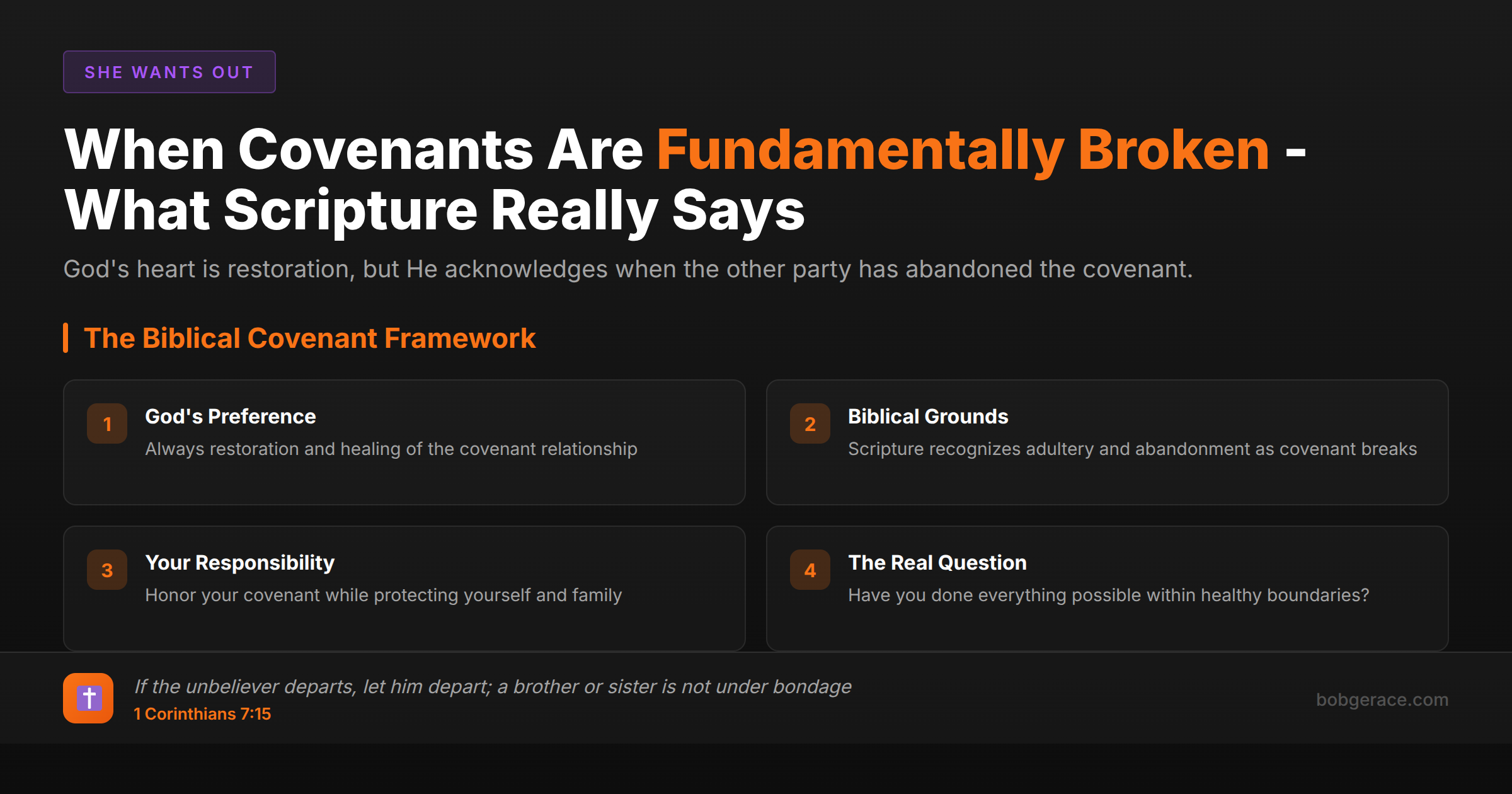
Here's the hard truth: God doesn't casually release people from covenants, but He does understand when covenants have been fundamentally broken by the other party. Scripture gives specific grounds for release - adultery and abandonment - but it's never God's preference. He's always working toward restoration first. The question you're really asking isn't whether God will release you, but whether you've done everything possible to honor your covenant while protecting yourself and your family. Many men I work with discover they've been asking the wrong question entirely. Instead of seeking release, they need to understand how to love well within boundaries, how to be faithful without being foolish, and how to trust God's timing even when their wife has already emotionally or physically left.
The Full Picture
The covenant question haunts men whose marriages are dying. You made vows before God, and you take them seriously. But when your wife has checked out emotionally, is having an affair, or has filed for divorce, you wonder if God expects you to fight for something that's already dead.
Here's what I've learned working with hundreds of men in this position:
God's heart is always toward covenant restoration, not release. He's not sitting in heaven with a rubber stamp, waiting to approve your divorce papers. But He's also not blind to abuse, adultery, or abandonment. Scripture acknowledges that sometimes covenants are broken by the other party's choices.
The mistake most men make is thinking in binary terms - either fight or flee. But there's a third option: faithful presence with wise boundaries. This means:
• Continuing to love and serve while protecting yourself from further harm • Refusing to enable destructive behavior in the name of covenant keeping • Being willing to do the hard work of change without guaranteeing your wife will respond • Understanding that covenant doesn't mean accepting abuse or infidelity
Many men discover that when they stop asking "Will God release me?" and start asking "How can I love well here?", everything changes. Not always the outcome, but always their peace and clarity about next steps.
What's Really Happening
From a therapeutic perspective, the covenant release question often masks deeper psychological needs that aren't being addressed. Men asking this question are typically experiencing what we call "moral injury" - the psychological wound that occurs when your deeply held values conflict with an impossible situation.
Research shows that individuals with strong religious commitments experience unique stress patterns when facing marital dissolution. They're caught between theological convictions and practical realities, creating what cognitive behavioral therapy identifies as a classic double-bind scenario.
The therapeutic goal isn't to provide a theological answer, but to help men process the complex emotions underneath. Often, I find three core fears driving this question:
Fear of abandoning responsibility: Many men equate covenant release with moral failure, creating shame spirals that prevent healthy decision-making.
Fear of divine punishment: Some believe that any form of marital separation will result in God's judgment or loss of spiritual standing.
Fear of uncertainty: The covenant framework provides structure and meaning. Without it, men feel adrift and directionless.
Clinically, healing begins when men can separate their identity and worth from their marital status. This doesn't minimize the importance of covenant, but it prevents the relationship outcome from becoming the sole measure of spiritual faithfulness. Men who achieve this integration typically show improved emotional regulation, decreased anxiety, and better decision-making capacity regardless of whether their marriage is restored.
What Scripture Says
Scripture speaks clearly about God's heart for covenant while acknowledging the reality of human brokenness. Let's look at what the Bible actually says:
Matthew 19:3-9 - Jesus acknowledges that Moses permitted divorce "because of the hardness of your hearts" and identifies adultery as grounds for release. This isn't God's preference, but His provision for broken situations.
1 Corinthians 7:15 - "If the unbeliever departs, let him depart; a brother or sister is not under bondage in such cases." Paul recognizes that abandonment can release the covenant obligation.
Malachi 2:16 - "For the Lord God of Israel says that He hates divorce." God's hatred of divorce stems from His love for covenant relationships, not condemnation of those caught in impossible situations.
1 Corinthians 7:10-11 - Paul distinguishes between separation (which may be necessary) and remarriage, showing that covenant thinking includes both permanence and wisdom.
Ephesians 5:25-33 - Husbands are called to love sacrificially, but this passage assumes a responsive relationship where both parties are engaged.
Hosea 1-3 - God's command to Hosea to pursue his unfaithful wife shows both the heart of covenant love and the pain of one-sided faithfulness.
The biblical pattern is clear: covenant is sacred, but God provides provisions for situations where the covenant has been fundamentally violated. The key is ensuring you've truly exhausted redemptive possibilities while protecting yourself and your family from ongoing harm.
What To Do Right Now
-
1
Seek pastoral counseling to process your specific situation through both biblical and practical lenses
-
2
Document patterns of covenant-breaking behavior (adultery, abandonment, abuse) without becoming bitter or vengeful
-
3
Establish clear boundaries that protect you while leaving room for genuine repentance and restoration
-
4
Invest in your own spiritual and emotional health regardless of your wife's choices
-
5
Consult with a Christian attorney to understand your legal rights and responsibilities
-
6
Pray specifically for wisdom to discern between God's call to patient love and His permission to seek protection
Related Questions
- How long do I wait before giving up?
- When is it actually over?
- What does faithfulness require when she won't reciprocate?
- How long did Hosea wait for Gomer?
- What is the 'stander' movement and is it biblical?
- When does standing become idolatry of the marriage?
- What does Scripture say about divorce?
- Does the Bible require me to stay after an affair?
- What's the difference between forgiveness and reconciliation?
Also find Bob on
Subscribe for weekly videos on Christian marriage.
Your Marriage Isn't a Theology Question
It's a specific situation with a real woman, real history, and real stakes. A coach who knows your story can help you see what honoring your covenant actually looks like in your case.
Talk to Bob →