What does faithfulness require when she won't reciprocate?
6 min read
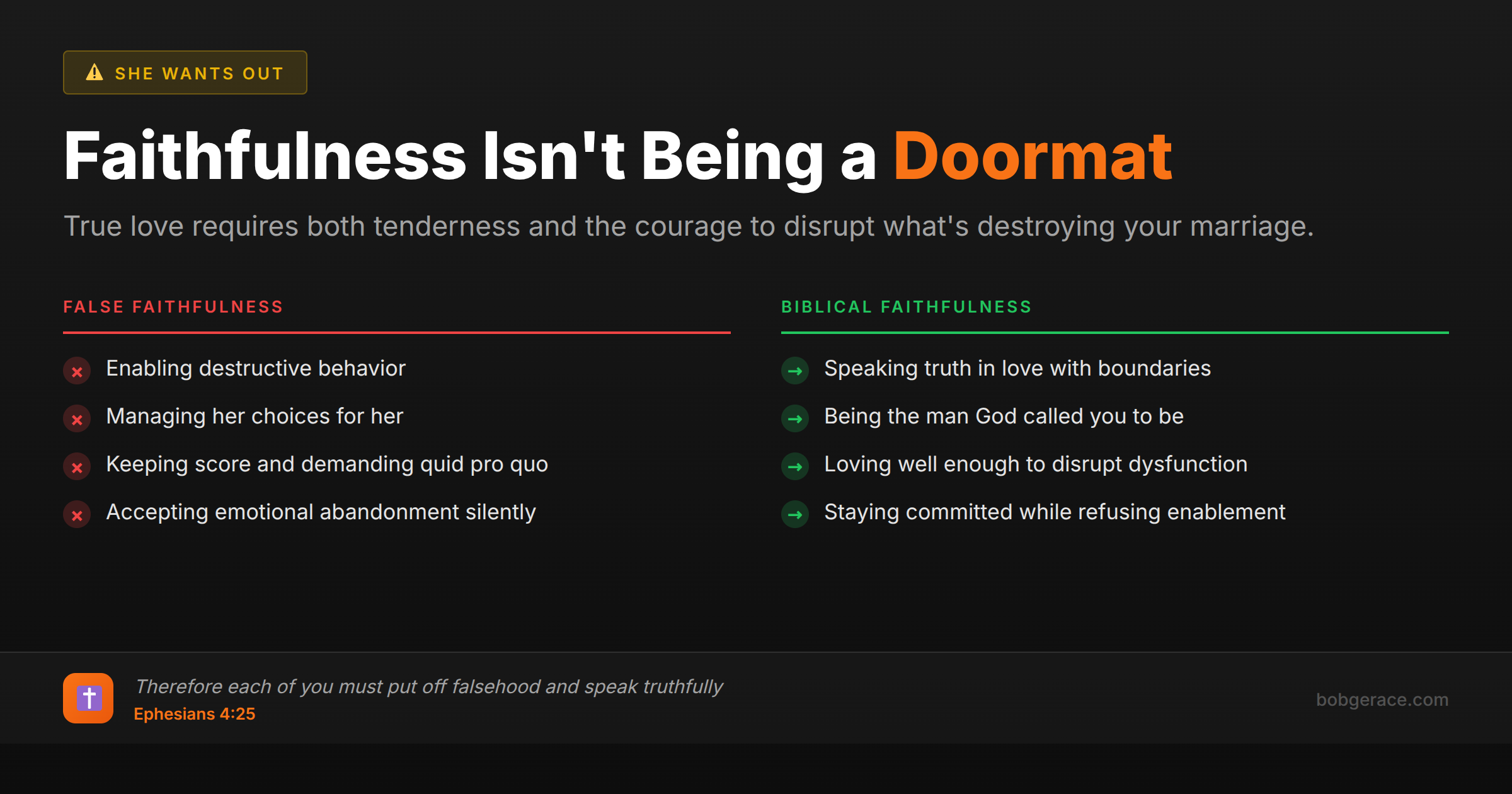
Faithfulness doesn't mean being a doormat or enabling destructive behavior. When your wife won't reciprocate, faithfulness requires you to love her enough to tell the truth, set boundaries, and stop participating in patterns that harm your marriage. True faithfulness is about being the man God called you to be - not managing her choices or outcomes. This isn't about keeping score or demanding quid pro quo. It's about understanding that biblical love is both tender and tough. You can remain committed to your marriage while refusing to enable withdrawal, contempt, or emotional abandonment. Faithfulness means loving her well enough to disrupt what isn't working, even when she doesn't appreciate it initially.
The Full Picture
Most men confuse faithfulness with passive endurance. They think being faithful means taking whatever comes, never rocking the boat, and hoping their goodness will eventually win her over. This misunderstanding keeps marriages stuck in destructive patterns.
Real faithfulness is active, not passive. It requires you to:
• Address problems directly instead of hoping they'll resolve themselves • Set clear boundaries around what you will and won't accept • Speak truth in love even when it's uncomfortable • Stop enabling her withdrawal or harmful behaviors • Model the relationship you want rather than just talking about it
The mistake many men make is thinking that if they just love harder, give more, or become perfect enough, she'll eventually come around. This creates a parent-child dynamic where you're managing her emotions and she's checking out more.
When she won't reciprocate, it often means the current system isn't working. Your faithfulness might actually require disrupting comfortable dysfunction. This could mean:
• Having difficult conversations she's been avoiding • Implementing consequences for destructive behavior • Getting outside help even if she resists • Making changes whether she participates or not
Faithfulness isn't about outcomes - it's about character and action. You can't control whether she responds, but you can control whether you're being the man your marriage needs. Sometimes the most faithful thing you can do is refuse to participate in patterns that are slowly killing your relationship.
What's Really Happening
From a therapeutic perspective, unreciprocated effort in marriage often creates what we call pursuit-distance cycles. The more one partner pursues connection, the more the other withdraws. This isn't usually conscious manipulation - it's an emotional regulation strategy.
When wives don't reciprocate, it's frequently because the current dynamic feels overwhelming or suffocating to them. Attachment theory helps us understand that some people manage emotional overwhelm by creating distance. Your increased efforts might actually trigger more withdrawal.
Research shows that differentiation - maintaining your sense of self while staying emotionally connected - is crucial for healthy relationships. Many men lose themselves trying to win their wives back, which paradoxically makes them less attractive and more anxiety-provoking to their spouses.
Gottman's research indicates that relationships need a 5:1 ratio of positive to negative interactions to thrive. However, when one person is doing all the positive work while the other remains disengaged, it creates an unsustainable imbalance that breeds resentment on both sides.
The clinical approach involves stopping ineffective patterns rather than intensifying them. This means:
• Reducing pursuit behaviors that trigger withdrawal • Focusing on self-differentiation rather than partner change • Implementing natural consequences rather than trying to convince • Building emotional regulation skills to manage anxiety
Neurologically, chronic relationship stress creates fight-flight-freeze responses that make genuine connection nearly impossible. Sometimes the most therapeutic intervention is creating enough stability and calm that both partners can access their higher brain functions again.
What Scripture Says
Scripture gives us a clear picture of faithful love that's both tender and truthful. Ephesians 4:15 tells us to speak "the truth in love," showing us that love without truth isn't really love at all.
Ephesians 5:25-28 calls husbands to "love your wives as Christ loved the church and gave himself up for her." Notice that Christ's love involved sacrifice and action, not just passive acceptance. He confronted sin, overturned tables when necessary, and spoke hard truths because He loved deeply.
Proverbs 27:5-6 reveals that "better is open rebuke than hidden love. Faithful are the wounds of a friend." Sometimes faithfulness requires saying things that wound temporarily but heal ultimately. Enabling destructive patterns isn't love - it's fear masquerading as kindness.
Matthew 18:15-17 gives us a framework for addressing problems directly. Even Jesus didn't ignore or enable bad behavior - He addressed it with increasing intensity when necessary. This principle applies to marriage relationships too.
1 Corinthians 13:4-7 describes love as patient and kind, but also notice it "does not delight in evil but rejoices with the truth." True love celebrates truth and confronts what opposes it.
Galatians 6:1-2 instructs us to "restore one another gently" while also "bearing one another's burdens." This requires active engagement, not passive endurance. You can't restore someone by enabling their destructive choices.
Biblical faithfulness means being who God called you to be regardless of how others respond. It's about character, not control. Your job is to love well, speak truth, set boundaries, and trust God with the outcomes.
What To Do Right Now
-
1
Stop trying to convince her to change and start focusing on becoming the man your marriage needs
-
2
Identify three specific behaviors you've been enabling and decide what boundaries you'll set around them
-
3
Schedule a calm conversation to address the pattern of non-reciprocation without attacking her character
-
4
Implement natural consequences for destructive behavior while expressing your continued commitment to the marriage
-
5
Develop your own interests and friendships so you're not emotionally dependent on her response
-
6
Seek wise counsel from a pastor or counselor who can help you distinguish between faithfulness and enabling
Related Questions
- How long do I wait before giving up?
- When is it actually over?
- How long should I 'stand' for my marriage?
- How do I know if I'm in denial or in faith?
- What does healthy hope look like vs. fantasy?
- When does waiting become enabling?
- What does biblical forgiveness require of me?
- How do I model grace without enabling?
- What does 'long-suffering' mean?
- How do I pursue reconciliation while refusing to participate in sin?
Also find Bob on
Subscribe for weekly videos on Christian marriage.
You Don't Have to Keep Guessing Alone
Coaching means a human who knows your marriage, your history, and where you're actually stuck. Not generic advice—calibrated to your situation.
Talk to Bob →