What is the 'stander' movement and is it biblical?
6 min read
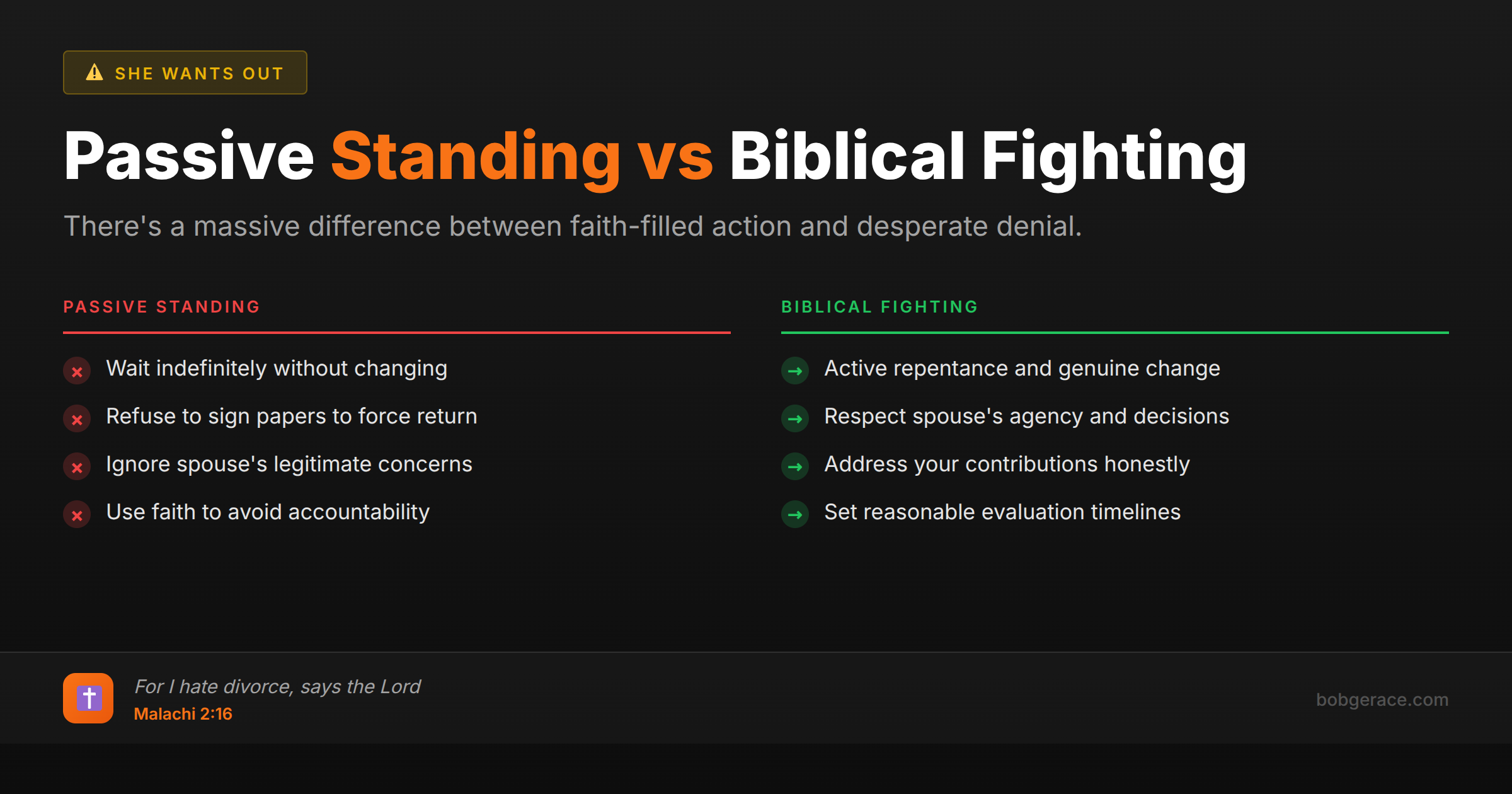
The 'stander' movement teaches that you should wait indefinitely for your spouse to return, often refusing to sign divorce papers and believing God will restore your marriage if you just have enough faith. While the heart behind it - wanting to save your marriage - is admirable, the movement often becomes a form of denial that prevents real growth and healing. Biblically speaking, yes, we should fight for our marriages. But biblical standing isn't passive waiting - it's active repentance, genuine change, and respecting your spouse's agency. When 'standing' becomes a way to avoid accountability or ignore your spouse's legitimate concerns, it's no longer biblical. It becomes manipulation disguised as faith.
The Full Picture
The 'stander' movement emerged from well-meaning Christians who wanted to fight for their marriages when divorce seemed inevitable. The core belief is that if you 'stand' for your marriage - refusing to give up, continuing to pray, and believing God for restoration - your spouse will eventually return.
The movement typically teaches: • Never agree to divorce or sign papers • Continue wearing your wedding ring • Refer to your separated/divorced spouse as your 'prodigal' • Believe that any dating or remarriage by your spouse is temporary • Wait indefinitely for God to change their heart • View any movement toward acceptance as lack of faith
Here's where it gets problematic: Many 'standers' use this theology to avoid looking at their own contributions to the marriage breakdown. They focus entirely on praying for their spouse to change while remaining unchanged themselves. This isn't biblical faith - it's spiritual bypassing.
The movement also ignores crucial realities: Your spouse has free will. God doesn't override people's choices, even in answer to prayer. When someone has clearly communicated they're done with the marriage, continuing to 'stand' can become a form of emotional harassment rather than love.
True biblical standing involves active repentance, not passive waiting. It means doing the hard work of examining your own heart, changing destructive patterns, and respecting your spouse's decision-making capacity. Sometimes the most loving thing you can do is let them go.
What's Really Happening
From a psychological perspective, the 'stander' movement often represents what we call 'anxious attachment in action.' When someone's primary attachment relationship is threatened, the natural response is to pursue and protest. The movement provides a framework that validates this pursuit indefinitely.
The psychological risks include:
Prolonged denial stages: Healthy grief processing requires moving through denial toward acceptance. The stander philosophy can keep someone stuck in denial for years, preventing emotional healing and growth.
Codependent patterns: Many standers exhibit classic codependent behaviors - trying to control outcomes they can't control, making their spouse responsible for their happiness, and avoiding self-examination by focusing entirely on the other person's 'problems.'
Trauma bonding: When someone continues to pursue a person who has clearly rejected them, it can create trauma bonding patterns that are psychologically unhealthy. The intermittent reinforcement of any positive contact creates an addictive cycle.
Impact on children: Children often suffer when a parent remains in 'stander' mode, as it prevents the family from moving toward healthy post-divorce functioning and co-parenting relationships.
Research shows that the healthiest outcomes in separation/divorce situations occur when individuals: 1) Take responsibility for their contributions, 2) Respect their spouse's autonomy, 3) Focus on their own healing and growth, and 4) Create healthy boundaries.
The most effective approach combines genuine accountability, personal growth work, and yes - sometimes fighting for the marriage. But fighting smartly, not desperately.
What Scripture Says
Scripture absolutely calls us to fight for our marriages, but it also provides a balanced framework that the stander movement often misses.
Malachi 2:16 - "'For I hate divorce,' says the Lord, the God of Israel." God's heart is clearly for marriage restoration. However, this verse is often taken out of context. The full passage is about covenant faithfulness and treating your spouse honorably.
1 Corinthians 7:10-16 gives Paul's teaching on marriage and divorce. Notably, verse 15 says, "But if the unbelieving partner separates, let it be so. In such cases the brother or sister is not enslaved." Paul acknowledges that sometimes people leave, and we're not 'enslaved' to pursue them indefinitely.
Matthew 18:15-17 provides the biblical pattern for addressing sin and broken relationships. It includes a process that culminates in 'letting them be as a Gentile and tax collector' if they refuse to listen. Even Jesus acknowledged that sometimes people won't respond to our efforts.
Ephesians 5:25-33 calls husbands to love sacrificially like Christ loved the church. But notice - Christ's love involves both pursuit AND respect for human choice. God doesn't force anyone to accept His love.
Romans 12:18 - "If possible, so far as it depends on you, live peaceably with all." The key phrase is 'so far as it depends on you.' We're responsible for our part, not theirs.
Galatians 6:1-5 teaches us to restore gently while examining ourselves and bearing our own load. True biblical standing involves deep self-examination and personal responsibility.
Biblical love sometimes means letting go. Even God, in His infinite love, allows people to walk away from Him.
What To Do Right Now
-
1
Examine your motives honestly - are you standing from faith or from fear of being alone?
-
2
Take full inventory of your contributions to the marriage problems without deflecting to your spouse's issues
-
3
Respect your spouse's clearly stated boundaries and decisions, even if you disagree with them
-
4
Focus 80% of your energy on your own healing and growth, 20% on appropriate marriage-building efforts
-
5
Set a reasonable timeline for evaluation - not giving up, but being realistic about indefinite waiting
-
6
Seek counseling to process your grief and develop healthy coping strategies beyond just 'standing and praying'
Related Questions
- How long do I wait before giving up?
- How long should I 'stand' for my marriage?
- When does standing become idolatry of the marriage?
- Does God ever release someone from a covenant?
- What's the difference between hope and presumption?
- How do I discern between my will and God's will?
- What does biblical forgiveness require of me?
- Does the Bible require me to stay after an affair?
- How do I discern God's will for my marriage?
Also find Bob on
Subscribe for weekly videos on Christian marriage.
Stop Guessing What Biblical Standing Means for Your Marriage
You need someone who knows your story—not just theology. Bob works with men navigating this exact tension: faith vs. reality, standing vs. denial. Bring your actual situation to a coach.
Talk to Bob →