How do I grieve while also fighting?
6 min read
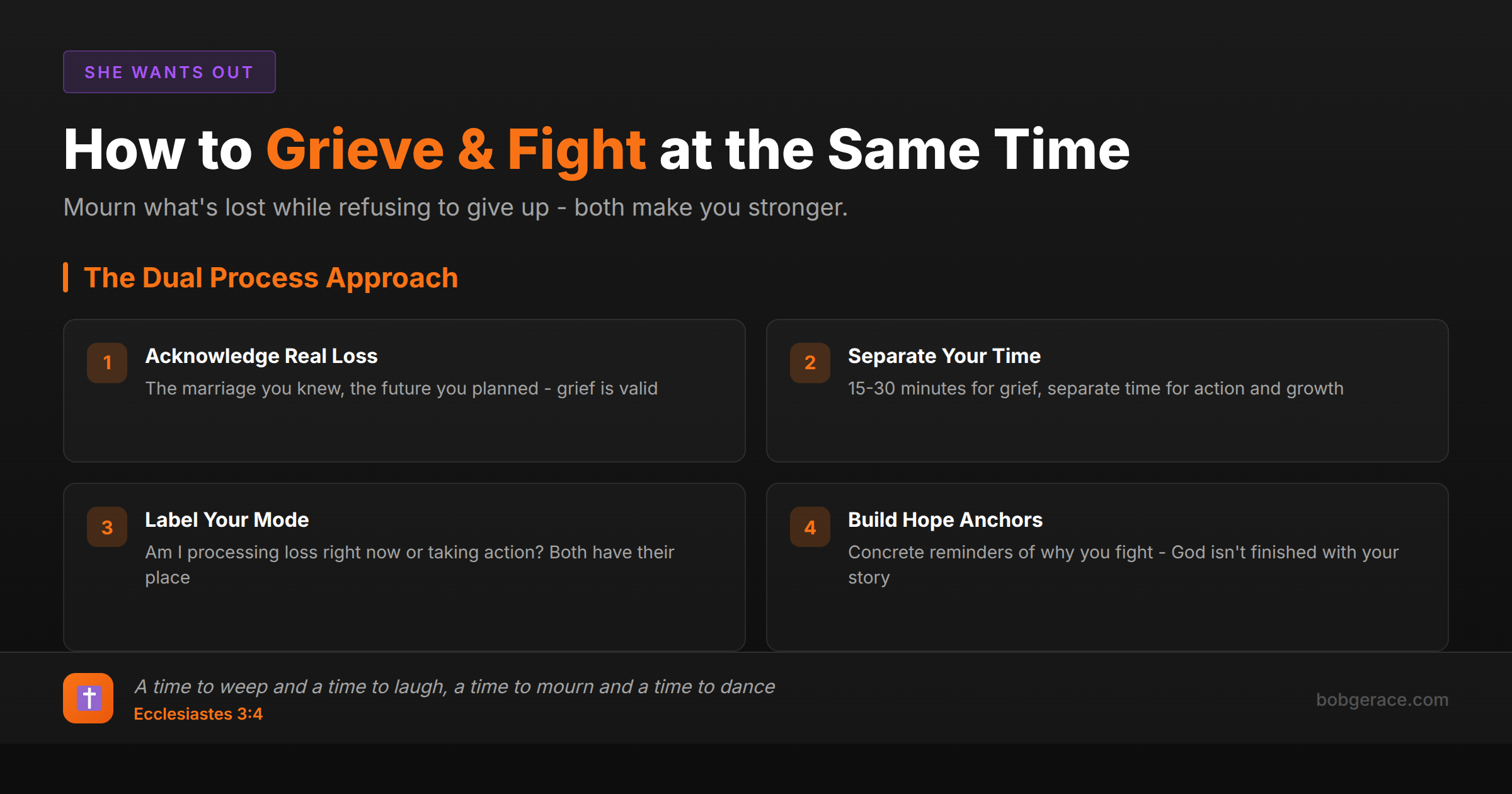
You're experiencing one of the most complex emotional challenges a man can face - mourning what feels like the death of your marriage while simultaneously refusing to let it die. This isn't contradiction; it's wisdom. You grieve because real loss has occurred - the marriage you knew, the future you planned, the woman who once loved you. But you fight because love doesn't quit, hope isn't foolish, and God isn't finished writing your story. The key is understanding that grief and hope can coexist. You can acknowledge the pain while taking action. You can mourn what's been lost while working toward restoration. This dual process actually makes you stronger, not weaker, because you're dealing with reality while refusing to accept defeat.
The Full Picture
Most men try to choose between grieving and fighting, thinking they're mutually exclusive. They either shut down emotionally to focus on strategy, or they get lost in grief and abandon all effort. Both approaches fail because they ignore the full reality of what you're experiencing.
You're grieving multiple losses simultaneously: • The wife who used to love and respect you • The intimacy and connection you once shared • Your role as protector and provider being valued • The future you planned together • Your identity as a successful husband • The security of your family unit
Meanwhile, you're fighting for multiple things: • The possibility of restoration • Your children's intact family • The covenant you made before God • The woman you know she can be again • Your own growth and transformation • Hope for a different future
The mistake most men make is thinking they need to choose. Healthy grieving actually fuels your fight. When you acknowledge and process your losses, you free up emotional energy that was trapped in denial or suppression. You become clearer about what you're truly fighting for.
Conversely, fighting gives meaning to your grief. Instead of just wallowing in loss, your pain becomes purposeful. Every tear shed becomes fuel for transformation. Every moment of heartbreak becomes motivation to become the man your marriage needs.
This process requires emotional compartmentalization - not suppression, but scheduling. You create space for grief without letting it consume your action time. You engage in the fight without pretending the losses aren't real.
What's Really Happening
From a psychological perspective, you're experiencing what we call ambiguous loss - grieving something that isn't definitively gone but has fundamentally changed. This is one of the most challenging forms of grief because there's no clear endpoint or resolution.
Research shows that dual-process coping is actually the most effective approach to grief. The Dual Process Model, developed by Stroebe and Schut, demonstrates that healthy grieving involves oscillating between loss-oriented coping (feeling and processing the pain) and restoration-oriented coping (taking action and building new patterns).
Your brain is processing this crisis on multiple levels: • The limbic system is responding to threat with fight-or-flight activation • The attachment system is simultaneously protesting the loss and seeking reconnection • The prefrontal cortex is trying to make sense of contradictory information • The stress response system is in chronic activation
This creates what I call emotional whiplash - rapid cycling between hope and despair, determination and exhaustion, love and anger. This isn't pathological; it's normal given the circumstances.
The key therapeutic insight is compartmentalization without suppression. You need dedicated time for processing grief - whether through journaling, therapy, or trusted friendships. But you also need dedicated time for strategic action and hope-building activities.
Neurologically, action creates hope by activating the brain's reward prediction pathways. When you take purposeful steps toward restoration, even small ones, your brain begins to anticipate positive outcomes. This doesn't negate the grief, but it provides neurochemical balance.
The danger is emotional fusion - when grief and action become so intertwined that you can't access either effectively. Professional support can help you navigate this separation while honoring both processes.
What Scripture Says
Scripture validates both your grief and your fight, showing us men who did exactly what you're doing now. Ecclesiastes 3:4 reminds us there is 'a time to weep and a time to laugh, a time to mourn and a time to dance' - sometimes these seasons overlap rather than follow sequentially.
Nehemiah 8:10 declares that 'the joy of the Lord is your strength,' but this came after Nehemiah wept over Jerusalem's broken walls. He grieved the destruction while simultaneously planning reconstruction. His tears fueled his determination.
Psalm 30:5 promises that 'weeping may endure for a night, but joy comes in the morning.' Notice it doesn't say weeping ends before morning comes - sometimes joy arrives while we're still wiping away tears.
Jesus himself models this dual experience. John 11:35 shows us 'Jesus wept' at Lazarus's tomb, yet He came specifically to resurrect His friend. He grieved the reality of death while actively working to reverse it. His tears didn't indicate lack of faith; they demonstrated the depth of His love.
Hosea's entire story illustrates fighting for marriage while grieving its brokenness. God commanded him to love an unfaithful wife, demonstrating how we can simultaneously mourn betrayal and pursue restoration. Hosea's pain was real; his commitment was stronger.
2 Corinthians 6:10 describes believers as 'sorrowful, yet always rejoicing' - carrying both grief and hope simultaneously. This isn't emotional schizophrenia; it's spiritual maturity that can hold tension without breaking.
Your grief honors what was precious. Your fight honors what could be again. Both responses reflect the heart of God, who grieves over broken relationships while never ceasing to pursue restoration.
What To Do Right Now
-
1
Schedule dedicated grief time daily - 15-30 minutes to feel, journal, or talk to God about your losses
-
2
Create separate action time for marriage-focused activities - reading, planning, personal growth work
-
3
Practice emotional labeling - identify whether you're in grief mode or fight mode in any given moment
-
4
Establish grief rituals - specific activities that help you process loss (walking, music, writing letters to God)
-
5
Build hope anchors - concrete reminders of why you're fighting and what restoration could look like
-
6
Connect with other men who understand both the grief and the fight - isolation amplifies both pain and hopelessness
Related Questions
- How long do I wait before giving up?
- What does self-care look like in this season?
- How do I know if I'm in denial or in faith?
- What does healthy hope look like vs. fantasy?
- What is 'closure' and do I need it to move on?
- How do I grieve a marriage that isn't dead yet?
- How do I not lose my mind right now?
- What is 'betrayal trauma' and do I have it?
- How do I pray when I'm angry at God?
- What does trauma recovery look like?
Also find Bob on
Subscribe for weekly videos on Christian marriage.
Bring Your Specific Story to Bob
Grieving while fighting isn't a formula—it's calibrated to where you are, what she's doing, and what your marriage actually needs right now. A coach sees what you can't.
Talk to Bob →