Is my desperation faith or codependency?
5 min read
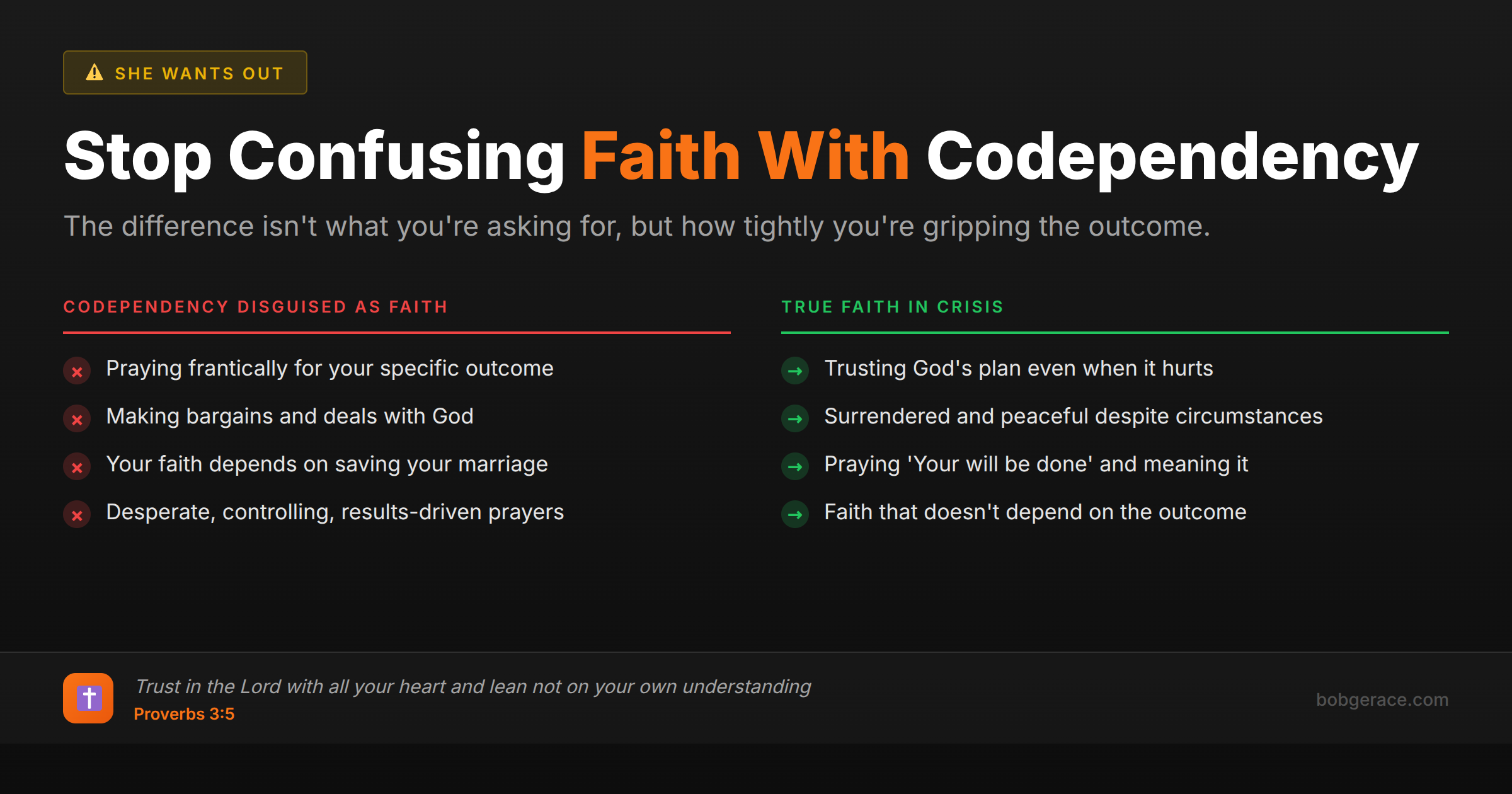
The line between faith and codependency can blur when your marriage is falling apart, but there are clear distinctions. Faith trusts God's plan even when the outcome isn't what you want - it's surrendered and peaceful despite circumstances. Codependency disguised as faith is desperate, controlling, and results-driven - you're bargaining with God for a specific outcome rather than trusting His sovereignty. If you're praying frantically, making deals with God, or feeling like your faith depends on saving your marriage, that's codependency wearing a spiritual mask. True faith says "Your will be done" and means it. Codependency says "Your will be done, but please let it be what I want." The difference isn't in what you're asking for, but in how tightly you're gripping the outcome.
The Full Picture
When your wife says she's done and your world is crashing, it's natural to turn to God. But crisis has a way of revealing whether our faith is genuine or just another form of control. Many men discover their "faith" during marriage crisis is actually desperation dressed up in spiritual language.
Codependent faith looks like: • Bargaining prayers: "God, if you save my marriage, I'll go to church every week" • Scripture as manipulation tools: Using Bible verses to convince your wife to stay • Frantic spiritual activity: Suddenly becoming "super Christian" to impress God and your spouse • Outcome-dependent trust: Your faith rises and falls with your marriage's condition • Performance-based relationship with God: Believing you can earn His favor through good behavior
Genuine faith during crisis: • Submits to God's sovereignty even when it hurts • Seeks transformation for its own sake, not to manipulate outcomes • Finds peace in uncertainty because it trusts God's character • Uses Scripture for personal growth, not as ammunition • Maintains consistency regardless of circumstances
The brutal truth: Most men start with codependent faith because we're wired to fix and control. That's not necessarily bad - it's human. But growth happens when we recognize the difference and choose to trust God's plan over our own agenda. Your marriage may or may not survive, but your relationship with God shouldn't depend on whether your wife comes back.
What's Really Happening
From a psychological standpoint, what you're experiencing is attachment system activation combined with spiritual bypass. When our primary attachment relationship (marriage) is threatened, our nervous system triggers fight, flight, or freeze responses. For many men, turning to faith becomes a form of "fawning" - desperately trying to appease both God and spouse to restore safety.
Codependency is fundamentally about external validation and control disguised as care. In religious contexts, this manifests as spiritual codependency - using faith practices to manage anxiety and control outcomes rather than for genuine spiritual growth. Research shows that anxiously attached individuals are more likely to engage in bargaining behaviors with their higher power during crisis.
The key psychological marker is locus of control. Healthy faith maintains an internal locus of control over personal choices while surrendering outcome control to God. Codependent faith desperately seeks external control through spiritual performance while feeling powerless over personal growth.
Neurologically, desperation creates tunnel vision and impaired decision-making. The prefrontal cortex goes offline, making it difficult to distinguish between genuine spiritual conviction and anxiety-driven compulsion. This is why crisis faith often feels so intense but lacks the peace that characterizes mature spirituality.
Therapeutic intervention focuses on developing distress tolerance and secure attachment to God as a stable base, rather than as another relationship to manage and manipulate. True spiritual maturity includes the ability to hold space for uncertainty while maintaining personal integrity and growth.
What Scripture Says
Scripture provides clear guidance on distinguishing between genuine faith and desperate self-reliance dressed in spiritual language.
Proverbs 3:5-6 says, "Trust in the Lord with all your heart and lean not on your own understanding; in all your ways submit to him, and he will make your paths straight." Notice it's about trusting God's wisdom over your own plans - including your plan to save your marriage at all costs.
Matthew 6:33 instructs us to "seek first his kingdom and his righteousness, and all these things will be given to you as well." This isn't a formula for getting what you want; it's about prioritizing God's purposes over your agenda. When your primary goal is becoming the man God calls you to be rather than fixing your marriage, you're operating in faith.
1 Peter 5:7 says "Cast all your anxiety on him because he cares for you." True casting means releasing control, not dumping your fears on God while still gripping tightly to outcomes. Codependency casts anxiety but retrieves it repeatedly.
James 4:3 reveals the heart issue: "When you ask, you do not receive, because you ask with wrong motives, that you may spend what you get on your pleasures." Are you asking God to save your marriage for His glory or your comfort?
Romans 8:28 promises that "in all things God works for the good of those who love him." Faith trusts this includes scenarios where your marriage doesn't survive. Codependency believes God's goodness depends on getting the outcome you want.
The biblical pattern is surrender leading to transformation, not performance leading to desired outcomes.
What To Do Right Now
-
1
Write down your specific prayers and requests about your marriage - examine whether you're trusting God's wisdom or demanding your preferred outcome
-
2
Stop using Scripture verses as ammunition to convince your wife and start using them for your own heart transformation
-
3
Practice praying "Your will be done" about your marriage and notice your internal resistance - that resistance reveals your codependency
-
4
Identify three ways you're trying to "earn" God's favor or your wife's return through spiritual performance and stop those behaviors
-
5
Set consistent spiritual disciplines (prayer, Bible reading, church attendance) regardless of your marriage situation - not to impress anyone, but for genuine growth
-
6
Find one trusted Christian mentor who will call out your codependent patterns and hold you accountable to genuine faith versus spiritual manipulation
Related Questions
- How do I pray when I can't form words?
- What's the difference between trusting God and being passive?
- How do I surrender without giving up?
- How do I know if I'm in denial or in faith?
- What does healthy hope look like vs. fantasy?
- When does standing become idolatry of the marriage?
- Why do I feel like I'm going to die if she leaves?
- What is anxious attachment and am I doing it right now?
- How do I discern between my will and God's will?
- What does it mean to love without grasping?
Also find Bob on
Subscribe for weekly videos on Christian marriage.
Your Marriage Isn't Everyone's Marriage
The line between faith and codependency shifts depending on your actual story—what she's said, what you've done, where you are today. A coach who knows your situation can tell you what's real and what's bargaining.
Talk to Bob →