Is this suffering formative or just painful?
6 min read
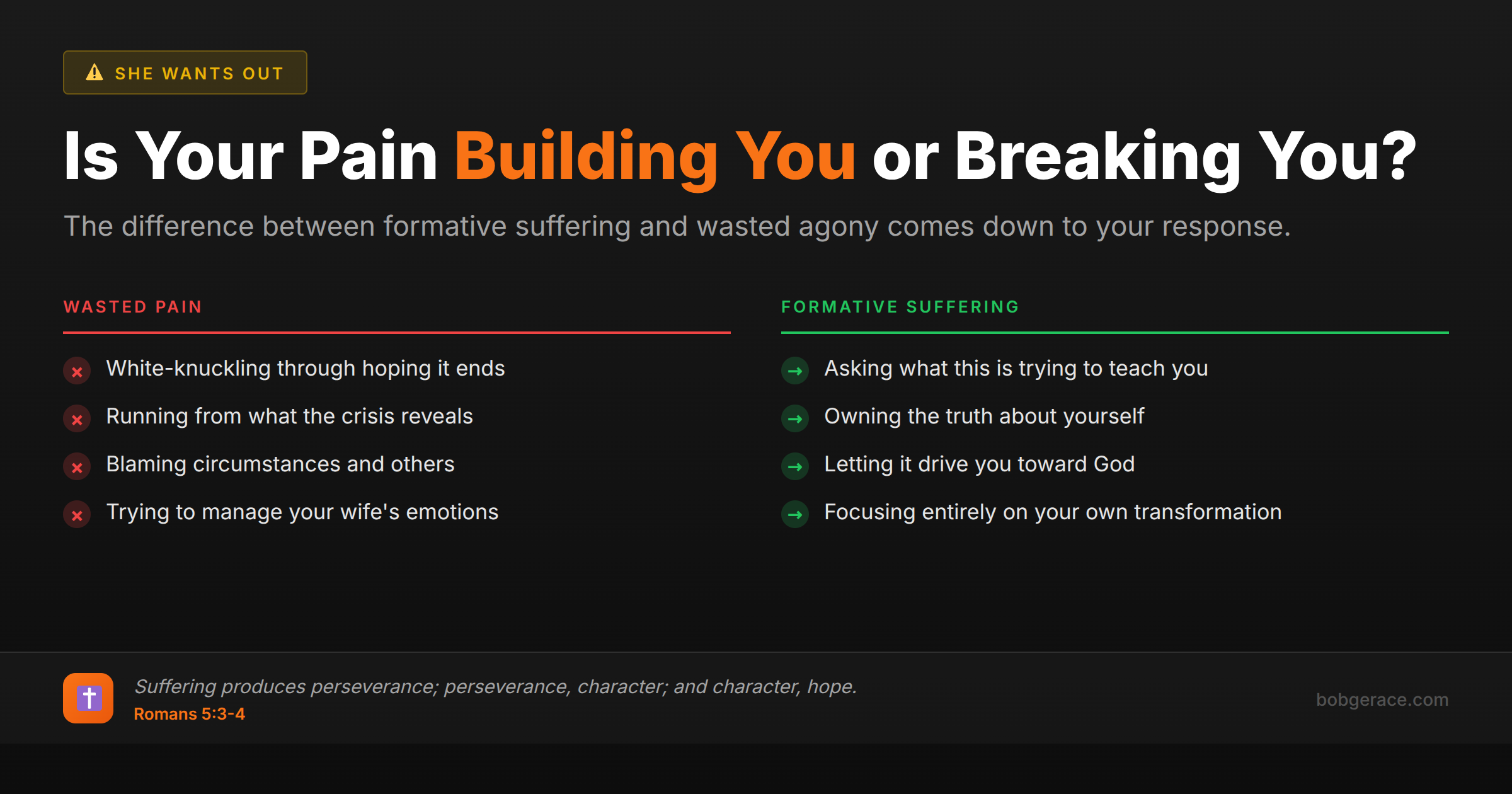
The difference between formative suffering and mere pain comes down to one thing: your response. Raw pain becomes redemptive when you stop running from it and start asking what it's trying to teach you. Right now, your marriage crisis feels like pure agony - and it is. But this same fire that's burning down everything you thought you knew about yourself can forge you into the man your wife needs and the man God designed you to be. Formative suffering has three markers: it reveals truth about yourself you couldn't see before, it drives you toward God rather than away from Him, and it produces lasting change in how you love others. If you're just white-knuckling through this hoping it ends, you're wasting the most powerful growth opportunity of your life.
The Full Picture
Every man going through marriage hell asks this question. You're lying awake at 3 AM wondering if this nightmare serves any purpose or if you're just being tortured for no reason. Here's the brutal truth: suffering doesn't automatically make you better. Plenty of men go through marriage crises and come out more bitter, defensive, and disconnected than before.
The difference isn't in what happens to you - it's in what you do with what happens to you. Formative suffering transforms you because you engage with it intentionally. You stop asking "Why me?" and start asking "What now?" You quit trying to manage your wife's emotions and start examining your own heart.
Common signs your suffering is becoming formative: • You're seeing patterns in your behavior you were blind to before • You're taking responsibility instead of keeping score • You're drawing closer to God instead of questioning His goodness • You're developing empathy for your wife's pain, not just your own • You're making real changes, not just promising to try harder
Warning signs you're stuck in destructive pain: • You're focused on how unfair everything is • You're waiting for your wife to appreciate your efforts • You're angry at God for allowing this • You're trying to fix everything except yourself • You keep doing the same things while expecting different results
The brutal reality is that your marriage crisis is going to hurt either way. The question is whether you'll let it break you open or just break you down. Formative suffering requires you to stay present with the pain instead of numbing it, escaping it, or trying to shortcut through it.
What's Really Happening
From a psychological standpoint, the distinction between formative and destructive suffering lies in what we call post-traumatic growth versus post-traumatic stress. Both are responses to crisis, but they lead to completely different outcomes.
Post-traumatic growth occurs when individuals develop greater resilience, deeper relationships, enhanced personal strength, spiritual development, and appreciation for life following adversity. This happens through what psychologists call meaning-making - the active process of finding purpose and significance in painful experiences.
Research shows that men who experience relationship trauma and emerge stronger share common cognitive patterns. They practice cognitive flexibility - the ability to reframe situations and find multiple perspectives. They engage in deliberate rumination rather than intrusive rumination, meaning they intentionally process their experiences rather than getting stuck in repetitive, negative thought loops.
The neurological reality is that crisis literally rewires your brain. Chronic stress can strengthen neural pathways associated with fear, defensiveness, and reactivity. However, intentional practices during crisis can strengthen pathways associated with emotional regulation, empathy, and problem-solving.
Key therapeutic principles for transformative suffering: • Acceptance before action - You must fully acknowledge reality before you can change it • Values-based responding - Making choices based on your deepest values, not your immediate emotions • Narrative reconstruction - Rewriting your story from victim to protagonist • Embodied processing - Working through trauma in your body, not just your mind
The men who transform through marital crisis don't bypass the pain - they metabolize it. They use therapeutic tools, spiritual practices, and community support to convert raw suffering into wisdom, compassion, and strength.
What Scripture Says
Scripture is unflinchingly honest about suffering's purpose. Romans 5:3-4 tells us, "We also glory in our sufferings, because we know that suffering produces perseverance; perseverance, character; and character, hope." Notice the progression - suffering doesn't automatically produce character. It produces perseverance first, which then develops character.
James 1:2-4 reinforces this: "Consider it pure joy, my brothers and sisters, whenever you face trials of many kinds, because you know that the testing of your faith produces perseverance. Let perseverance finish its work so that you may be mature and complete, not lacking anything." The key phrase is "let perseverance finish its work." Most men quit before the transformation is complete.
Hebrews 12:11 provides the clearest framework: "No discipline seems pleasant at the time, but painful. Later on, however, it produces a harvest of righteousness and peace for those who have been trained by it." Your marriage crisis is training you - but only if you submit to the training rather than fighting it.
2 Corinthians 1:3-4 reveals suffering's ultimate purpose: "Praise be to the God and Father of our Lord Jesus Christ, the Father of compassion and the God of all comfort, who comforts us in all our troubles, so that we can comfort those in any trouble with the comfort we ourselves receive from God." Your pain isn't just about you - it's preparing you to help others.
1 Peter 4:12-13 warns us not to be surprised by suffering but to "rejoice inasmuch as you participate in the sufferings of Christ, so that you may be overjoyed when his glory is revealed." This isn't masochistic - it's recognizing that transformation requires crucifixion of your old self.
The biblical pattern is clear: suffering becomes redemptive when you stop resisting God's work through it and start cooperating with His purposes in it.
What To Do Right Now
-
1
Write down three specific ways this crisis has already revealed truth about yourself you couldn't see before
-
2
Identify one destructive pattern in your marriage you're now willing to own completely, without blame-shifting
-
3
Schedule 20 minutes daily for prayer or meditation, specifically asking God what He wants to teach you through this
-
4
Find one person who's been through marriage restoration and ask them how suffering transformed them
-
5
Stop trying to manage your wife's emotions and focus entirely on your own heart transformation for the next 30 days
-
6
Create a "growth journal" where you document lessons learned and character changes, reviewing it weekly
Related Questions
- How does the Spirit actually change a person?
- What's the relationship between human effort and divine transformation?
- What can I learn from this crisis?
- How do I grow regardless of outcome?
- What might I discover through this pain?
- What is the purpose of pain in God's economy?
- Why does God allow marital suffering?
- Is my suffering redemptive?
- What is 'post-traumatic growth'?
Also find Bob on
Subscribe for weekly videos on Christian marriage.
Don't waste this pain alone
You're asking the right question. But turning suffering into formation requires someone who knows your specific marriage, not just the concept. Bob works with men in exactly this spot.
Talk to Bob →