Kids are caught in the middle — how do I protect them?
6 min read
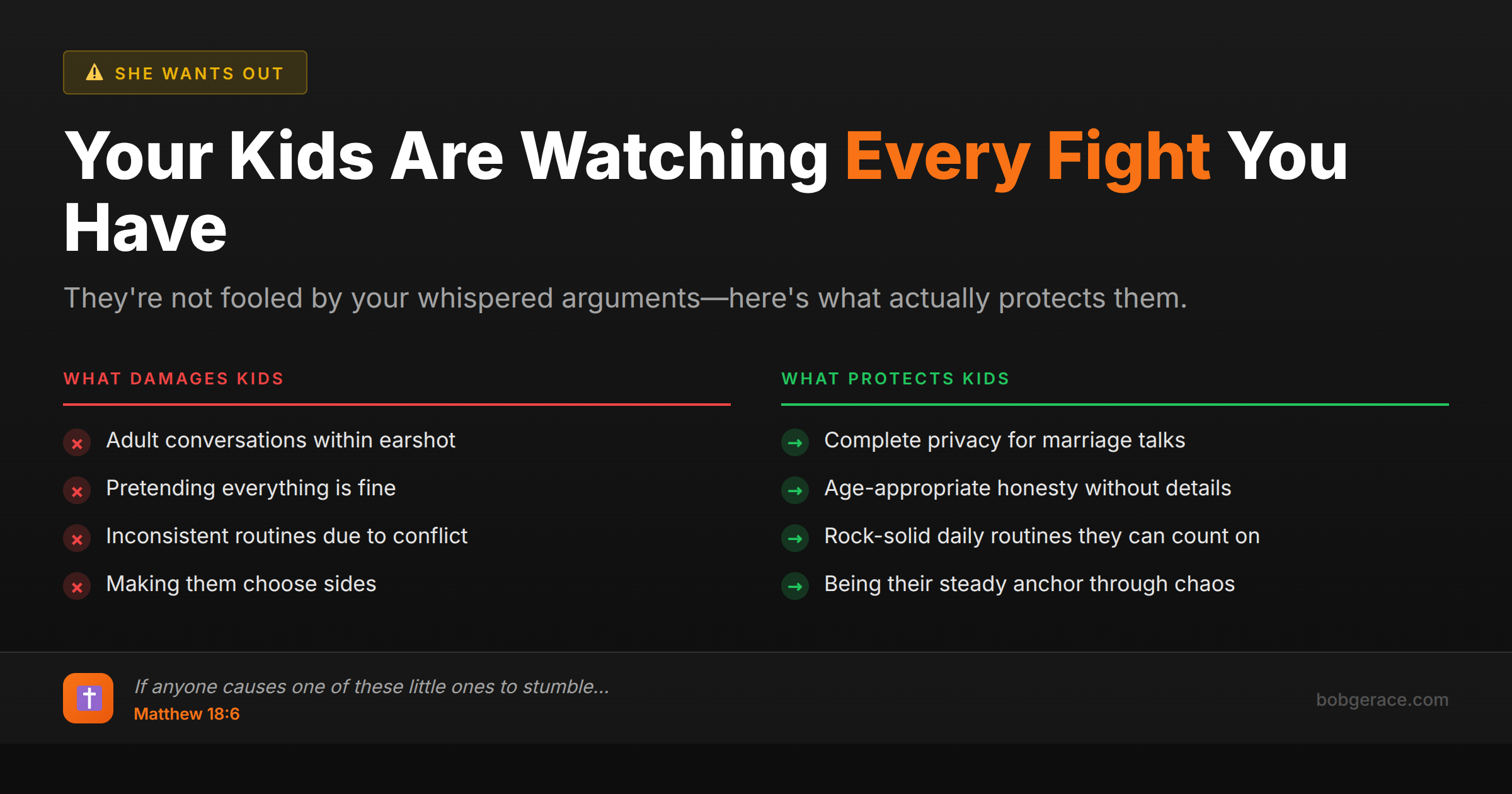
Your children's emotional safety depends entirely on how you and your wife handle this crisis. Right now, they're watching everything—your tone, your stress, your fights—and internalizing it as their fault or their future. The harsh truth? Most parents think they're hiding the conflict better than they are. Protecting your kids isn't about pretending everything's fine—they already know it's not. It's about creating predictable safety zones where they can just be kids. This means no adult conversations within earshot, consistent routines they can count on, and age-appropriate honesty that doesn't burden them with details they can't process. Your job is to be their steady anchor while everything else feels unstable.
The Full Picture
Children are like emotional sponges during marital crisis—they absorb tension, fear, and instability even when parents think they're being discreet. The biggest mistake parents make is underestimating what their kids already know and feel.
Your children are likely experiencing:
• Hypervigilance - constantly scanning for signs of conflict or change • Self-blame - wondering if they caused the problems between mom and dad • Loyalty conflicts - feeling torn between choosing sides • Future anxiety - worrying about divorce, moving, or family breakup • Emotional dysregulation - acting out, withdrawing, or regressing in behavior
The protection they need isn't from knowledge that something's wrong—it's from the adult burden of trying to fix it, understand it, or choose sides. Children need to remain children, not become mediators, messengers, or emotional support systems for struggling parents.
Consider 8-year-old Jake, whose parents thought they were "protecting" him by having heated discussions after bedtime. Jake started having nightmares and refusing to go to school. When they moved their conversations completely outside the home and established predictable bedtime routines, his anxiety decreased significantly.
The goal isn't perfect parents or a perfect marriage—it's consistent, predictable safety where children can trust that the adults are handling adult problems. Your kids need to know that whatever happens between you and your wife, they will always be loved, provided for, and protected.
What's Really Happening
From a developmental perspective, children experiencing parental conflict show measurable increases in cortisol levels—the stress hormone that impacts learning, sleep, and emotional regulation. Research from the University of Rochester demonstrates that children as young as 6 months can detect and respond to interparental conflict with increased distress behaviors.
The concept of 'triangulation' is critical here. When parents involve children in their conflict—whether through seeking alliance, sharing inappropriate details, or using them as messengers—children develop what we call 'parentification.' They begin taking responsibility for adult emotions and relationships, which disrupts normal cognitive and emotional development.
Neurologically, chronic stress from family conflict impacts the developing brain's ability to form secure attachments and regulate emotions. The amygdala becomes hyperactive while the prefrontal cortex—responsible for executive function—remains underdeveloped. This manifests as behavioral problems, academic struggles, and difficulty with peer relationships.
However, children are remarkably resilient when provided with consistent emotional safety. Studies show that children who experience family crisis but maintain predictable routines, clear boundaries, and age-appropriate communication actually develop stronger coping mechanisms long-term.
The key protective factor isn't the absence of family stress—it's the presence of at least one emotionally regulated adult who maintains consistent, nurturing connection with the child throughout the crisis. This creates what attachment theorists call a 'secure base' from which children can navigate uncertainty.
What Scripture Says
Scripture places the protection of children at the heart of godly parenting, especially during difficult seasons. Deuteronomy 6:7 instructs us: "Impress them on your children. Talk about them when you sit at home and when you walk along the road, when you lie down and when you get up." This speaks to creating consistent, safe spaces for connection and guidance.
Matthew 18:6 offers a sobering warning: "If anyone causes one of these little ones—those who believe in me—to stumble, it would be better for them to have a large millstone hung around their neck and to be drowned in the depths of the sea." While speaking specifically about faith, this principle applies to any harm we might cause children through our actions or neglect.
Psalm 127:3 reminds us that "Children are a heritage from the Lord, offspring a reward from him." Even in crisis, our children remain God's gifts entrusted to our care. Our conflicts with our spouse don't change our fundamental responsibility to shepherd their hearts.
Ephesians 6:4 provides practical guidance: "Fathers, do not exasperate your children; instead, bring them up in the training and instruction of the Lord." During marital crisis, it's easy to become so consumed with conflict that we inadvertently burden or frustrate our children with adult stress.
Proverbs 22:6 encourages us to "Start children off on the way they should go, and even when they are old they will not turn from it." The way we handle family crisis teaches our children how to navigate future difficulties. We're modeling either anxiety and conflict or faith and perseverance.
Protecting our children reflects God's heart for the vulnerable and demonstrates trust that He can work even through family struggles for their ultimate good.
What To Do Right Now
-
1
Create a 'no adult conversation' rule when children are present—move all marriage discussions completely out of their hearing range
-
2
Establish consistent daily routines (meals, bedtime, activities) that remain stable regardless of marital tension
-
3
Have an age-appropriate conversation acknowledging that mom and dad are working through some difficulties but reassuring them it's not their fault
-
4
Designate specific one-on-one time with each child weekly where you focus entirely on their interests and needs
-
5
Remove children completely from any role as messenger, mediator, or confidant regarding marital issues
-
6
Connect with their teachers or school counselors to ensure they have additional support and monitoring outside the home
Related Questions
- How do I tell the kids?
- What do I say when kids ask what's happening?
- How do I co-parent during this?
- What are signs my kids are struggling?
- How do I be a good dad through this?
- What do kids need most from dad during divorce?
- How do I not lose my mind right now?
- What does self-care look like in this season?
- How do I regulate my own system?
- How do I model Christ to my kids in this?
Also find Bob on
Subscribe for weekly videos on Christian marriage.
Your Kids Need a Coach in Your Corner
Protecting your children means getting your own marriage right—and that's hard to do alone when you're in it. A coach who knows your specific situation helps you see what you can't see and stay steady when it matters most.
Talk to Bob →