She's been unhappy for years — is it too late?
6 min read
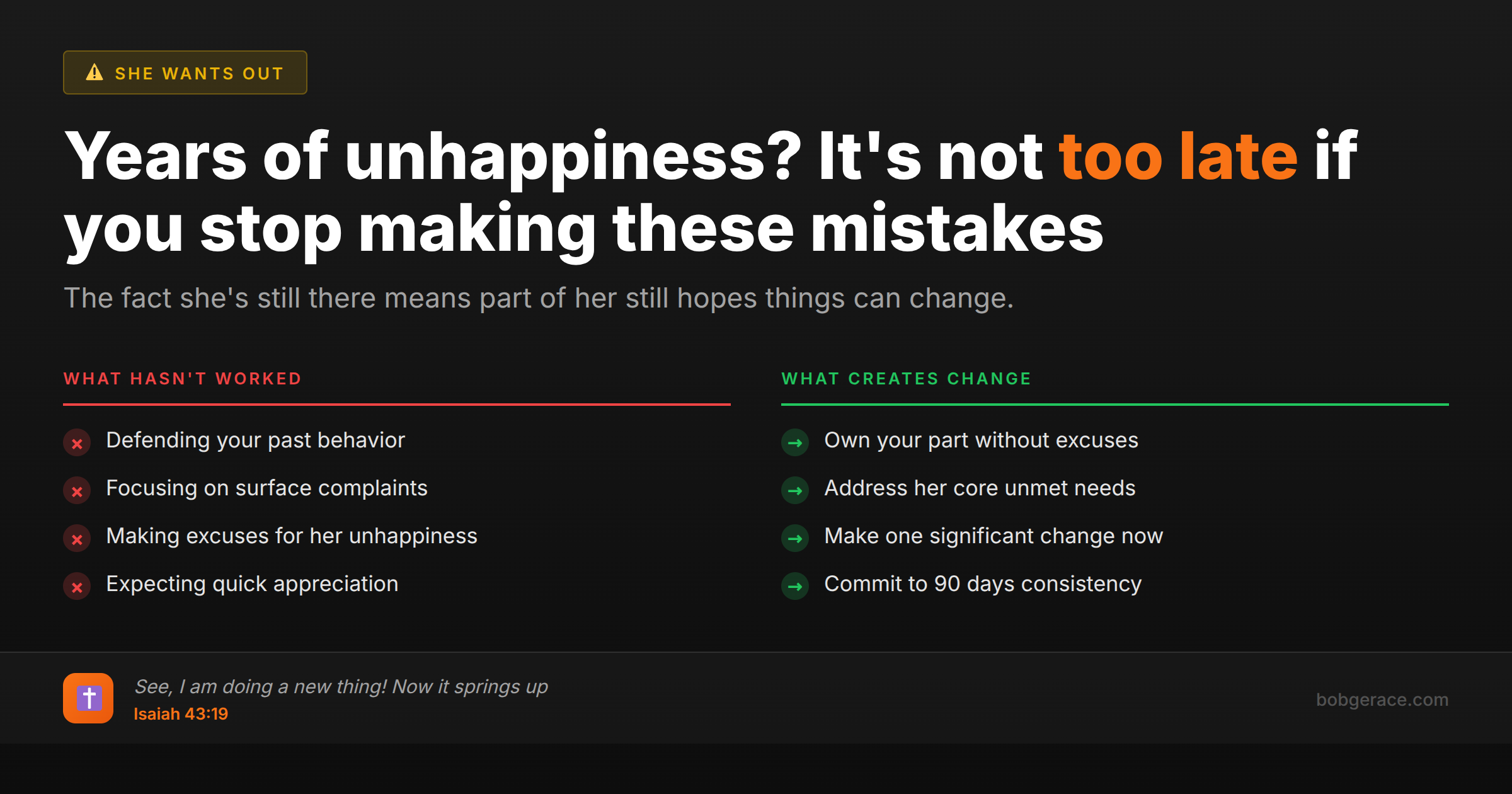
No, it's not too late—but the window is closing, and you need to act differently than you have been. I've seen marriages restored after decades of unhappiness, but only when the husband stopped doing what wasn't working and started doing what actually creates change. The fact that she's been unhappy for years tells me two things: first, you've been trying to fix this the wrong way, and second, she's still there, which means part of her still hopes things can change. Years of unhappiness create deep patterns, but they also create opportunity for dramatic transformation when you finally address the root issues instead of the symptoms.
The Full Picture
When a wife has been unhappy for years, most husbands make the same critical mistake: they focus on how long she's been unhappy instead of why she became unhappy in the first place. The timeline feels overwhelming, but it's actually irrelevant to your success.
Here's what years of unhappiness really means:
• She's given you multiple chances - Women don't stay unhappy for years without trying to communicate their needs. She's likely brought up the same issues repeatedly, in different ways, hoping you'd finally hear her.
• The problems have compounded - What started as specific issues have now become character judgments. She's moved from "He doesn't listen to me" to "He doesn't care about me" to "He'll never change."
• Her emotional resources are depleted - Years of unmet needs create emotional exhaustion. She's not just unhappy about current issues—she's grieving the marriage she thought she'd have.
• Patterns are deeply entrenched - Both of you have developed ways of interacting that reinforce the problems. You've created a negative cycle that feeds on itself.
But here's what gives me hope: marriages that have been struggling for years often have the most dramatic transformations. When you've hit bottom, there's nowhere to go but up. The wife who's been unhappy for years often has the strongest positive response when she finally sees real, sustained change—because she knows how rare and valuable that change is.
The key is understanding that you can't gradually improve your way out of this. Years of unhappiness require a complete reset, not minor adjustments.
What's Really Happening
From a clinical perspective, chronic marital unhappiness creates what we call "negative sentiment override"—a state where even positive actions from a spouse are interpreted through a negative lens. This isn't stubbornness; it's a protective psychological mechanism.
When someone experiences years of unmet emotional needs, their brain literally rewires to expect disappointment. The neural pathways associated with hope and trust become weakened, while those connected to vigilance and self-protection strengthen. This is why small gestures often feel meaningless to a chronically unhappy spouse—their nervous system has adapted to expect these efforts to be temporary.
However, research from the Gottman Institute shows that even marriages in negative sentiment override can be restored through consistent, sustained changes in interaction patterns. The key is what Dr. John Gottman calls "turning toward" rather than "turning away" from your partner's emotional bids for connection.
The timeline actually works in your favor once real change begins. A spouse who has experienced years of disappointment has a heightened sensitivity to authentic transformation. They become experts at detecting whether change is genuine or performative. This means that when they finally recognize real change, their response is often profound and lasting.
The neuroplasticity research tells us that new neural pathways can form at any age, but they require consistent repetition over time—typically 90-120 days for new patterns to become automatic. This is why marriage restoration after chronic unhappiness requires sustained effort, but the results can be transformative.
What Scripture Says
Scripture speaks directly to the power of transformation, regardless of how long problems have persisted. Isaiah 43:18-19 declares, "Forget the former things; do not dwell on the past. See, I am doing a new thing! Now it springs up; do you not perceive it? I am making a way in the wilderness and streams in the wasteland."
God specializes in making new things from old, broken situations. 2 Corinthians 5:17 reminds us, "Therefore, if anyone is in Christ, the new creation has come: The old has gone, the new is here!" This isn't just about individual salvation—it's about the transforming power available in every area of life, including marriage.
Ezekiel 36:26 speaks to heart transformation: "I will give you a new heart and put a new spirit in you; I will remove from you your heart of stone and give you a heart of flesh." Years of unhappiness can create hearts of stone—both yours and hers. But God's power can soften what seems permanently hardened.
The parable in Matthew 20:1-16 shows workers hired at different hours of the day receiving the same reward. The timing of when you start doing marriage right doesn't diminish the value of the outcome. Ecclesiastes 3:1 teaches us, "To every thing there is a season, and a time to every purpose under heaven."
Romans 8:28 provides hope: "And we know that in all things God works for the good of those who love him, who have been called according to his purpose." Even years of marital struggle can be redeemed and used for good when surrendered to God's transforming power.
The question isn't whether it's too late—it's whether you're ready to let God do a new thing in your marriage.
What To Do Right Now
-
1
Stop defending the past and own your part in her years of unhappiness without making excuses
-
2
Identify the core unmet needs she's been expressing (often safety, value, and connection) rather than focusing on surface complaints
-
3
Make one significant change immediately that addresses her deepest concern, not what you think should matter most
-
4
Commit to 90 days of consistent new behavior without expecting her to respond positively or give you credit
-
5
Get professional help from someone who specializes in marriage restoration, not general counseling
-
6
Document your changes daily to maintain accountability and track progress during her inevitable testing period
Related Questions
- When is it actually over?
- Is there a point of no return?
- How long do I wait before giving up?
- What percentage of marriages recover from this point?
- What factors predict successful reconciliation?
- We've tried before and failed — is this time different?
- She brings up things from years ago
- How do I address years of built-up hurt?
- What is 'accumulated resentment'?
- Can old attachment injuries be healed?
Also find Bob on
Subscribe for weekly videos on Christian marriage.
Your Marriage Needs a Different Strategy
Years of the same approach got you here. A coach who knows your specific situation can show you what needs to change in the next 30 days.
Talk to Bob →