What do I concede vs. what do I hold firm on?
5 min read
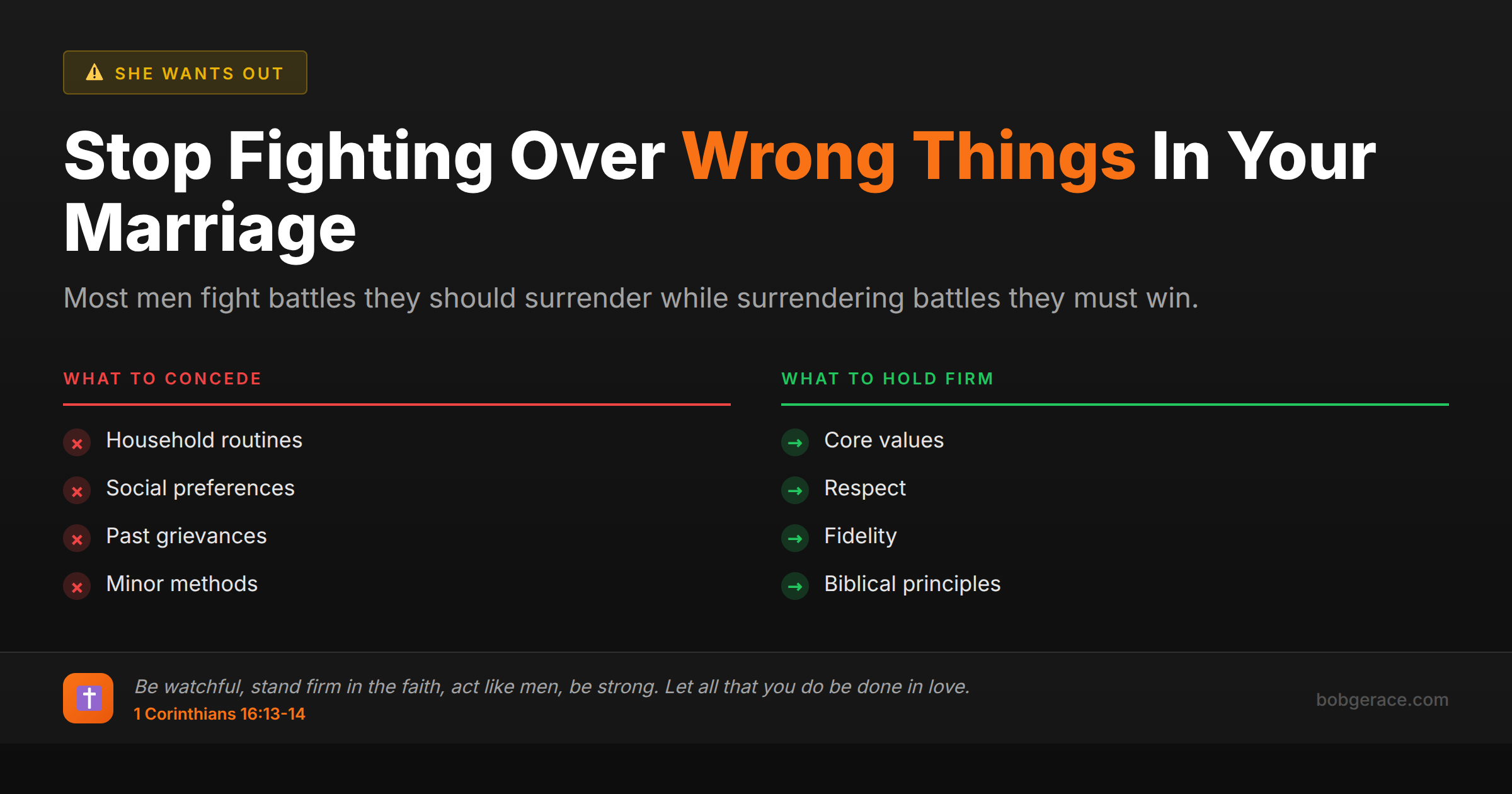
Here's the truth: you need to hold firm on your core values and non-negotiables while being flexible on preferences and methods. Hold firm on respect, fidelity, and your commitment to the marriage. Don't compromise on fundamental biblical principles or enable destructive behavior. But concede on things like household routines, social preferences, or past grievances that don't threaten the marriage foundation. The key is distinguishing between principles and preferences. Your principles are your anchor - they keep you grounded and earn respect. Your flexibility on preferences shows you're reasonable and willing to work together. Most men get this backwards, fighting over small stuff while compromising on what actually matters.
The Full Picture
When your wife is already acting out or pulling away, every decision feels loaded. You're walking a tightrope between being too rigid and being a pushover. Here's what most men miss: strategic concession isn't weakness - it's wisdom.
What to hold firm on: • Respect and basic decency - You don't accept abuse, contempt, or being treated like garbage • Fidelity and commitment - Zero tolerance for affairs or exit planning behind your back • Your core values - Faith, integrity, and what makes you who you are • Healthy boundaries - What you will and won't tolerate in your home • Your role as husband and father - You don't abdicate responsibility or authority
What you can concede on: • Past mistakes - Stop relitigating old arguments and grievances • Preferences and methods - How things get done matters less than that they get done • Control over her choices - You can't force her responses, only influence them • Timeline and pace - Healing happens on God's timeline, not yours • Secondary issues - Don't die on every hill; pick your battles wisely
The mistake most men make is fighting tooth and nail over trivial stuff while slowly giving ground on what actually matters. They'll argue for an hour about the dishwasher but say nothing when she speaks to them with contempt. Reverse this pattern. Be gracious and flexible on small things, unmovable on big ones.
What's Really Happening
From a therapeutic perspective, this question reveals a man trying to regain control in a relationship that feels chaotic. The challenge is that rigid control often pushes a disconnected spouse further away, while complete capitulation erodes respect and attraction.
Research in relationship dynamics shows that differentiation - the ability to maintain your sense of self while staying emotionally connected - is crucial for healthy relationships. When you hold firm on core values, you're demonstrating differentiation. When you concede on preferences, you're showing flexibility and emotional maturity.
What's happening psychologically is that your wife is testing boundaries. She may be unconsciously checking whether you'll maintain your integrity under pressure or collapse into either rigidity or people-pleasing. Both extremes signal emotional instability.
The concept of strategic accommodation suggests that healthy relationships require both partners to make strategic concessions that serve the greater good of the relationship, while maintaining individual identity and core values. This isn't about winning or losing - it's about creating an environment where both people can thrive.
Neurologically, when we feel threatened (as you likely do now), our brains default to fight-or-flight responses. This makes us either overly defensive about everything or completely submissive. Neither response builds attraction or respect. The goal is to engage your prefrontal cortex - the part that can think strategically about what truly matters versus what's just ego or habit.
What Scripture Says
Scripture gives us clear guidance on this tension between standing firm and showing grace. Ephesians 4:15 tells us to speak "the truth in love" - holding firm on truth while delivering it with grace and love.
1 Corinthians 16:13-14 says "Be watchful, stand firm in the faith, act like men, be strong. Let all that you do be done in love." Notice the balance: stand firm AND act in love. Your strength isn't proven by being inflexible on everything.
Matthew 5:37 reminds us "Let your yes be yes and your no be no." When you say no to something that violates your core values, mean it. When you say yes to reasonable requests, follow through. Your word needs to be reliable.
Proverbs 27:5-6 says "Better is open rebuke than hidden love. Faithful are the wounds of a friend." Sometimes love requires holding firm and saying difficult truths. But notice it's about faithfulness, not control.
1 Peter 3:7 instructs husbands to live with their wives "in an understanding way." This means being wise about what battles to fight. Understanding when to hold firm and when to yield shows spiritual maturity.
Philippians 2:3-4 calls us to "do nothing from selfish ambition" but to "look not only to your own interests, but also to the interests of others." Your firmness should serve the marriage, not just your ego. Your concessions should build the relationship, not enable destruction.
What To Do Right Now
-
1
Write down your top 5 non-negotiable values and principles - these are your hills to die on
-
2
List 10 things you've been fighting about and categorize them as 'principle' or 'preference'
-
3
Stop arguing about anything in the 'preference' category starting today
-
4
Choose one core boundary you've been neglecting and calmly but firmly reestablish it
-
5
Apologize for any past rigidity on minor issues while reaffirming your commitment to core values
-
6
Practice saying 'You're right' or 'That works for me' on small decisions to build goodwill
Related Questions
- Should I contest or cooperate?
- How do I protect assets without being aggressive?
- How do I respond to divorce papers?
- What leverage do I have and should I use it?
- When does legal strategy serve reconciliation vs. destroy it?
- How do I slow the process without obstructing?
- What is a boundary vs. an ultimatum?
- What boundaries are non-negotiable?
- How do I enforce without controlling?
- What's the difference between forgiveness and trust?
Also find Bob on
Subscribe for weekly videos on Christian marriage.
Not Sure Where Your Line Is?
A coach who knows your marriage can tell you what you're giving away vs. what you're protecting. You don't have to guess this alone.
Talk to Bob →