Should I contest or cooperate?
5 min read
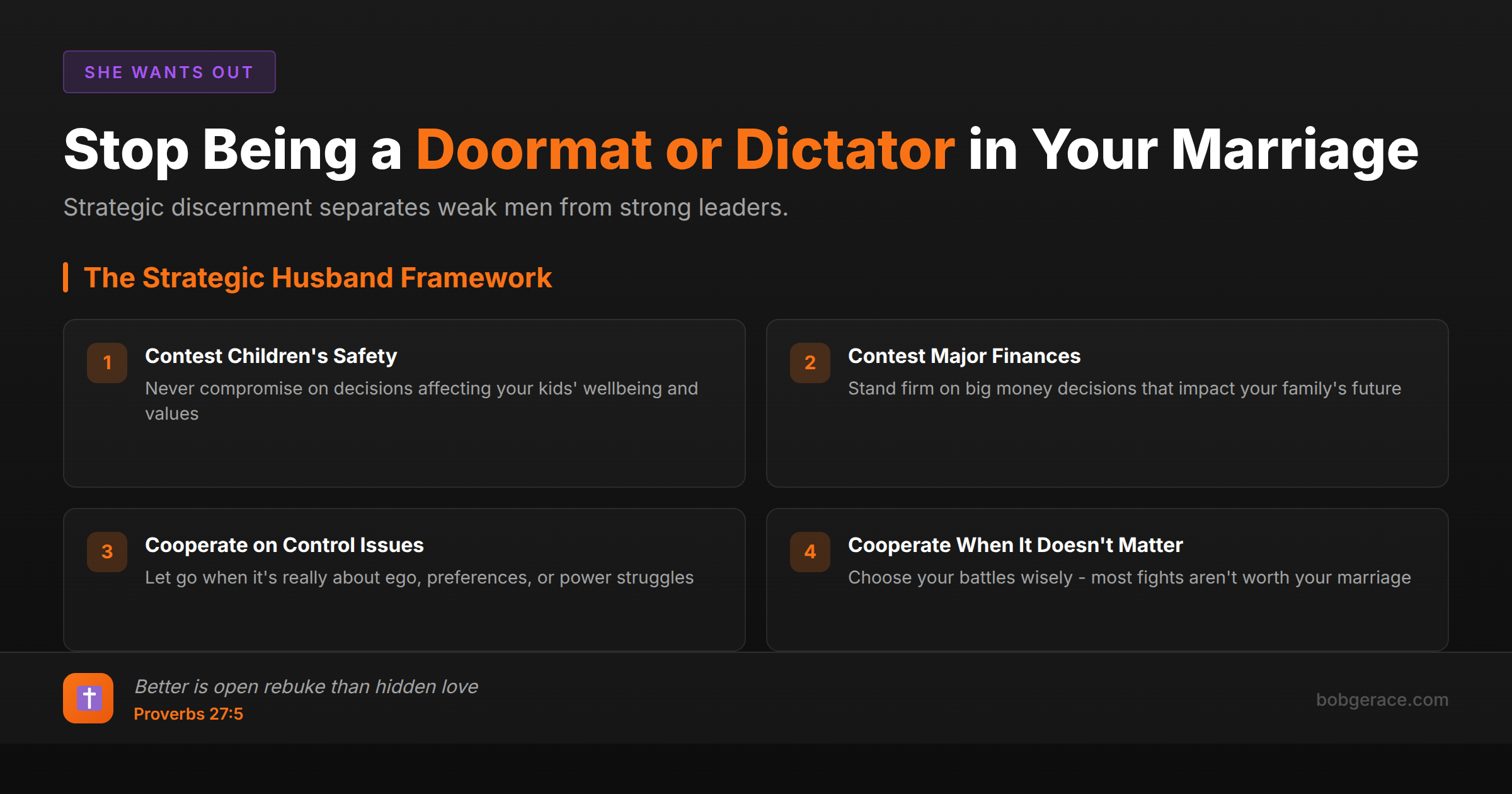
The answer depends entirely on what you're fighting about and what you're trying to accomplish. Contesting every decision makes you an adversary. Cooperating with everything makes you a doormat. The key is strategic discernment. Contest when it involves your children's wellbeing, major financial decisions, or situations that compromise your core values. Cooperate when the issue is about control, ego, or things that ultimately don't matter for your marriage's survival. Most men get this backwards - they fight over small things and cave on big ones. Here's the truth: your wife is watching how you respond more than what you're responding to. She needs to see a man who can stand firm when it matters but also has the wisdom to let things go. That's not weakness - that's strength under control.
The Full Picture
When your marriage is in crisis, every interaction feels like a potential battle. Your wife says she wants space - do you give it or fight for connection? She makes unilateral decisions about money, kids, or social plans - do you assert your voice or go along to keep peace?
Here's what most men miss: this isn't really about the individual decisions. It's about demonstrating the kind of man you are and the kind of marriage you want to build.
Contest when: • Children's safety or wellbeing is at stake - This is non-negotiable territory • Major financial decisions affect your family's security - Joint assets require joint decisions • Your core values or integrity are being compromised - Some hills are worth dying on • Legal or long-term consequences are involved - Divorce papers, custody arrangements, major contracts
Cooperate when: • The issue is about control rather than principle - She changes dinner plans, rearranges furniture • Your ego is driving the resistance - You're fighting to "win" rather than for what's right • The outcome doesn't materially impact your family - Social events, extended family dynamics • Cooperation demonstrates growth - Showing you can be flexible where you used to be rigid
The biggest mistake? Fighting everything because you're scared of losing control. This turns you into her adversary instead of her partner. The second biggest mistake? Fighting nothing because you're scared of conflict. This makes you invisible.
Strategic cooperation isn't surrender - it's choosing your battles wisely. When you stop fighting over every small thing, your voice carries more weight when you do speak up.
What's Really Happening
From a therapeutic perspective, the contest-versus-cooperate dilemma reflects deeper attachment and control dynamics. Research in marital therapy shows that couples in crisis often develop adversarial patterns where every interaction becomes a power struggle.
Gottman's research identifies criticism, defensiveness, contempt, and stonewalling as the "four horsemen" of relationship apocalypse. When men automatically contest their wife's decisions, they often trigger these destructive cycles. Conversely, automatic cooperation can signal anxious attachment and fear of abandonment.
The therapeutic goal isn't winning or losing - it's differentiation. This means maintaining your sense of self while staying emotionally connected. Healthy couples can disagree without becoming adversaries because they have secure attachment bonds.
When wives say they want out, they're often expressing frustration with relationship dynamics, not necessarily individual decisions. She's testing whether you can be both strong and flexible - qualities that indicate emotional maturity and relationship readiness.
Neurologically, chronic conflict triggers the brain's threat-detection system, flooding both partners with stress hormones. This makes rational decision-making nearly impossible. Strategic cooperation helps regulate the nervous system and creates space for genuine problem-solving.
The clinical recommendation: develop discernment skills. This involves pausing before reacting, identifying your emotional state, and asking whether this issue serves your larger relationship goals. Men who master this skill often see dramatic improvements in their marriages within weeks.
What Scripture Says
Scripture provides clear guidance on when to stand firm and when to yield, always within the context of love and wisdom.
Ephesians 5:25 says, *"Husbands, love your wives, just as Christ loved the church and gave himself up for her."* Christ's love was both sacrificial and decisive - He yielded His life but never compromised truth or righteousness.
Proverbs 27:5-6 teaches, *"Better is open rebuke than hidden love. Wounds from a friend can be trusted, but an enemy multiplies kisses."* Sometimes loving your wife means respectfully disagreeing when she's making decisions that could harm your family.
1 Corinthians 13:4-7 reminds us that *"Love is patient, love is kind... it is not easily angered, it keeps no record of wrongs."* This doesn't mean being passive, but choosing your battles from a place of love rather than wounded pride.
Matthew 10:16 instructs us to *"be as shrewd as snakes and as innocent as doves."* This perfectly captures the balance - strategic wisdom combined with pure motives. Contest when it serves love and family wellbeing, not when it serves your ego.
Ecclesiastes 3:1,7 reminds us there is *"a time for everything... a time to be silent and a time to speak."* Wisdom knows the difference.
The biblical model isn't domination or passivity - it's servant leadership. This means taking responsibility for your family's wellbeing while honoring your wife's voice and perspective. Sometimes that requires firm boundaries, sometimes gracious flexibility.
What To Do Right Now
-
1
Pause before responding to any decision and ask: 'What am I really fighting for here?'
-
2
Identify your non-negotiables - write down 3-5 core principles you will always defend
-
3
Choose one small area where you typically contest and practice cooperation instead
-
4
When you do need to disagree, start with 'I understand your perspective, and I have concerns about...'
-
5
Stop keeping score of who wins and loses - focus on what serves your family
-
6
Pray or meditate before major conversations to check your heart motives
Related Questions
- She's already talked to a lawyer — what now?
- She filed for divorce — can I stop it?
- How do I respond to divorce papers?
- How do I protect assets without being aggressive?
- What do I concede vs. what do I hold firm on?
- When does legal strategy serve reconciliation vs. destroy it?
- What boundaries should I set?
- What's the difference between boundary and ultimatum?
- What does Scripture say about divorce?
- How do I discern God's will for my marriage?
Also find Bob on
Subscribe for weekly videos on Christian marriage.
Your Marriage Isn't a Template
What to contest in your situation depends on factors only you know. A coach who hears your actual story can help you see what matters and what doesn't.
Talk to Bob →