What's the difference between fighting for marriage and fighting in court?
5 min read
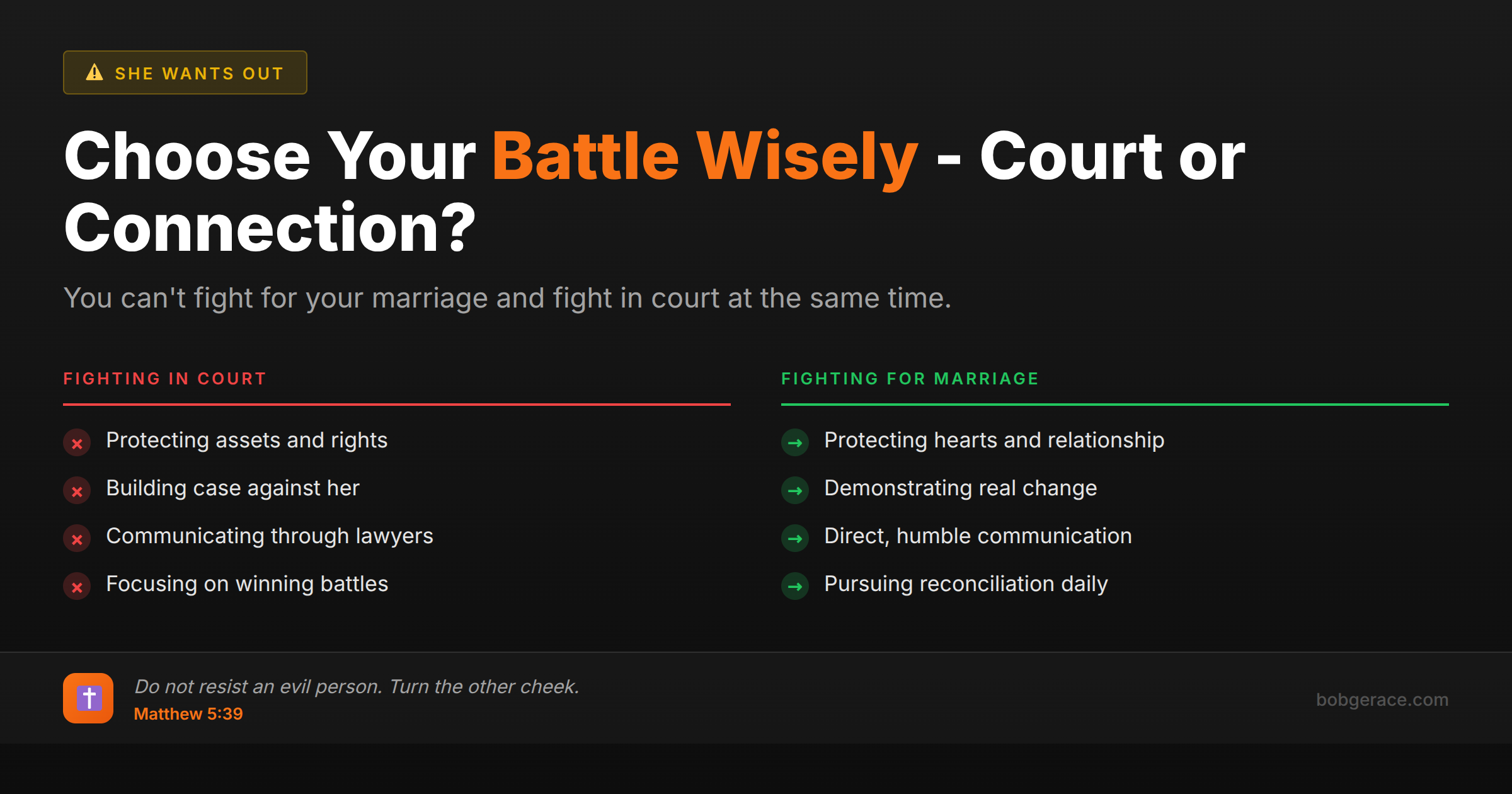
Fighting for your marriage is about building bridges while fighting in court is about burning them down. When you fight for your marriage, you're pursuing reconciliation, demonstrating change, and creating safety for your wife to return. You're fighting against the real enemies - pride, hurt, and broken patterns - not against her. Fighting in court means you've shifted into adversarial mode where winning becomes more important than restoration. Court fights focus on protecting assets and rights, while marriage fights focus on protecting hearts and relationship. The strategies are completely opposite, and you can't do both effectively at the same time.
The Full Picture
The fundamental difference comes down to your ultimate goal. Are you fighting to win or fighting to reconcile? These require completely different mindsets and strategies.
Fighting for marriage means: • You're still operating as a team, even when she doesn't feel like it • Your goal is creating safety and demonstrating genuine change • You absorb conflict rather than escalate it • You focus on long-term relationship health over short-term victories • You communicate through actions more than words • You pursue her heart, not just compliance
Fighting in court means: • You've moved into adversarial positions - it's you versus her • Your goal becomes protecting yourself and your interests • Every interaction becomes evidence gathering • You focus on what you can prove rather than what you can heal • Communication happens through lawyers • You pursue legal victories, not heart change
The biggest trap men fall into is mixing these approaches. They say they want to save the marriage while simultaneously building a court case. This creates massive confusion and destroys trust. Your wife can sense when you've switched from 'husband mode' to 'adversary mode' - and once she feels you're preparing for battle, she'll start preparing too.
Many men think being 'strategic' means protecting themselves legally while pursuing restoration. But this dual approach actually sabotages both goals. You can't love someone back while simultaneously building a case against them.
What's Really Happening
From a psychological perspective, these represent two completely different attachment strategies. Fighting for marriage activates what we call 'approach behaviors' - you're moving toward connection, even in conflict. Fighting in court activates 'avoidance and defensive behaviors' - you're protecting yourself from perceived threat.
When couples shift into litigation mode, several psychological processes occur that make reconciliation exponentially harder. First, confirmation bias intensifies - both parties start interpreting every action through an adversarial lens. A text about picking up kids becomes evidence of control rather than co-parenting communication.
Second, the fundamental attribution error kicks in. In marriage mode, you might think 'she's having a bad day' when she's cold. In court mode, that same behavior becomes 'she's vindictive and manipulative.' You start attributing negative intent to everything.
Third, trauma bonding shifts to trauma opposition. Instead of 'us against the world,' it becomes 'me against her.' The stress of legal proceedings actually rewires the brain to see your spouse as a threat rather than a source of comfort.
Research shows that couples who engage in lengthy custody battles have significantly lower rates of eventual reconciliation - not just because of the legal process, but because of these psychological shifts. The adversarial system literally trains you to think like enemies.
The most damaging aspect is cognitive dissonance - trying to hold 'I love her and want her back' alongside 'I need to protect myself from her' creates internal stress that usually resolves by abandoning the reconciliation goal.
What Scripture Says
Scripture gives us clear guidance on how to handle conflict, and it's radically different from our legal system's approach. Matthew 5:39 says *'But I tell you, do not resist an evil person. If anyone slaps you on the right cheek, turn to them the other cheek also.'* This doesn't mean being a doormat, but it means not fighting fire with fire.
1 Corinthians 6:1-7 directly addresses this issue: *'If any of you has a dispute with another, do you dare to take it before the ungodly for judgment instead of before the Lord's people?... Therefore, if you have disputes about such matters, do you ask for a ruling from those whose way of life is scorned by the church? I say this to shame you. Is it possible that there is nobody among you wise enough to judge a dispute between believers? But instead, one brother takes another to court—and this in front of unbelievers! The very fact that you have lawsuits among you means you have been completely defeated already. Why not rather be wronged? Why not rather be cheated?'*
Ephesians 4:26-27 instructs: *'In your anger do not sin: Do not let the sun go down while you are still angry, and do not give the devil a foothold.'* Legal battles extend conflict indefinitely, giving the enemy massive footholds in your family.
Romans 12:18 provides the heart attitude: *'If it is possible, as far as it depends on you, live at peace with everyone.'* Fighting for your marriage keeps this door open; fighting in court slams it shut.
The biblical model is always restoration over retribution, reconciliation over rights. This doesn't mean ignoring wisdom or protection, but it means your primary energy goes toward healing rather than winning.
What To Do Right Now
-
1
Decide which fight you're actually in - you cannot effectively do both simultaneously
-
2
If pursuing marriage restoration, remove all legal threats and court preparation from your communication
-
3
Shift your language from 'protecting yourself' to 'creating safety for reconciliation'
-
4
Document your marriage restoration efforts rather than building a court case against her
-
5
Communicate directly with her rather than through intermediaries when possible
-
6
Focus your energy on demonstrating change rather than proving you're right
Related Questions
- Should I contest or cooperate?
- How do I protect assets without being aggressive?
- What do I concede vs. what do I hold firm on?
- When does legal strategy serve reconciliation vs. destroy it?
- How do I not let lawyers poison what's left?
- How do I show up as my best self when the system incentivizes my worst?
- What boundaries should I set?
- What's the difference between boundary and ultimatum?
- How do I pursue reconciliation while refusing to participate in sin?
- What does loving confrontation look like biblically?
Also find Bob on
Subscribe for weekly videos on Christian marriage.
Your Marriage Needs Strategy, Not Guesswork
You're making decisions right now that either open the door or close it. A coach who knows your story helps you see what you can't see alone.
Talk to Bob →