What does healthy communication during separation look like?
6 min read
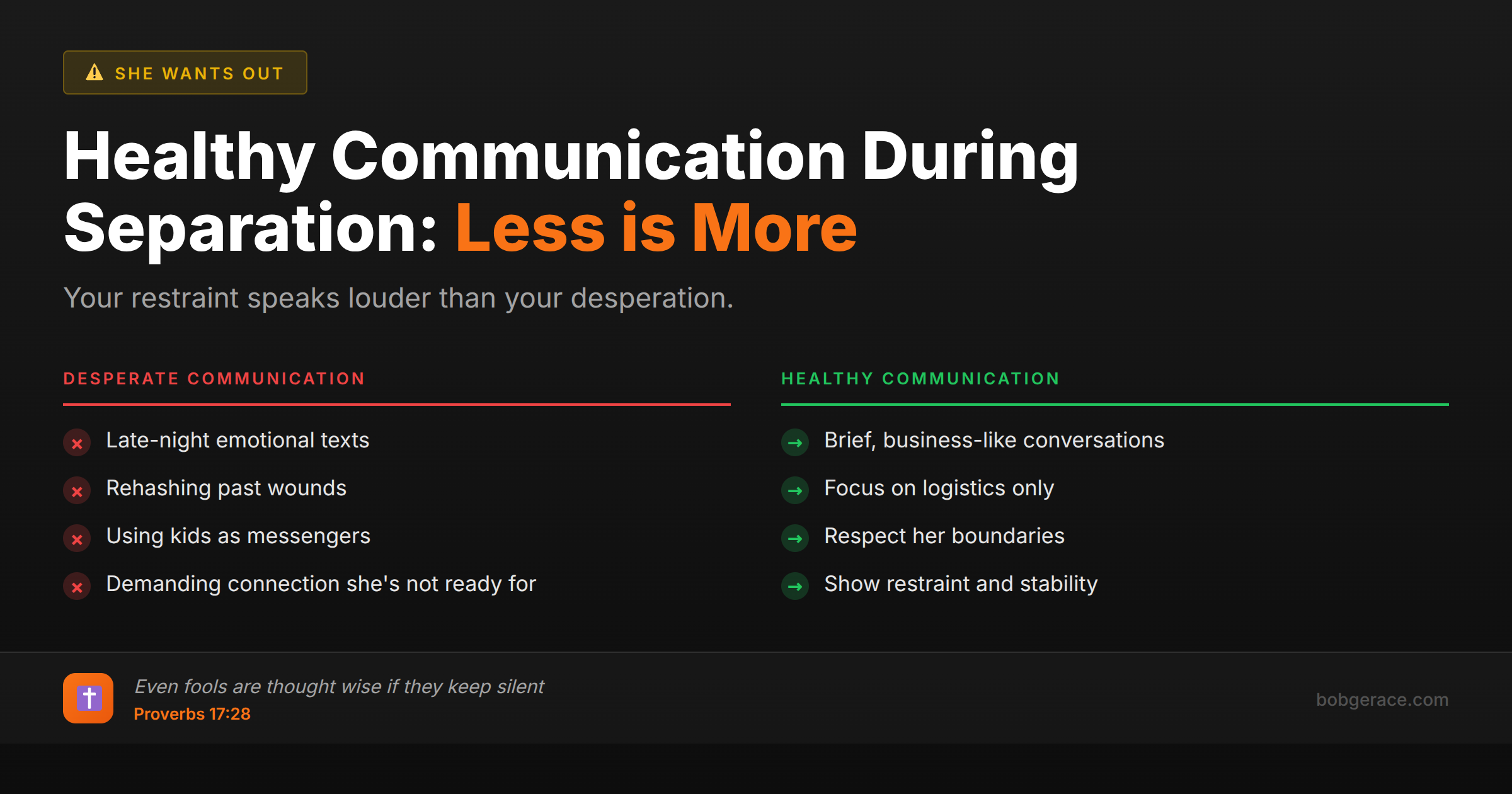
Healthy communication during separation means choosing respect over revenge, even when you're hurting. It looks like brief, business-like conversations focused on logistics - kids, finances, household matters - without rehashing past wounds or demanding emotional connection she's not ready to give. The hardest part? Accepting that healthy communication during separation often means *less* communication, not more. You're not trying to win her back through words right now. You're demonstrating the man you're becoming through your actions and restraint. This means no late-night texts, no emotional manipulation, and no using the kids as messengers. It's about showing up as someone safe and stable, even when everything inside you wants to fight for what you're losing.
The Full Picture
Most men get this backwards. They think separation means they need to communicate *more* - more explanations, more apologies, more attempts to process feelings together. But healthy communication during separation is actually about strategic restraint and rebuilding trust through consistency.
What healthy separation communication includes: • Logistics only: Schedule changes, financial decisions, household repairs • Respect for boundaries: When she says she needs space, you give it • Consistent tone: Professional but not cold, brief but not rude • Child-focused: Conversations about the kids stay about the kids • Reliable responses: You answer when necessary but don't initiate unless required
What it absolutely doesn't include: • Processing your feelings together • Rehashing who did what to whom • Trying to convince her to come back • Asking about her social life or new relationships • Using guilt or manipulation to get emotional responses
The biggest mistake I see is men who treat separation like an extended marriage counseling session. They want to talk through everything, explain their perspective, and process emotions together. But she's separated precisely because she doesn't want that level of emotional engagement with you right now.
Here's the reality check: Your words got you into this mess, and more words won't get you out. She needs to see change, not hear promises. Healthy communication during separation demonstrates that change through what you *don't* say as much as what you do.
What's Really Happening
From a therapeutic perspective, separation represents what we call emotional dysregulation in the relationship system. The pursuing-distancing dynamic that led to separation doesn't magically stop when someone moves out - it often intensifies.
Research from Dr. Sue Johnson's work on Emotionally Focused Therapy shows that during relationship crises, partners often become trapped in negative interaction cycles. The pursuer (often the husband) escalates their attempts to connect through words, while the distancer (often the wife) withdraws further to protect themselves from overwhelm.
Healthy communication during separation requires interrupting this cycle. This means the pursuing partner must learn to self-regulate rather than seeking regulation through their spouse. Neurologically, when we're in crisis, our prefrontal cortex - responsible for rational thought - goes offline. We default to fight-or-flight responses.
The clinical goal isn't reconnection yet - it's individual regulation. Each partner needs to develop what we call differentiation - the ability to maintain your sense of self without needing the other person to validate or soothe you.
Studies on successful relationship repair after separation show that couples who eventually reconcile had partners who used the separation period for individual growth rather than relationship negotiation. The communication patterns that emerge during separation often predict whether reconciliation will be successful.
Key therapeutic principle: You cannot think or talk your way out of an emotional crisis. Safety and trust are rebuilt through consistent, boundaried actions over time, not through conversations.
What Scripture Says
Scripture gives us clear guidance on how to communicate during difficult seasons, especially when relationships are strained.
Proverbs 17:28 reminds us: *"Even fools are thought wise if they keep silent, and discerning if they hold their tongues."* Sometimes the most loving thing you can do is resist the urge to explain, defend, or convince. Your restraint can speak louder than your words.
Ephesians 4:29 sets the standard: *"Do not let any unwholesome talk come out of your mouths, but only what is helpful for building others up according to their needs, that it may benefit those who listen."* Ask yourself before every interaction: Will these words build her up or tear her down? Will they meet her actual needs or just your need to be heard?
James 1:19 gives us the framework: *"Everyone should be quick to listen, slow to speak and slow to become angry."* During separation, this means listening to what she's really saying - often that she needs space - rather than rushing to respond or getting angry when she doesn't engage.
1 Peter 3:15 teaches: *"Always be prepared to give an answer to everyone who asks you to give the reason for the hope that you have. But do this with gentleness and respect."* Notice it says "when asked." You don't need to constantly justify or explain. When the opportunity comes, respond with gentleness and respect.
Matthew 5:37 calls us to simplicity: *"All you need to say is simply 'Yes' or 'No'; anything beyond this comes from the evil one."* Healthy separation communication is often beautifully simple - clear, direct, without manipulation or hidden agendas.
God's pattern is clear: Love through restraint when restraint serves the other person better than engagement.
What To Do Right Now
-
1
Establish clear communication boundaries - agree on how and when you'll communicate about logistics, kids, and finances
-
2
Create a 24-hour rule before responding to any emotionally charged texts or emails from her
-
3
Draft a simple template for necessary communications that stays factual and avoids emotional language
-
4
Remove her from social media temporarily to avoid the temptation to over-communicate or monitor her activity
-
5
Set specific times for checking messages rather than being constantly available or reactive
-
6
Practice the "BRIEF" method - Be Respectful, Informative, Engaging, and Friendly without being overly familiar
Related Questions
- What are the rules of separation?
- Can we separate and still work on things?
- What is 'structured separation' and does it work?
- What boundaries make separation therapeutic?
- How do I avoid 'separation drift'?
- What's the difference between space to heal and space to exit?
- How do I listen without fixing?
- What does non-defensive response look like?
- What boundaries should I set?
- How do I co-parent during this?
Also find Bob on
Subscribe for weekly videos on Christian marriage.
Your separation is different from the next guy's
A coach who knows your story can tell you what restraint looks like in your specific situation—and when you're actually making it worse. You don't have to keep guessing.
Talk to Bob →