What if she's genuinely unsafe and I'm not being paranoid?
6 min read
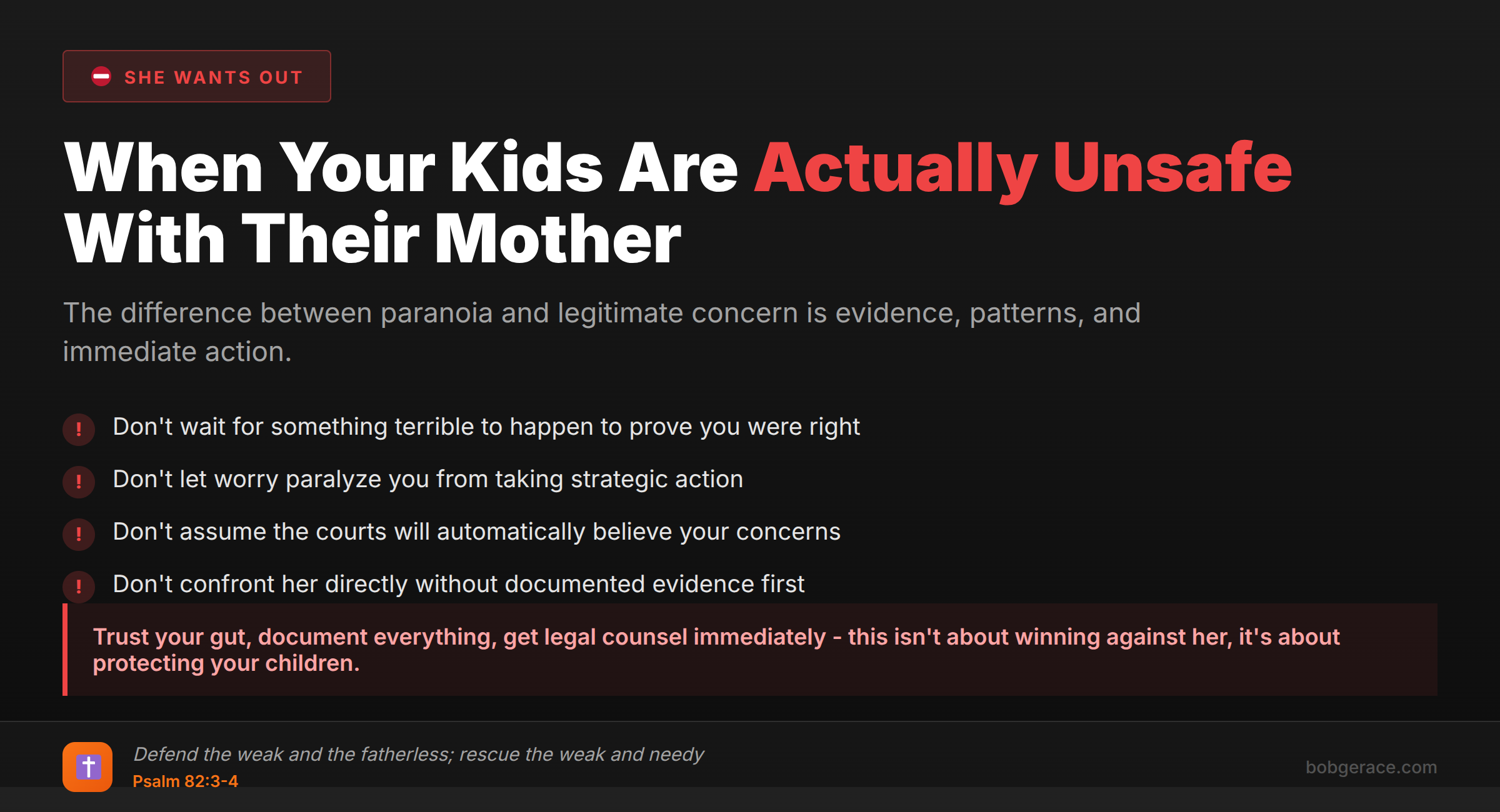
When your gut is telling you that your children are genuinely at risk with their mother, trust it - but document everything. Real safety concerns require immediate, strategic action, not just worry. The difference between paranoia and legitimate concern is evidence, patterns, and your children's wellbeing. I've worked with fathers whose ex-wives were struggling with addiction, mental health crises, or dangerous relationships. The key is building an undeniable case while protecting your kids immediately. This isn't about winning against her - it's about creating safety for your children. You need legal counsel, documented evidence, and often emergency intervention. Don't wait for something terrible to happen to prove you were right.
The Full Picture
The reality is stark: family courts see false accusations daily, which makes proving genuine safety concerns incredibly difficult. But when children are truly at risk, you cannot afford to be passive or hope things improve on their own.
Genuine safety concerns typically involve: • Substance abuse - active addiction, driving under the influence with kids, drug use in the home • Mental health crises - untreated severe depression, psychotic episodes, suicide attempts • Dangerous relationships - bringing violent partners around children, exposing kids to criminal activity • Neglect patterns - consistently failing to provide basic care, leaving young children unsupervised • Physical or emotional abuse - any form of violence or severe psychological manipulation
The biggest mistake fathers make is thinking the truth will speak for itself. Courts require evidence, not intuition. Your ex-wife appearing functional in public while chaos reigns at home is more common than you think. Judges see polished presentations in courtrooms, not what happens behind closed doors.
Start thinking like an investigator, not an angry ex-husband. Every concerning incident needs documentation - dates, times, witnesses, photos when appropriate. Your children's safety reports matter, but kids' testimonies are complicated in family court. Focus on observable, verifiable facts that paint an undeniable picture.
Remember: emergency custody modifications exist for genuine crises. If children are in immediate danger, courts can act quickly. But frivolous emergency motions damage your credibility permanently. Make sure your evidence justifies emergency intervention before pulling that trigger.
What's Really Happening
From a clinical perspective, distinguishing between legitimate safety concerns and heightened anxiety post-divorce requires careful assessment. Research shows that high-conflict divorces can create hypervigilance in both parents, where normal parenting mistakes feel catastrophic.
However, genuine safety concerns typically follow recognizable patterns. The ACE (Adverse Childhood Experiences) framework helps identify real risks: exposure to violence, household dysfunction, abuse, or neglect. These aren't isolated incidents but consistent patterns that threaten healthy development.
Trauma responses in children provide crucial indicators. Legitimate safety concerns often manifest as regression in development, persistent fear responses, unexplained injuries, or dramatic behavioral changes after visits. Children experiencing genuine threats show consistent patterns across multiple environments - home, school, and social settings.
The phenomenon of 'trauma bonding' complicates these situations. Children may defend an unsafe parent due to psychological survival mechanisms, not because they're actually safe. This is why children's stated preferences don't always align with their best interests.
Documentation becomes psychologically protective for fathers in these situations. The process of systematic recording helps distinguish between emotional reactivity and legitimate concerns. When patterns emerge in documentation, they're typically valid. Random, isolated complaints often reflect anxiety rather than genuine risk.
Professional intervention assessment is crucial. Child psychologists, school counselors, and pediatricians can provide objective third-party observations that carry significant weight in legal proceedings. Their professional opinions help courts distinguish between parental conflict and genuine child welfare concerns.
What Scripture Says
Scripture is absolutely clear about our responsibility to protect children from harm. Psalm 82:3-4 commands us: *'Defend the weak and the fatherless; uphold the cause of the poor and the oppressed. Rescue the weak and the needy; deliver them from the hand of the wicked.'* This isn't suggestion - it's a direct mandate.
Proverbs 31:8-9 reinforces this calling: *'Speak up for those who cannot speak for themselves, for the rights of all who are destitute. Speak up and judge fairly; defend the rights of the poor and needy.'* Your children cannot navigate the legal system themselves. They need you to be their advocate and protector.
1 Corinthians 16:13-14 provides the framework for how to act: *'Be on your guard; stand firm in the faith; be courageous; be strong. Do everything in love.'* Notice the balance - courage and strength combined with love. This isn't about vengeance against your ex-wife; it's about protective action motivated by love for your children.
Matthew 18:6 contains one of Jesus's strongest warnings: *'If anyone causes one of these little ones—those who believe in me—to stumble, it would be better for them to have a large millstone hung around their neck and to be drowned in the depths of the sea.'* God takes threats to children seriously.
The biblical model isn't passive hoping and praying while children suffer. Nehemiah 4:13-14 shows us the pattern: *'From that day on, half of my men did the work, while the other half were equipped with spears, shields, bows and armor... I said to the nobles, the officials and the rest of the people, 'Don't be afraid of them. Remember the Lord, who is great and awesome, and fight for your families.'* Strategic action combined with faith in God's justice.
What To Do Right Now
-
1
Document every concerning incident immediately - date, time, witnesses, children's condition, specific observations without emotional commentary
-
2
Contact a family law attorney experienced in emergency custody modifications within 48 hours to understand your legal options
-
3
Request school and medical records to identify any patterns of concern noted by professionals who interact with your children
-
4
Install a co-parenting communication app to create a record of all interactions and concerning statements from their mother
-
5
Schedule individual sessions with a child psychologist to assess your children's wellbeing and create professional documentation
-
6
Prepare emergency custody paperwork with your attorney but file only when you have undeniable evidence that justifies immediate intervention
Related Questions
- How do I tell the kids?
- What are signs my kids are struggling?
- How do I co-parent during this?
- What is 'parental alienation' and is it happening?
- How do I document concerning behavior without being paranoid?
- What does a healthy co-parenting relationship look like?
- What boundaries should I set?
- I can't control my anger
- I don't hit her but I still scare her
- What does coercive control look like?
Also find Bob on
Subscribe for weekly videos on Christian marriage.
Your Kids' Safety Needs a Coach Today
If you're building a case or facing an emergency custody situation, you need someone who knows your specific facts and can help you move fast without mistakes.
Talk to Bob →