How long does acute trauma response last?
6 min read
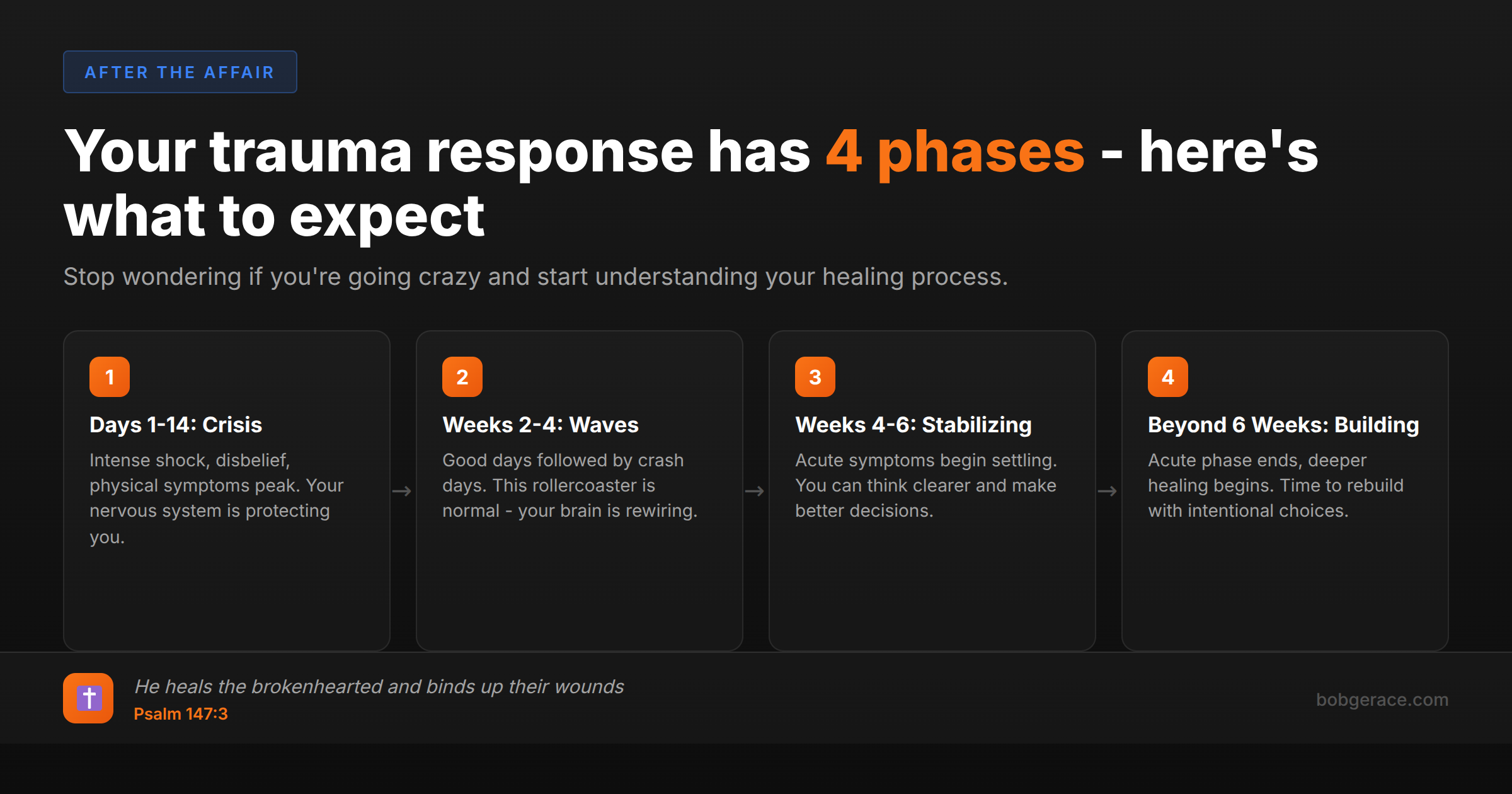
The acute trauma response typically lasts 2-6 weeks, though everyone's timeline is different. During this period, you might experience intense emotions, sleep disruption, difficulty concentrating, and physical symptoms like headaches or stomach issues. This is your nervous system's natural response to betrayal. The intensity usually peaks in the first few days to two weeks, then gradually begins to settle. However, trauma responses can come in waves - you might feel better for a few days, then have another difficult period. This is completely normal and doesn't mean you're not healing. Your brain is literally rewiring itself to process this betrayal.
The Full Picture
When your spouse betrays you with another person, your brain doesn't just register disappointment - it registers life threat. Your nervous system can't distinguish between a saber-tooth tiger and betrayal trauma. Both trigger the same fight-or-flight response that kept our ancestors alive.
The acute phase typically unfolds in predictable stages. Days 1-7: Shock, disbelief, and adrenaline surges dominate. You might feel eerily calm one moment and completely overwhelmed the next. Sleep becomes elusive, and eating feels impossible. Weeks 2-3: Reality sets in. The adrenaline crash hits hard, bringing exhaustion, intense anger, or deep sadness. Your body might ache like you have the flu. Weeks 4-6: The nervous system begins to recalibrate. You'll have longer periods of stability punctuated by emotional waves.
Here's what most people don't tell you: healing isn't linear. You might feel strong on Tuesday and completely shattered on Wednesday. This doesn't mean you're going backward. It means your brain is processing trauma in the way God designed it to.
Factors that influence your timeline include the severity of the betrayal, whether this is your first discovery, your support system, and how your spouse responds to being caught. If they're defensive and continue lying, your acute response will last longer because your nervous system can't settle into safety.
What's Really Happening
//blog.bobgerace.com/christian-marriage-identity-crisis-stop-living-from-wounds/:From a neurological standpoint, betrayal trauma hijacks three critical brain systems simultaneously. The amygdala - your alarm system - becomes hypervigilant, constantly scanning for more threats. The hippocampus, responsible for memory formation, gets flooded with stress hormones, which is why details might feel fuzzy or intrusive thoughts loop endlessly. Meanwhile, the prefrontal cortex - your rational thinking center - goes partially offline.
This creates what we call 'trauma time distortion.' Minutes feel like hours when you're triggered, but weeks can blur together. Your brain is working overtime to categorize this experience and determine safety levels. The acute response typically peaks within 72 hours and begins to stabilize around week 3-4, but individual variation is enormous.
What I see in my practice is that clients who understand this neurobiological reality actually recover faster. When you know that forgetting words mid-sentence or feeling exhausted after minimal activity is brain-based, not weakness, you can respond with self-compassion rather than self-criticism. The nervous system heals faster in an environment of safety and understanding, not pressure and judgment.
What Scripture Says
God's Word acknowledges that deep wounds take time to heal. Psalm 147:3 reminds us that "He heals the brokenhearted and binds up their wounds." Notice it doesn't say He heals instantly, but that He heals. There's a process involved.
Ecclesiastes 3:3 teaches there is "a time to break down and a time to build up." You're in the breaking down phase right now - not by choice, but by circumstance. This dismantling of your old reality is necessary before rebuilding can begin. Isaiah 61:3 promises "beauty for ashes, the oil of joy for mourning." The ashes come first. The beauty follows.
Psalm 30:5 offers hope for the timeline: "Weeping may endure for a night, but joy comes in the morning." Your 'night' might last weeks, not hours, but morning will come. 2 Corinthians 4:17 puts it in perspective: "Our light and momentary troubles are achieving for us an eternal glory that far outweighs them all."
God doesn't minimize your pain or rush your process. Matthew 11:28 shows Jesus saying, "Come to me, all you who are weary and burdened, and I will give you rest." He invites you to rest in Him during this acute phase, not to push through it faster than your soul can handle.
What To Do Right Now
-
1
Accept that 2-6 weeks of acute response is normal - stop fighting your natural healing process
-
2
Prioritize sleep and nutrition even when you don't feel like it - your brain needs fuel to heal
-
3
Practice grounding techniques when triggered - name 5 things you can see, 4 you can hear, 3 you can touch
-
4
Limit major decisions during the acute phase - your prefrontal cortex isn't operating at full capacity
-
5
Create a daily safety routine - same wake time, same bedtime, predictable meals and activities
-
6
Reach out for professional support if symptoms worsen after week 6 or include suicidal thoughts
Related Questions
You Don't Have to Navigate This Alone
The acute trauma phase is overwhelming, but you're not meant to walk through it without support. Let me help you understand what's happening and create a path forward.
Get Support →