What role did her individual issues play?
6 min read
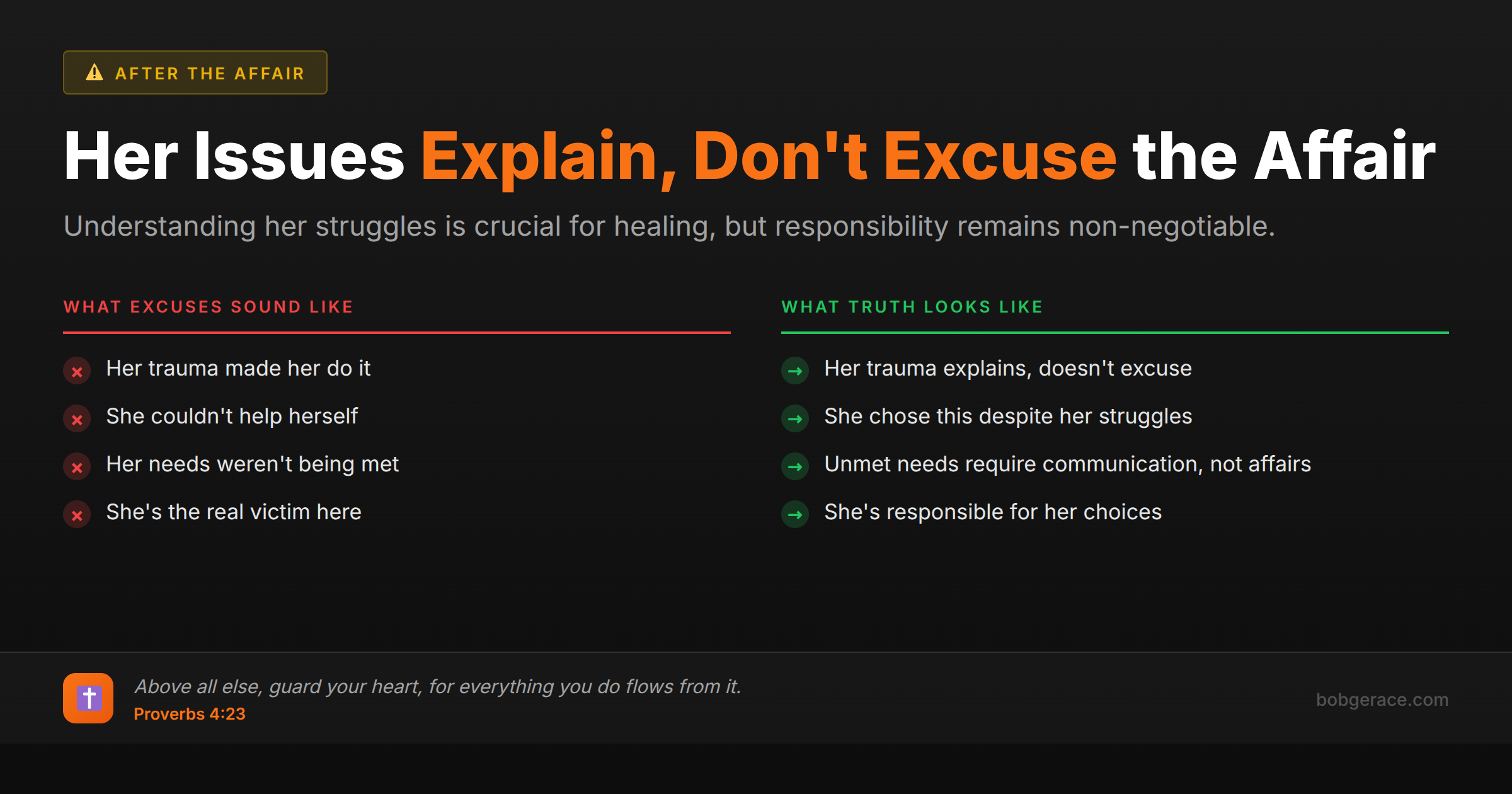
Her individual issues played a significant role, but they're not the whole story. Research shows that personal vulnerabilities like low self-esteem, unresolved trauma, attachment insecurities, or unmet emotional needs create conditions where affairs become more likely. However, these issues don't excuse the affair—they help explain it. Many people face similar struggles without choosing infidelity. Understanding her individual issues is crucial for recovery because it reveals the deeper work needed beyond just ending the affair. This includes addressing underlying emotional patterns, developing healthier coping mechanisms, and learning to communicate needs directly rather than seeking fulfillment outside the marriage.
The Full Picture
When we examine affairs through research, we consistently find that individual psychological factors create vulnerability to infidelity, but they operate within a complex web of circumstances.
Common Individual Risk Factors: - Attachment insecurity - Fear of abandonment or difficulty with intimacy - Low self-esteem - Seeking external validation and attention - Unresolved trauma - Using affairs to escape or numb emotional pain - Poor impulse control - Difficulty resisting immediate gratification - Narcissistic traits - Believing rules don't apply to them - Depression or anxiety - Seeking relief through exciting new relationships
The Opportunity Factor matters too. Even with individual vulnerabilities, affairs require opportunity—being around someone who shows interest, having unsupervised time, or being in situations where boundaries blur.
Life transitions often trigger affairs. Major changes like career shifts, children leaving home, health issues, or milestone birthdays can activate existing vulnerabilities. The affair becomes a way to cope with or escape from uncomfortable realities.
Here's what's crucial to understand: her individual issues explain but don't excuse. Millions of people struggle with similar psychological challenges without choosing infidelity. The individual issues created susceptibility, but the affair was still a choice made repeatedly over time.
Research also shows that addressing only the individual issues without examining relationship dynamics and rebuilding trust rarely leads to lasting recovery. The most successful outcomes happen when both individual healing and relationship repair occur simultaneously.
What's Really Happening
From a clinical perspective, affairs rarely happen in a vacuum—they emerge from a perfect storm of individual vulnerability, opportunity, and often relationship distress. What I see consistently is that the individual issues create a psychological climate where affairs become possible, even likely.
The vulnerability model helps us understand this. Imagine psychological resilience as a immune system for relationships. When someone has unresolved trauma, attachment wounds, or chronic emotional needs that aren't being addressed, their 'relationship immune system' becomes compromised. They become more susceptible to the 'infection' of an affair when exposed to the right conditions.
Emotional regulation is often at the core. Many individuals who have affairs struggle with managing difficult emotions healthily. The affair partner becomes a drug of sorts—providing temporary relief from anxiety, depression, loneliness, or feelings of inadequacy. This is why affairs can become addictive; they're serving a psychological function beyond just sexual or romantic connection.
Identity issues frequently surface. Sometimes the affair represents an attempt to reclaim a lost sense of self or to explore aspects of identity that feel suppressed in the marriage. This is particularly common during midlife transitions.
What's critical for recovery is recognizing that while these individual issues contributed to the affair, //blog.bobgerace.com/marriage-lament-christian-healing-story-complete/:healing requires taking full responsibility for the choices made. The most successful outcomes occur when the unfaithful partner commits to deep individual work while simultaneously engaging in relationship repair. This dual approach addresses both the root vulnerabilities and the relational damage.
What Scripture Says
Scripture clearly teaches that while we all have individual struggles and weaknesses, we're still fully responsible for our choices and their consequences.
Our Hearts Are the Source: *"Above all else, guard your heart, for everything you do flows from it."* (Proverbs 4:23) - Individual issues often stem from an unguarded heart that has allowed wrong thoughts and desires to take root.
Temptation vs. Sin: *"Each person is tempted when they are dragged away by their own evil desire and enticed. Then, after desire has conceived, it gives birth to sin."* (James 1:14-15) - Individual vulnerabilities may make someone more susceptible to temptation, but sin occurs when we choose to act on those desires.
No Excuse for Sin: *"If we claim to be without sin, we deceive ourselves and the truth is not in us."* (1 John 1:8) - We must acknowledge our individual issues without using them to justify unfaithfulness.
Transformation is Possible: *"Therefore, if anyone is in Christ, the new creation has come: The old has gone, the new is here!"* (2 Corinthians 5:17) - Individual issues don't have to define us; God offers complete transformation.
Renewing the Mind: *"Do not conform to the pattern of this world, but be transformed by the renewing of your mind."* (Romans 12:2) - Addressing individual issues requires actively changing thought patterns and beliefs.
God's Strength in Weakness: *"My grace is sufficient for you, for my power is made perfect in weakness."* (2 Corinthians 12:9) - Individual struggles become opportunities for God's power to work through us when we surrender them to Him.
What To Do Right Now
-
1
Document the individual issues you've observed without making them excuses for the affair
-
2
Insist that she take full responsibility for her choices regardless of her personal struggles
-
3
Support her getting professional help for underlying issues while maintaining boundaries
-
4
Recognize that your own individual issues may have contributed to relationship vulnerabilities
-
5
Focus on your healing and growth rather than trying to fix her individual problems
-
6
Set clear expectations that addressing individual issues is necessary but not sufficient for reconciliation
Related Questions
- Why did she cheat?
- What are the most common reasons women have affairs?
- What role did our relationship problems play?
- How does attachment style relate to affair risk?
- Is there a typical 'affair profile' for women?
- Is she responsible even if I contributed to problems?
- Where does this come from?
- What patterns did I inherit vs. choose?
- What attachment style did I develop in childhood?
- What is 'complex trauma' and do I have it?
Also find Bob on
Subscribe for weekly videos on Christian marriage.
Your Marriage Isn't a Textbook Case
Her issues, your history, what's actually happening in your house—coaching means a human who knows your specific situation and helps you figure out what to do next.
Talk to Bob →