What is 'attachment affair' vs. 'exit affair'?
6 min read
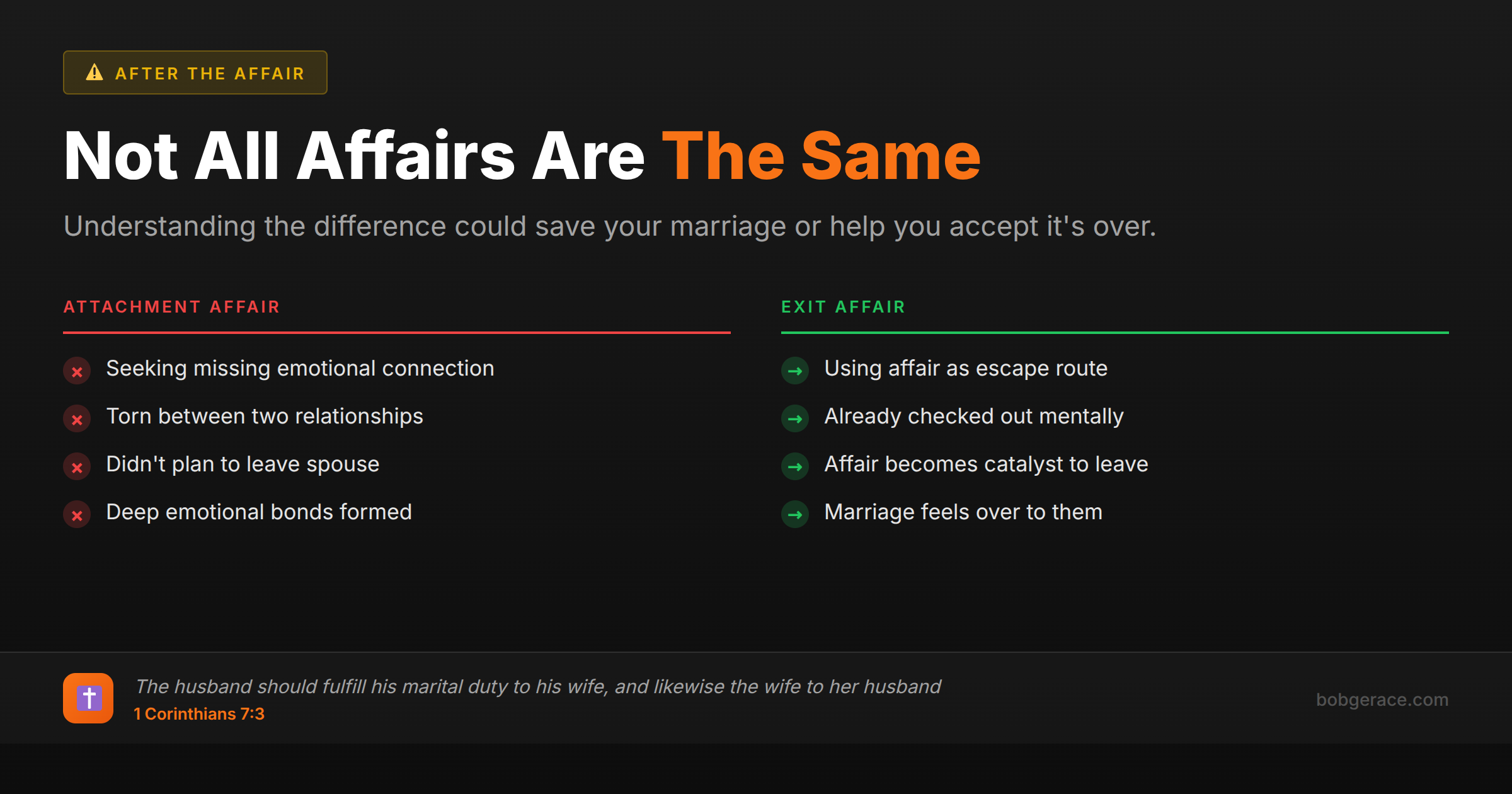
An attachment affair happens when someone seeks emotional connection they're missing in their marriage, often without planning to leave their spouse. These affairs typically involve deep emotional bonds and the unfaithful partner feels torn between two relationships. An exit affair, on the other hand, is used as a way out of the marriage - either consciously or unconsciously. The person has already emotionally checked out of their marriage and the affair becomes the catalyst or excuse to end it. Understanding which type you're dealing with is crucial because attachment affairs often indicate a marriage that can be saved, while exit affairs suggest one partner has already decided to leave. The motivation behind the affair - seeking missing connection versus seeking an escape route - determines both the recovery process and the likelihood of reconciliation.
The Full Picture
When I work with couples dealing with infidelity, one of the first things I need to determine is what type of affair we're facing. Not all affairs are created equal, and the distinction between attachment affairs and exit affairs can mean the difference between a marriage that heals stronger than before and one that ends in divorce.
Attachment affairs stem from unmet emotional needs within the marriage. The unfaithful partner typically doesn't set out to have an affair - it develops gradually through emotional intimacy with someone who provides what's missing at home. These individuals often feel genuine love for both their spouse and their affair partner, creating intense internal conflict. They're not trying to escape their marriage; they're trying to fill a void while staying in it. Common triggers include feeling emotionally neglected, unappreciated, or disconnected from their spouse over time.
Exit affairs serve a completely different purpose. Here, the unfaithful partner has already mentally and emotionally left the marriage, even if they haven't physically departed yet. The affair becomes either a conscious strategy to force the end of the marriage or an unconscious way to create enough damage that divorce becomes inevitable. Sometimes it's about finding a 'soft landing' - having someone else lined up before leaving. Other times it's about creating a crisis so dramatic that the betrayed spouse will be the one to end the marriage, allowing the unfaithful partner to avoid taking responsibility for the decision.
The key difference lies in intention and attachment. In attachment affairs, there's still emotional investment in the marriage alongside the affair. In exit affairs, the marriage has already been written off, and the affair is simply the vehicle for departure.
What's Really Happening
From a clinical perspective, these two affair types activate completely different psychological mechanisms and require vastly different therapeutic approaches. Attachment affairs often involve what we call 'compartmentalization' - the ability to hold two conflicting emotional realities simultaneously. The person genuinely loves their spouse while also developing deep feelings for their affair partner. This creates significant cognitive dissonance and emotional turmoil.
Neurologically, attachment affairs trigger the brain's reward system through both relationships, creating what's essentially a dual attachment pattern. The person isn't trying to replace one relationship with another; they're trying to maintain both. This is why individuals in attachment affairs often seem tortured by their situation - their brain is literally being pulled in two directions by competing attachment //blog.bobgerace.com/marriage-focus-systems-christian-husband/:systems.
Exit affairs operate differently. Here, we see what attachment theory calls 'deactivation strategies' - the systematic shutdown of emotional bonds with the primary partner. The affair serves as a replacement attachment, making it easier to disconnect from the marriage. Neurologically, the brain begins transferring its primary attachment patterns to the new person while simultaneously creating negative associations with the spouse.
The prognosis differs significantly. Attachment affairs, while devastating, often indicate that the core attachment to the spouse remains intact but wounded. With proper therapeutic intervention, these marriages can not only recover but often emerge stronger because the underlying issues get addressed. Exit affairs are far more challenging because the primary attachment bond has already been severed psychologically. Recovery requires essentially rebuilding attachment from ground zero, which is possible but requires the unfaithful partner to genuinely want to re-engage with their marriage.
What Scripture Says
Scripture speaks directly to the heart issues underlying both types of affairs. The Bible doesn't categorize infidelity by type, but it does address the motivations and heart conditions that lead to these different affair patterns.
For attachment affairs, we see the warning in 1 Corinthians 7:3-5: "The husband should fulfill his marital duty to his wife, and likewise the wife to her husband... Do not deprive each other except perhaps by mutual consent and for a time, so that you may devote yourselves to prayer." When emotional and physical intimacy breaks down in marriage, it creates vulnerability to seeking that connection elsewhere. This doesn't excuse the affair, but it shows God's design for marriages to be mutually nurturing.
Proverbs 27:14 warns about the power of emotional connection: "If anyone loudly blesses their neighbor early in the morning, it will be taken as a curse." The Message translation puts it this way: "If you wake your friend early in the morning by shouting 'Rise and shine!' It will sound to him more like a curse than a blessing." When spouses stop blessing each other emotionally, others may fill that role inappropriately.
For exit affairs, we see the heart condition described in Malachi 2:14-16: "You ask, 'Why?' It is because the Lord is the witness between you and the wife of your youth. You have been unfaithful to her, though she is your partner, the wife of your marriage covenant... 'The man who hates and divorces his wife,' says the Lord, the God of Israel, 'does violence to the one he should protect.'" Exit affairs often involve a hardened heart that has already broken covenant internally.
Matthew 19:8-9 addresses this hardness: "Moses permitted you to divorce your wives because your hearts were hard. But it was not this way from the beginning." Whether dealing with attachment or exit affairs, God's heart is always toward restoration and softening hardened hearts toward covenant faithfulness.
What To Do Right Now
-
1
Identify the affair type honestly - Look at the unfaithful partner's behavior and words. Are they torn between two relationships (attachment) or have they already emotionally left the marriage (exit)?
-
2
Stop trying to compete with the affair partner - Your approach should be based on the affair type, not on trying to win back someone who may have already decided to leave
-
3
Address the underlying issues immediately - For attachment affairs, focus on rebuilding emotional connection. For exit affairs, focus on whether genuine recommitment is possible
-
4
Set clear boundaries and consequences - Regardless of affair type, the unfaithful partner must end all contact with the affair partner to move forward
-
5
Get professional help from someone who understands affair types - Generic marriage counseling often fails because it doesn't address the specific dynamics of different affair patterns
-
6
Prepare for different timelines - Attachment affair recovery often takes 18-24 months. Exit affair recovery may take longer or may not be possible if the unfaithful partner won't genuinely re-engage
Related Questions
- What are the most common reasons women have affairs?
- Why did she cheat?
- Is it about sex or emotion?
- What's the difference between emotional and physical affairs?
- What role did our relationship problems play?
- What role did her individual issues play?
- What is limerence?
- She says she needs time to decide
- Why does she seem like a different person?
Also find Bob on
Subscribe for weekly videos on Christian marriage.
Which Type Is Yours?
Knowing the category doesn't tell you what to do about your wife, your history, your kids. A coach who knows your marriage does.
Talk to Bob →