What happened to her attachment to me?
6 min read
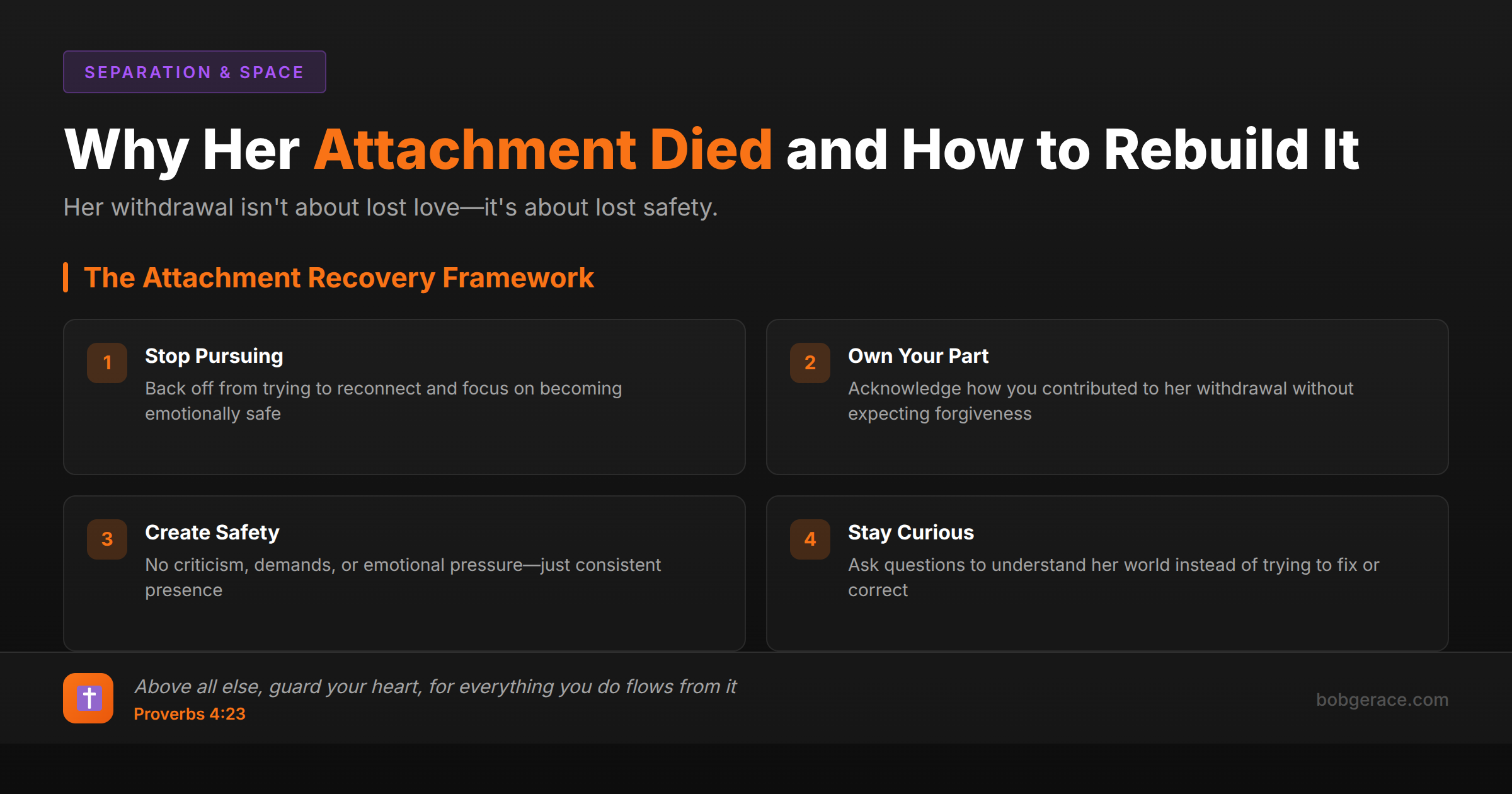
Her attachment to you didn't disappear overnight—it eroded gradually through unmet emotional needs, repeated disappointments, or protective withdrawal. When women feel consistently unseen, unheard, or unsafe in the relationship, their attachment system naturally pulls back to protect them from further hurt. This isn't about love disappearing; it's about her emotional safety system kicking in. She may have tried to reconnect multiple times before, but when those attempts weren't received well or reciprocated, she began to detach as a survival mechanism. The good news? Attachment can be rebuilt when you create consistent safety, emotional attunement, and genuine care for her inner world.
The Full Picture
Attachment doesn't just vanish—it gets injured. Think of your wife's attachment to you like a rope that's been fraying strand by strand. Each unresolved conflict, each time she felt dismissed or misunderstood, each moment she reached for connection and found criticism instead—these all weakened the bond.
The attachment system is designed for survival. When your wife doesn't feel emotionally safe with you, her nervous system does what it's designed to do: it creates distance to protect her heart. This isn't vindictive or manipulative—it's biological. Her brain is literally trying to keep her safe from repeated emotional injury.
Women typically go through predictable stages before checking out completely. First, they protest—bringing up issues, asking for change, sometimes even fighting for the relationship. Then they become anxious, working harder to connect while feeling increasingly frustrated. Finally, they detach—not because they don't care, but because caring was too painful.
The irony is heartbreaking: the more emotionally unsafe she feels, the more she withdraws. The more she withdraws, the more you might pursue or criticize, which makes her feel even less safe. This creates a downward spiral that can feel impossible to break.
But here's what most men miss: her checking out is often her last attempt to save the marriage. She's essentially saying, "I can't keep getting hurt like this, but I'm not ready to leave yet either." This detached space is where she decides whether there's any hope left—and your response in this season will largely determine the outcome.
What's Really Happening
From an attachment perspective, your wife's withdrawal represents what we call 'deactivation'—a protective strategy her nervous system employs when the primary attachment relationship feels threatening rather than safe. This isn't a conscious choice; it's a neurobiological response to repeated attachment injuries.
Research shows that women in distressed marriages often experience a phenomenon called 'emotional flooding,' where their stress response system becomes chronically activated. When this happens, the brain begins to associate the spouse with danger rather than comfort, triggering protective detachment behaviors.
The attachment bond operates on three fundamental needs: felt safety, seen and understood, and soothed in distress. When these needs go consistently unmet, the attachment system begins to 'deactivate' as a protective mechanism. Your wife isn't choosing to love you less—her brain is choosing to protect her from further emotional injury.
What's crucial to understand is that attachment injuries are cumulative. Each time she felt criticized instead of comforted, dismissed instead of heard, or blamed instead of understood, neural pathways were reinforced that coded you as 'unsafe.' The good news is that neuroplasticity allows these patterns to change when new, consistently safe experiences are created.
What Scripture Says
God designed marriage as the most intimate earthly relationship, where two become one flesh. When attachment breaks down, we're not just dealing with relational issues—we're dealing with a fracture in God's intended design for marriage unity.
"Above all else, guard your heart, for everything you do flows from it." (Proverbs 4:23) Your wife's withdrawal is actually her following biblical wisdom—she's guarding her heart because it's been wounded. Rather than seeing this as rejection, understand it as protection.
"Husbands, love your wives as Christ loved the church and gave himself up for her." (Ephesians 5:25) Christ's love created safety for the church to draw near. Ask yourself: does your love create safety for your wife to be vulnerable, or does she feel she needs to protect herself?
"Be completely humble and gentle; be patient, bearing with one another in love." (Ephesians 4:2) Rebuilding attachment requires the fruit of the Spirit—gentleness, patience, and long-suffering love that doesn't demand immediate results.
"A gentle answer turns away wrath, but a harsh word stirs up anger." (Proverbs 15:1) Your wife's detachment may be her heart's response to harshness. Consistent gentleness can begin to reverse this protective withdrawal.
"Be kind and compassionate to one another, forgiving each other, just as in Christ God forgave you." (Ephesians 4:32) Attachment healing happens in an environment of kindness and compassion, not demand and criticism.
"Love is patient, love is kind... it keeps no record of wrongs." (1 Corinthians 13:4-5) This type of love creates the safety necessary for attachment to be restored.
What To Do Right Now
-
1
Stop pursuing and start creating safety. Back off from trying to reconnect and focus on becoming a safe person to be around—no criticism, demands, or emotional pressure.
-
2
Own your part without expecting her response. Acknowledge specific ways you've contributed to her emotional withdrawal, without requiring her to forgive or reconnect immediately.
-
3
Become curious instead of critical. When she does interact, ask questions to understand her world rather than trying to fix, correct, or defend yourself.
-
4
Demonstrate consistency over time. Small, consistent acts of kindness and respect will rebuild trust faster than grand gestures that feel manipulative.
-
5
Work on yourself whether she engages or not. Get coaching, read books, pray, and become the man God's calling you to be regardless of her response.
-
6
Give her space to feel without trying to change her feelings. Let her be sad, angry, or distant without trying to talk her out of it or make her feel better immediately.
Related Questions
- What is 'emotional disengagement'?
- Is her shutdown protective or permanent?
- What is 'deactivation' and did I cause it?
- What attachment injuries lead to this kind of withdrawal?
- Can deactivated attachment reactivate?
- Why does she seem to attach to everyone but me?
- What are 'attachment injuries' and how many did I cause?
- What is 'attachment injury' and did I cause one?
- What is 'attachment affair' vs. 'exit affair'?
Also find Bob on
Subscribe for weekly videos on Christian marriage.
Your Marriage Isn't a Generic Case Study
Rebuilding her attachment to you requires moves calibrated to your specific history, her specific wounds, where you actually are today. A coach who knows your story helps you stop guessing.
Talk to Bob →