What does avoidant attachment look like in a wife?
6 min read
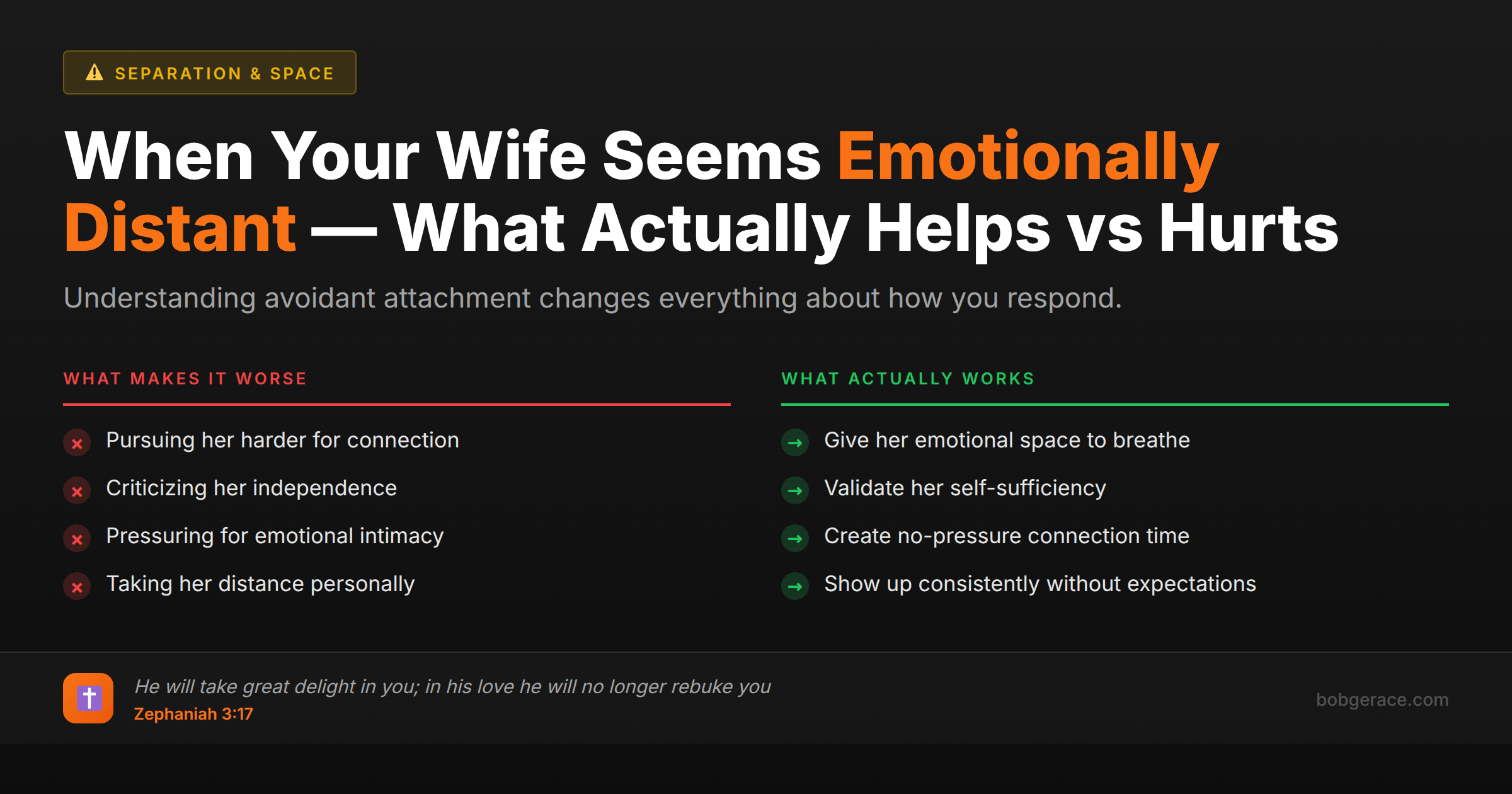
An avoidantly attached wife typically displays patterns of emotional distance, excessive independence, and discomfort with intimacy. She may minimize her own needs, avoid conflict by withdrawing, and struggle to express vulnerability or ask for support. This often manifests as being overly self-reliant, deflecting emotional conversations, maintaining rigid boundaries, and seeming uncomfortable with physical affection or deep emotional connection. These behaviors aren't rejection or lack of love—they're protective strategies developed early in life. She learned that emotional needs weren't reliably met, so she adapted by not having them at all. Understanding this helps husbands respond with patience rather than taking her distance personally, creating space for gradual healing and connection.
The Full Picture
Avoidant attachment in wives shows up in ways that can feel confusing and hurtful to husbands. She might seem like she doesn't need you, doesn't want closeness, or prefers handling everything alone. But here's what's really happening beneath the surface.
Common behaviors include: - Emotional minimizing: She downplays feelings, both hers and yours, saying things like "it's not a big deal" or "I'm fine" - Hyper-independence: Insisting on doing everything herself, refusing help even when struggling - Conversation deflection: Changing subjects when talks get deep, making jokes to lighten serious moments - Physical distance: Seeming uncomfortable with prolonged hugs, cuddling, or intimate touch - Conflict avoidance: Shutting down during disagreements or leaving the room entirely
The deeper pattern is self-protection. She learned early that emotional vulnerability led to disappointment, so she built walls. These aren't conscious choices to hurt you—they're automatic responses that once kept her safe.
In marriage, this creates cycles where her distance triggers your pursuit, which feels overwhelming to her, causing more withdrawal. She interprets your desire for closeness as neediness or control, while you interpret her independence as rejection.
The tragedy is that underneath her composed exterior is often a woman who deeply desires connection but doesn't know how to receive it safely. She's not broken or selfish—she's protecting a tender heart that was wounded when it was most vulnerable.
What's Really Happening
From a clinical perspective, avoidant attachment develops when a child's emotional needs are consistently unmet or dismissed. The child learns that survival depends on self-sufficiency, not connection. This adaptive strategy becomes problematic in adult intimate relationships.
Neurologically, avoidantly attached individuals have heightened activity in brain regions associated with emotional regulation and suppression. When faced with emotional intimacy, their nervous system literally activates stress responses, making closeness feel dangerous rather than comforting.
In wives, this often presents as what I call "functional disconnection"—they can perform relationship duties while remaining emotionally unavailable. They excel at practical care but struggle with emotional attunement. This isn't conscious rejection; it's nervous system protection.
The key insight is that her avoidance increases when she feels pressured for intimacy. Paradoxically, giving her space and demonstrating consistent, non-demanding presence creates safety. Over time, this can help her nervous system learn that connection doesn't equal danger.
Healing requires patience and often professional support. The goal isn't to eliminate her need for independence, but to expand her capacity for interdependence. With proper understanding and intervention, avoidantly attached individuals can develop secure relationship patterns, though it requires addressing the underlying trauma that created the protective strategies.
What Scripture Says
Scripture reveals God's heart for emotional healing and authentic connection in marriage. Understanding avoidant attachment through a biblical lens shows us God's design for intimacy and His patience with our protective patterns.
God models safe attachment: *"The Lord your God is with you, the Mighty Warrior who saves. He will take great delight in you; in his love he will no longer rebuke you, but will rejoice over you with singing"* (Zephaniah 3:17). This shows God's consistent, delighted presence—the security avoidant hearts desperately need.
Marriage reflects this safety: *"Above all, love each other deeply, because love covers over a multitude of sins"* (1 Peter 4:8). Deep love creates the safety needed for vulnerable hearts to open gradually.
Healing happens in community: *"Therefore encourage one another and build each other up"* (1 Thessalonians 5:11). God designed us for connection, and He uses marriage as a healing relationship where old wounds can be addressed.
Patience in the process: *"Be completely humble and gentle; be patient, bearing with one another in love"* (Ephesians 4:2). Healing attachment wounds requires the patience that reflects God's character.
Truth and grace together: *"Speaking the truth in love, we will grow to become in every respect the mature body of him who is the head, that is, Christ"* (Ephesians 4:15). Growth happens when truth is delivered with love, not pressure.
God's ultimate healing: *"He heals the brokenhearted and binds up their wounds"* (Psalm 147:3). God specializes in healing the exact wounds that create avoidant patterns.
What To Do Right Now
-
1
Stop pursuing harder - Give her emotional space and reduce pressure for intimacy, which will counterintuitively create more safety
-
2
Become boringly consistent - Show up reliably in small ways without expecting emotional responses or gratitude
-
3
Validate her independence - Appreciate her self-sufficiency instead of criticizing it, showing you're not trying to change her
-
4
Create no-pressure connection - Spend time together without deep conversations or physical demands, just enjoying shared activities
-
5
Address your own attachment - Examine whether your need for closeness has become demanding or anxious, which triggers her avoidance
-
6
Seek professional help - Consider couples therapy with someone trained in attachment work to navigate this complex dynamic safely
Related Questions
- What is 'emotional disengagement'?
- Is her shutdown protective or permanent?
- What is 'deactivation' and did I cause it?
- What attachment injuries lead to this kind of withdrawal?
- Can deactivated attachment reactivate?
- What is 'earned avoidance' from marriage pain?
- What is anxious attachment and am I doing it right now?
- What's the pursue-withdraw cycle and how do I stop it?
- How does attachment style relate to affair risk?
- What does secure attachment behavior look like in him?
Also find Bob on
Subscribe for weekly videos on Christian marriage.
Your Wife Isn't a Case Study
Avoidant attachment shows up differently in every marriage. A coach who knows your specific dynamic helps you respond to her patterns without losing yourself.
Talk to Bob →