What is 'deactivation' and did I cause it?
6 min read
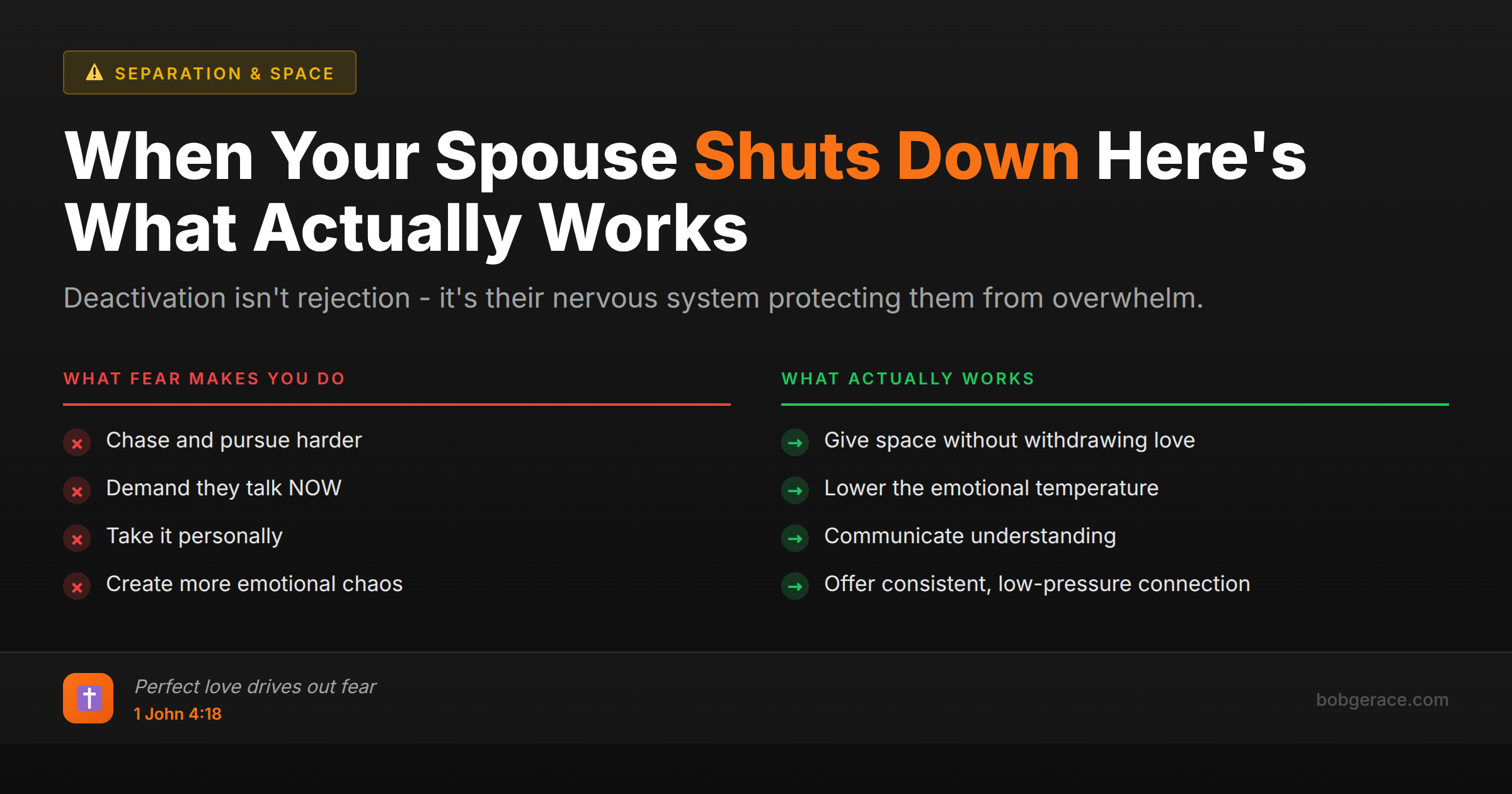
Deactivation is when someone with avoidant attachment automatically shuts down their emotional connection system when they feel overwhelmed, threatened, or suffocated in the relationship. It's like an emotional circuit breaker that trips to protect them from perceived danger. Your spouse isn't choosing to hurt you - their nervous system is literally switching into self-protection mode. While you didn't 'cause' their attachment style (that was formed in childhood), certain behaviors can trigger deactivation. Pursuing too intensely, being overly critical, or creating emotional chaos can activate their defensive systems. The good news? Once you understand what's happening, you can learn to approach them in ways that feel safer and actually invite connection instead of triggering withdrawal.
The Full Picture
Deactivation is your spouse's unconscious survival strategy, not a personal attack on you.
When someone with avoidant attachment experiences deactivation, their brain essentially says, "Danger! Too much closeness! Shut it down!" This isn't a conscious choice - it's an automatic response hardwired from childhood experiences where emotional needs weren't consistently met or where closeness felt unsafe.
Here's what deactivation looks like: - Sudden emotional distance after periods of closeness - Deflecting serious conversations with humor or changing subjects - Focusing intensely on work, hobbies, or anything besides the relationship - Physical withdrawal - less affection, intimacy, eye contact - Minimizing relationship problems or your concerns - Creating conflict to justify distance
Understanding the trigger patterns: Deactivation often happens after moments of vulnerability or increased intimacy. Paradoxically, the closer you get, the more their system panics. It's like they have an internal thermostat that says "too hot" when emotional intimacy reaches certain levels.
This explains why your spouse might seem loving one day and cold the next, or why they pull away right after meaningful conversations or physical intimacy. Their attachment system is protecting them from what feels like overwhelming emotional exposure.
The shame cycle: Most people with avoidant attachment feel deep shame about their need for space and their inability to stay emotionally present. They often judge themselves harshly for hurting you, which creates more internal pressure and triggers even more deactivation. It becomes a vicious cycle where shame fuels withdrawal, and withdrawal creates more shame.
What's Really Happening
From a clinical perspective, deactivation is a neurobiological response rooted in the attachment system formed during the first two years of life. When caregivers were inconsistently available, emotionally distant, or overwhelmed by the child's needs, that child learned to minimize their own emotional needs to maintain some sense of connection and safety.
The neuroscience behind deactivation: During deactivation, the avoidant person's nervous system shifts into a hypervigilant state where the amygdala (fear center) becomes overactive while the prefrontal cortex (rational thinking) goes offline. This creates a physiological state where emotional processing becomes nearly impossible.
Their stress hormone levels spike, and their body literally cannot access the neural pathways needed for emotional intimacy. It's not stubbornness - it's biology.
Common triggers I see in my practice: - Direct expressions of need or emotion from their partner - Conversations about the relationship's future - Physical illness or vulnerability - Major life transitions (moving, job changes, having children) - Their partner's emotional distress or anxiety
The protective function: It's crucial to understand that deactivation served a vital protective function in childhood. These individuals learned that emotional needs led to rejection, criticism, or being overwhelmed by a caregiver's emotional reactivity. Deactivation helped them maintain crucial relationships by becoming 'easier' to be around.
The tragedy is that this same protective mechanism now threatens the very relationship they most want to preserve. Understanding this paradox is the first step toward healing and creating new patterns of secure connection.
What Scripture Says
Scripture gives us profound insight into how fear affects our ability to love and be loved, and God's heart for healing our deepest wounds.
Fear vs. Love: *"There is no fear in love. But perfect love drives out fear, because fear has to do with punishment. The one who fears is not made perfect in love."* - 1 John 4:18
Deactivation is fundamentally driven by fear - fear of rejection, abandonment, or emotional overwhelm. Your spouse's withdrawal isn't about not loving you; it's about fear preventing them from expressing and receiving love freely.
God's Heart for the Wounded: *"He heals the brokenhearted and binds up their wounds."* - Psalm 147:3
God sees and understands the childhood wounds that created these defensive patterns. He doesn't condemn your spouse for their struggle with intimacy - He wants to bring healing to those deep places of pain.
The Call to Patience: *"Be completely humble and gentle; be patient, bearing with one another in love."* - Ephesians 4:2
God calls us to extend the same patience He shows us. Your spouse's deactivation patterns didn't develop overnight, and they won't heal overnight either. This is a call to Christ-like patience and understanding.
Speaking Truth in Love: *"Instead, speaking the truth in love, we will grow to become in every respect the mature body of him who is the head, that is, Christ."* - Ephesians 4:15
You can lovingly address these patterns without shaming or attacking. Truth-telling becomes an act of love when done with gentleness and genuine care for your spouse's healing.
Hope for Transformation: *"Therefore, if anyone is in Christ, the new creation has come: The old has gone, the new is here!"* - 2 Corinthians 5:17
God specializes in transforming hearts and healing attachment wounds. What was learned in brokenness can be relearned in love.
What To Do Right Now
-
1
Stop pursuing and start creating safety - Give them emotional space without withdrawing your love. Think 'accessible but not pushy.'
-
2
Lower the emotional temperature - Avoid intense conversations, criticism, or demands when you sense deactivation happening.
-
3
Communicate your understanding - Say something like: 'I can see you need some space right now, and that's okay. I'm here when you're ready.'
-
4
Focus on consistent, low-pressure connection - Small gestures, brief check-ins, shared activities without heavy emotional demands.
-
5
Address your own anxiety first - Your emotional reactivity to their withdrawal often makes deactivation worse. Get your own support.
-
6
Seek professional help together - Attachment wounds require skilled guidance to heal. Don't try to fix this alone.
Related Questions
- What is 'emotional disengagement'?
- Is her shutdown protective or permanent?
- What does avoidant attachment look like in a wife?
- Can deactivated attachment reactivate?
- What attachment injuries lead to this kind of withdrawal?
- What would help her nervous system feel safe again?
- What is anxious attachment and am I doing it right now?
- Why does my pursuing make her pull away more?
- What does 'protest behavior' look like and am I doing it?
- How do I become a safe person again?
Also find Bob on
Subscribe for weekly videos on Christian marriage.
You can't fix this alone in your head
Deactivation isn't a concept problem — it's a live pattern in your marriage. A coach who knows your story can show you what's actually triggering it and how to stop making it worse.
Talk to Bob →