What role does time play in forgiveness?
6 min read
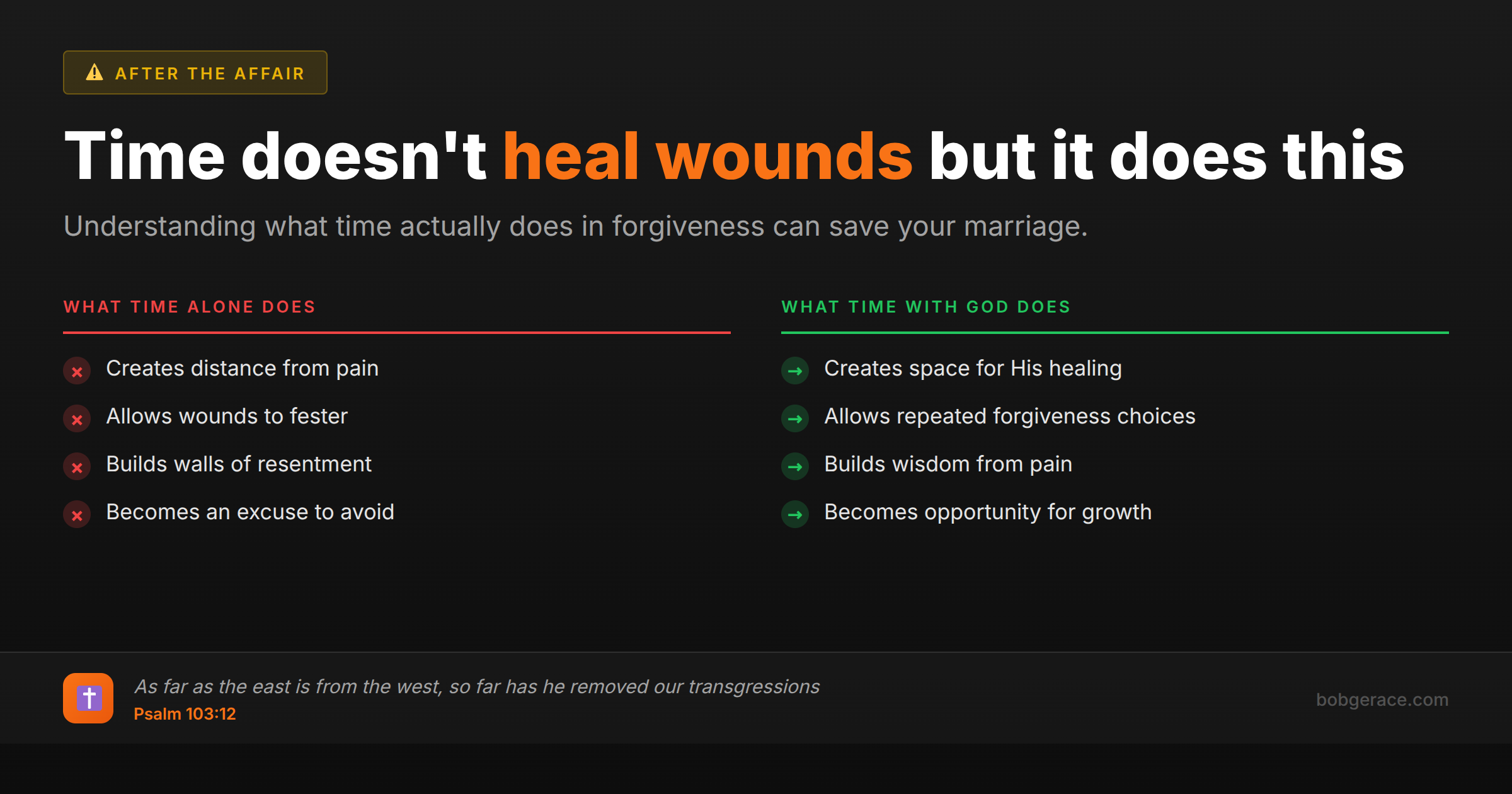
Time plays a crucial but misunderstood role in forgiveness. While forgiveness itself is a decision that can happen instantly, the healing process that accompanies forgiveness unfolds over time. Scripture shows us that God's forgiveness is immediate and complete, but our human experience of processing hurt, rebuilding trust, and experiencing emotional healing requires patience and time. The Bible doesn't teach that time automatically heals wounds or that we should simply "wait it out." Instead, time provides the space for God's work in our hearts, for repeated choices to forgive, and for the Holy Spirit to transform our pain into wisdom. In marriage, understanding time's role in forgiveness prevents us from rushing the process while also keeping us from using time as an excuse to avoid the hard work of reconciliation.
The Full Picture
Time is both friend and enemy in the forgiveness process. As a friend, time gives us the space we need to process deep wounds, allows the Holy Spirit to work in our hearts, and provides opportunities for repeated acts of grace that rebuild relationship foundations. As an enemy, time can become an excuse for delayed obedience, a breeding ground for bitterness, or a false hope that wounds will simply disappear without intentional work.
The confusion comes from mixing up forgiveness with healing. Forgiveness is a decision—a choice to release the debt and choose blessing over revenge. This can happen in a moment. Healing, however, is a process that involves our emotions, memories, trust levels, and relational patterns catching up to our forgiveness decision. This process requires time, just like physical wounds need time to mend even after we've received medical treatment.
In marriage, time's role becomes even more complex because you're not just forgiving and moving on—you're forgiving and moving forward together. The person who hurt you is still there every morning. This means time becomes the canvas on which new experiences, consistent behaviors, and rebuilt trust can be painted. It's not passive waiting; it's active reconstruction.
Scripture shows us that God operates outside of time (2 Peter 3:8), yet He works within time for our benefit. His forgiveness is instant and complete, but His process of sanctification—making us more like Christ—unfolds over our lifetime. Similarly, our forgiveness can be immediate and complete, while our healing and restoration happen progressively through God's patient work in our lives and marriages.
What's Really Happening
From a clinical perspective, time affects forgiveness through several psychological and neurological processes that we're only beginning to understand. When we experience betrayal or deep hurt, our brain's threat detection system becomes hypervigilant, creating what we call 'emotional time distortion'—where painful memories feel more recent and vivid than they actually are.
The forgiveness process requires what I call 'neural pathway renovation.' Our brains have literally carved pathways of hurt, anger, and defensive responses. Creating new pathways of grace, trust, and //blog.bobgerace.com/christian-marriage-confession-psychology-her-secret/:vulnerability-and-defensiveness) requires repetition over time. This isn't weakness—it's how God designed our brains to learn and adapt. Each time we choose forgiveness over resentment, we're strengthening new neural pathways while allowing the old ones to weaken.
I see many couples get frustrated with the 'forgiveness timeline,' expecting either instant emotional relief or linear progress. The reality is that healing happens in waves, with setbacks and breakthroughs. Time provides the container for these waves, but it's not passive time—it's time filled with intentional choices, prayer, and often professional support.
The danger zones I observe are: using time as an avoidance mechanism ('I'm not ready to deal with this yet'), expecting time to do the work that only intentional forgiveness can do, or rushing the process because 'it's been long enough.' Healthy forgiveness respects both the immediate nature of the forgiveness decision and the gradual nature of emotional and relational healing.
What Scripture Says
God's forgiveness transcends time while working within it. 'As far as the east is from the west, so far has he removed our transgressions from us' (Psalm 103:12). God's forgiveness is complete and immediate, yet Scripture also reveals His patient process of sanctification over time.
Jesus taught both immediate and progressive aspects of forgiveness. 'And when you stand praying, if you hold anything against anyone, forgive them, so that your Father in heaven may forgive you your sins' (Mark 11:25). This suggests immediate action, yet Jesus also taught us to pray daily, 'Forgive us our debts, as we also have forgiven our debtors' (Matthew 6:12), indicating an ongoing process.
Scripture acknowledges the time element in healing. 'He heals the brokenhearted and binds up their wounds' (Psalm 147:3). The word 'heals' implies a process, not an instant fix. Isaiah 61:3 speaks of God giving 'beauty for ashes, the oil of joy for mourning, the garment of praise for the spirit of heaviness,' suggesting transformation over time.
Paul's writings show forgiveness as both decision and process. 'Be kind and compassionate to one another, forgiving each other, just as in Christ God forgave you' (Ephesians 4:32). The present tense suggests ongoing action. In Philippians 3:12-14, Paul speaks of 'pressing on' and 'forgetting what is behind,' indicating that even spiritual giants needed time to fully experience the freedom forgiveness brings.
The principle of patient love governs the timeline. 'Love is patient, love is kind... it keeps no record of wrongs' (1 Corinthians 13:4-5). This patience applies both to our own healing process and to our spouse's journey toward change and restoration.
What To Do Right Now
-
1
Make the forgiveness decision today—don't wait for feelings to align or circumstances to change
-
2
Acknowledge that healing is a process and give yourself permission to need time without guilt
-
3
Create healthy boundaries during the healing process that protect without punishing
-
4
Establish regular prayer and Bible study focused on God's grace and forgiveness principles
-
5
Seek professional Christian counseling if trauma or repeated patterns complicate the process
-
6
Practice patience with your spouse's timeline while maintaining your own healing journey
Related Questions
- Can I forgive before I'm ready?
- What does forgiveness feel like when it's real?
- How do I know if I've actually forgiven?
- What if the pain keeps coming back?
- What's the process of forgiveness?
- What blocks forgiveness?
- How long does recovery take?
- How long does real change actually take?
- What does healing timeline look like?
- How long does it take to save a marriage?
Also find Bob on
Subscribe for weekly videos on Christian marriage.
Forgiveness in Your Actual Marriage
Time doesn't heal on its own—you need someone who knows your story, sees where you're stuck, and helps you make the next right move in your specific situation.
Talk to Bob →