How do I build tolerance for being wrong?
6 min read
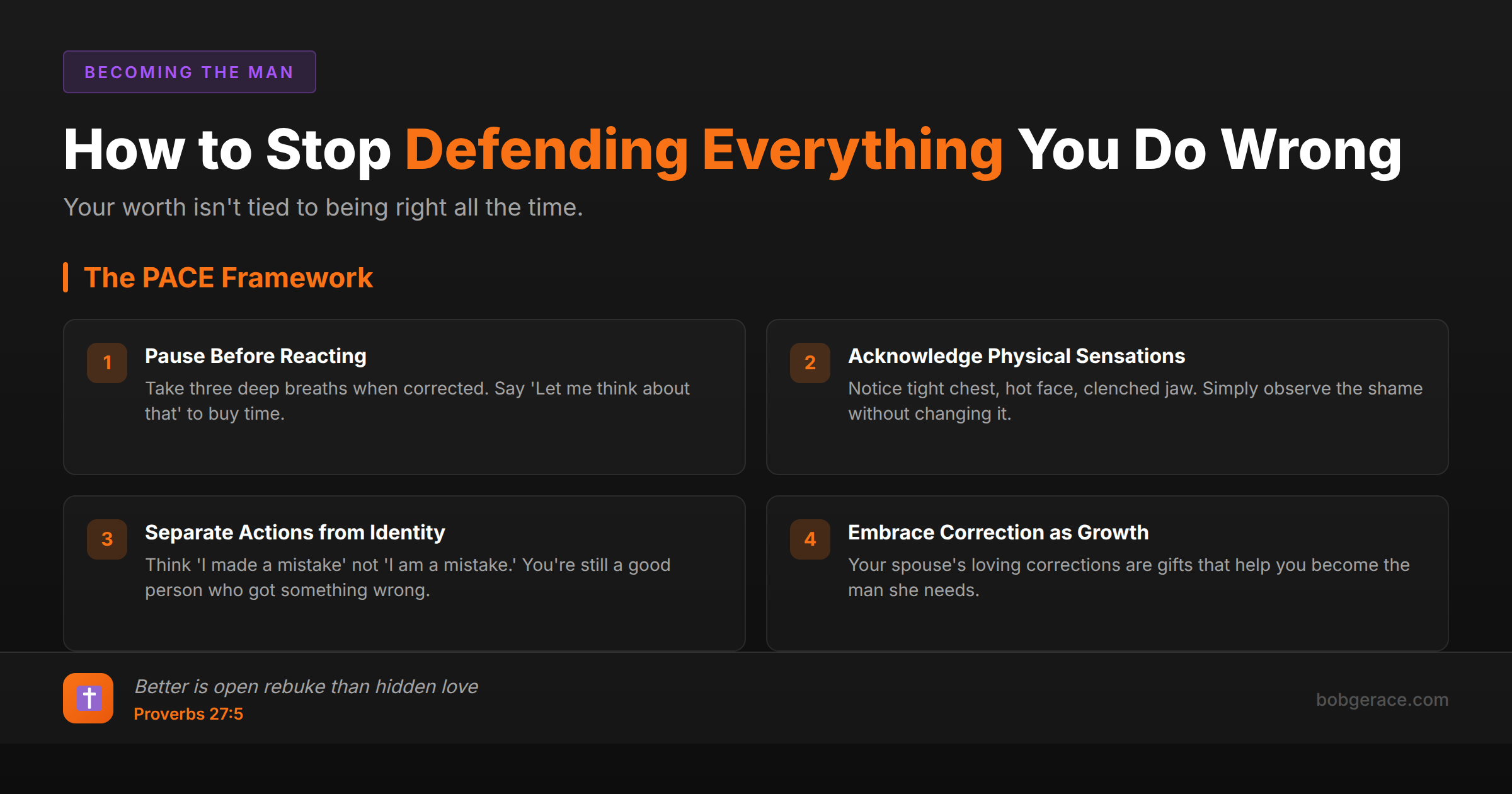
Building tolerance for being wrong starts with understanding that your worth isn't tied to being right all the time. Most people who struggle with this have deep shame that gets triggered when they make mistakes, causing them to defend, deflect, or attack instead of simply acknowledging error. The key is to separate your identity from your actions. You can be a good person who made a mistake, a loving spouse who said something hurtful, or a capable adult who got something wrong. Start small - practice admitting minor mistakes without over-explaining or defending. Notice the physical sensations of shame when they arise, and remind yourself that being wrong is human, not catastrophic.
The Full Picture
Being unable to tolerate being wrong destroys marriages faster than almost any other pattern. When you can't handle making mistakes, you become defensive, argumentative, and impossible to resolve conflict with. Your spouse stops bringing up legitimate concerns because they know it will turn into a fight about your feelings rather than addressing the actual issue.
This isn't really about being wrong - it's about shame. Somewhere along the way, you learned that making mistakes meant you were bad, unworthy, or unlovable. Maybe you had critical parents, experienced bullying, or developed perfectionist tendencies as a survival mechanism. Now, even small corrections feel like attacks on your entire character.
Here's what's really happening in your nervous system: When someone points out that you're wrong, your brain interprets this as a threat to your social standing and worthiness. Your fight-or-flight response kicks in, flooding you with stress hormones that make it nearly impossible to think clearly or respond appropriately. You're not choosing to be defensive - you're having an automatic trauma response.
The good news is that tolerance can be built. Just like building physical strength, you can gradually increase your capacity to handle being wrong without falling apart. This requires understanding the difference between your actions and your identity, developing self-compassion, and creating new neural pathways through repeated practice.
Your marriage needs you to get good at this. When you can say "You're right, I messed up" without collapsing or counter-attacking, you create safety for honest communication. Conflicts get resolved instead of escalated. Your spouse feels heard and valued instead of frustrated and shut down.
What's Really Happening
From a clinical perspective, intolerance for being wrong typically stems from insecure attachment patterns and shame-based identity formation. Individuals with this struggle often developed hypervigilance around criticism during their formative years, creating neural pathways that interpret any correction as existential threat.
The shame-based identity says "I am what I do," meaning mistakes feel like character assassinations rather than simple human errors. This creates a psychological phenomenon called "cognitive fusion" - you become so identified with being right that being wrong threatens your sense of self.
Neurologically, when shame is triggered, the prefrontal cortex (responsible for rational thinking) goes offline while the amygdala (fear center) takes control. This explains why you might say things during these moments that you later regret - you're literally not thinking clearly.
Building tolerance requires what we call "distress tolerance skills" - the ability to experience uncomfortable emotions without immediately acting to escape them. This involves recognizing shame sensations in your body (tight chest, hot face, racing heart), naming the emotion, and riding it out instead of defending against it.
The therapeutic goal is developing what Kristin Neff calls "self-compassion" - treating yourself with the same kindness you'd show a friend who made a mistake. This involves mindful awareness of your humanity, common humanity (everyone makes mistakes), and self-kindness instead of self-attack.
What Scripture Says
Scripture is clear that wisdom comes through acknowledging our limitations and mistakes, not hiding from them. Proverbs 27:5-6 tells us, "Better is open rebuke than hidden love. Wounds from a friend can be trusted, but an enemy multiplies kisses." Your spouse's corrections, when given in love, are gifts that help you grow.
James 1:19 instructs us to be "quick to listen, slow to speak and slow to become angry." When you're defensive about being wrong, you're doing the opposite - quick to speak (defend), slow to listen, and quick to become angry. This verse provides a practical framework for responding differently.
The gospel itself requires acknowledging we're wrong. 1 John 1:8-9 says, "If we claim to be without sin, we deceive ourselves and the truth is not in us. If we confess our sins, he is faithful and just and will forgive us." You practice gospel living every time you admit fault without shame spiraling.
Proverbs 12:1 is direct: "Whoever loves discipline loves knowledge, but whoever hates correction is stupid." This isn't harsh - it's loving truth. When you resist being wrong, you resist growth and wisdom.
Ephesians 4:15 calls us to "speak the truth in love," but this requires being able to receive truth in love as well. Your identity isn't in your performance but in Christ's finished work. Romans 8:1 reminds us there is "no condemnation for those who are in Christ Jesus" - even when you're wrong.
Remember Ecclesiastes 7:20: "Indeed, there is no one on earth who is righteous, no one who does what is right and never sins." Expecting yourself to never be wrong is expecting something God doesn't even expect.
What To Do Right Now
-
1
Start with body awareness - Notice physical sensations when someone corrects you (tight chest, hot face, clenched jaw). Simply observe without trying to change anything.
-
2
Practice the pause - When you feel defensive, take three deep breaths before responding. Say 'Let me think about that' to buy yourself time.
-
3
Separate actions from identity - Remind yourself 'I made a mistake' instead of 'I am a mistake.' Your worth isn't determined by being right.
-
4
Use the 24-hour rule - If you can't admit you're wrong in the moment, commit to coming back within 24 hours to acknowledge your mistake.
-
5
Start with low-stakes practice - Admit you're wrong about small things (directions, facts, preferences) to build your tolerance muscle gradually.
-
6
Develop a standard phrase - Practice saying 'You're right, I was wrong' or 'I messed up' without adding explanations or defenses immediately after.
Related Questions
Ready to Stop the Defensive Cycle?
Learning to handle being wrong takes practice and support. Let's work together to build your tolerance for mistakes and create a healthier marriage dynamic.
Get Help Now →