How do I enforce without controlling?
6 min read
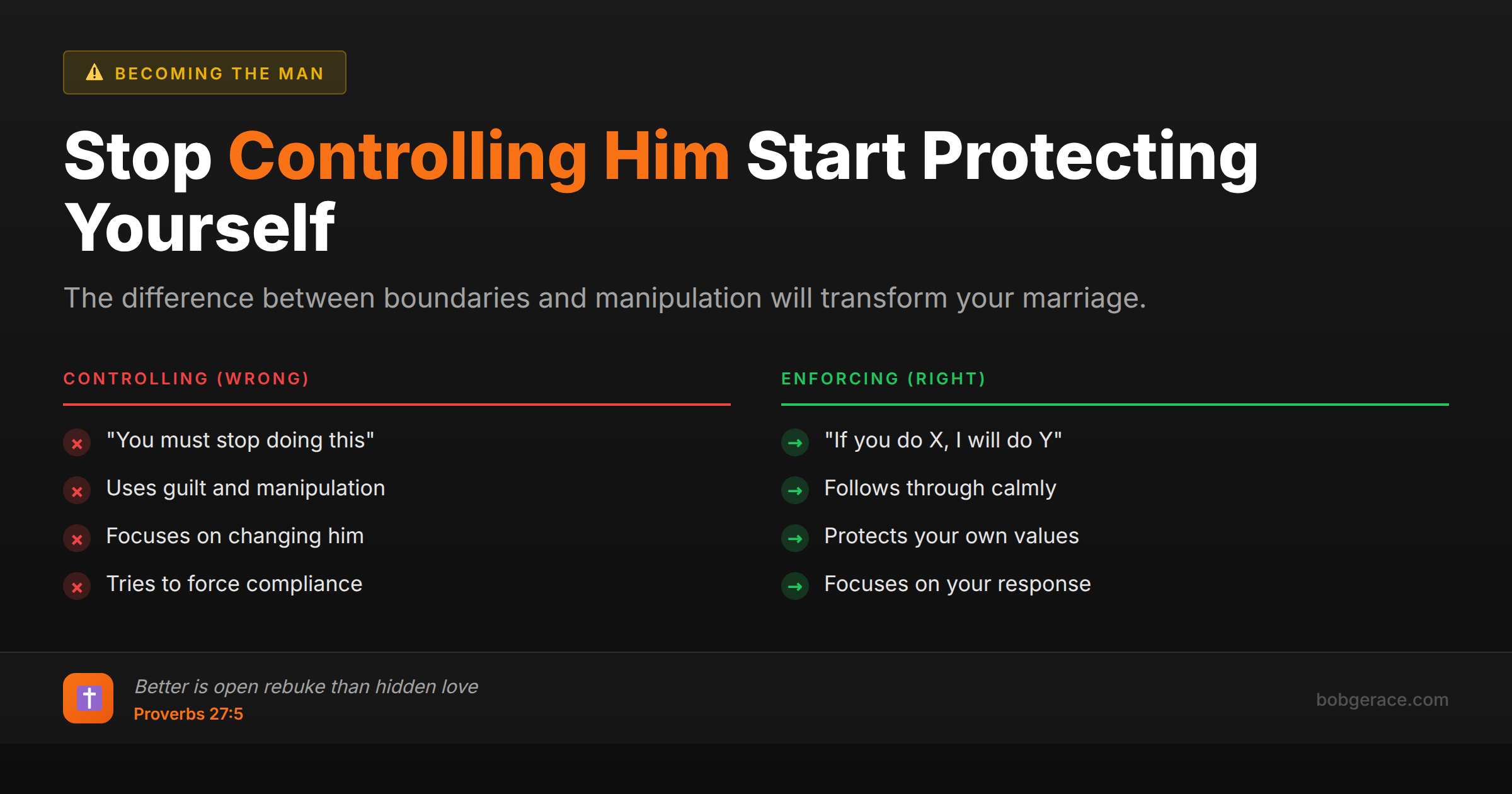
Enforcement focuses on your own actions and consequences, while control attempts to manipulate your spouse's choices. When you enforce a boundary, you're saying 'If you do X, I will do Y' - then you follow through consistently without trying to force their behavior. Control says 'You must do this' and uses manipulation, guilt, or coercion to get compliance. Healthy enforcement means you clearly communicate your boundary, implement consequences when it's crossed, and remain calm throughout the process. You're not trying to punish or change your husband - you're protecting yourself and maintaining your values. The key is focusing on what you can control (your responses) rather than what you can't (his choices).
The Full Picture
This is one of the most important distinctions you can master as a wife. The line between healthy boundary enforcement and controlling behavior often gets blurred, especially when you're frustrated or feeling powerless in your marriage.
Boundary enforcement is protective - it's about safeguarding your emotional, physical, and spiritual well-being. When you enforce a boundary, you're essentially saying, "I cannot control what you choose to do, but I can control how I respond to your choices." You're taking responsibility for your own peace and safety without trying to force your husband to be different.
Control, on the other hand, is manipulative - it's about trying to force specific outcomes or behaviors from your spouse. Control uses tactics like guilt, threats, silent treatment, or emotional manipulation to get compliance. It says, "You have to change so I can feel better."
The practical difference shows up in your approach. With enforcement, you might say: "I've asked you not to speak to me disrespectfully. If you continue to raise your voice at me, I'm going to leave the room and we can talk when you're calm." Then you follow through without drama or trying to make him feel bad.
With control, you might say: "You're being horrible to me! You never listen! I'm not talking to you until you apologize and promise to never do this again!" The focus shifts to punishing him and forcing an outcome.
The heart issue matters tremendously here. Enforcement comes from a place of self-respect and healthy boundaries. Control comes from fear, anger, or a desperate need to manage outcomes. One builds respect in your marriage; the other erodes it.
What's Really Happening
From a therapeutic standpoint, the difference between boundary enforcement and controlling behavior lies in the locus of control and the underlying motivation. Women who struggle with this distinction often come from backgrounds where boundaries were either non-existent or rigidly controlling - they lack a healthy model.
Controlling behavior typically stems from anxiety and a deep fear of abandonment or rejection. When we feel powerless, our nervous system can hijack our rational thinking, pushing us toward controlling tactics as a survival mechanism. This creates a paradox: the more we try to control our spouse, the more likely we are to push them away.
Healthy boundary enforcement, conversely, comes from a regulated nervous system and a secure sense of self. It's rooted in self-respect rather than fear. When you enforce boundaries from this place, you're communicating your worth and values clearly without trying to manage your spouse's response.
I often tell my clients to check their internal state before enforcing a boundary. Are you feeling desperate, angry, or panicked? Those emotions often lead to controlling behaviors. Or are you feeling sad but resolved, disappointed but clear? Those emotions typically support healthy enforcement.
The neurological difference is significant too. Control activates your spouse's threat detection system, triggering defensiveness and resistance. Calm, consistent boundary enforcement actually helps regulate both of your nervous systems over time, creating more safety and connection in the relationship.
What Scripture Says
Scripture gives us a beautiful framework for understanding the difference between godly boundaries and ungodly control. God Himself models perfect boundary enforcement - He clearly communicates His standards, follows through with consequences, but never forces our compliance.
Proverbs 27:5-6 reminds us: *"Better is open rebuke than hidden love. Wounds from a friend can be trusted, but an enemy multiplies kisses."* True love sometimes requires difficult conversations and firm boundaries, but it's always done for the other person's good, not to control them.
Galatians 6:5 tells us: *"For each one should carry their own load."* This verse speaks directly to the heart of boundaries - we're responsible for our own choices and responses, not for managing other people's behavior. When you try to control your husband, you're essentially trying to carry his load for him.
Matthew 7:3-5 challenges us to examine our own hearts: *"Why do you look at the speck of sawdust in your brother's eye and pay no attention to the plank in your own eye?"* Before enforcing any boundary, we need to check our motivations. Are we trying to control outcomes, or are we genuinely protecting what God has entrusted to us?
1 Peter 3:1-2 offers wisdom specifically for wives: *"Wives, in the same way submit yourselves to your own husbands so that, if any of them do not believe the word, they may be won over without words by the behavior of their wives, when they see the purity and reverence of your lives."* Notice this isn't about controlling or fixing your husband - it's about living with integrity and letting God work in his heart.
The key biblical principle is this: we're called to be faithful to God's standards in our own lives while entrusting the outcomes to Him.
What To Do Right Now
-
1
Check your heart first - Before enforcing any boundary, ask yourself: 'Am I trying to protect myself or control my husband?' Pray and get your heart right with God.
-
2
Communicate clearly and calmly - State your boundary in simple, non-accusatory terms: 'I will not continue conversations when voices are raised' rather than 'You always yell at me.'
-
3
Focus on your actions, not his - Your boundary should describe what YOU will do, not what you're demanding from him. 'I will leave the room' not 'You need to stop.'
-
4
Follow through consistently - Do exactly what you said you'd do, every time, without drama or explanations. Consistency builds respect and trust in your word.
-
5
Stay calm during enforcement - Don't lecture, punish, or try to make him feel guilty. Simply implement your boundary with as much peace as possible.
-
6
Release the outcome to God - Your job is to maintain your boundary with love and integrity. God's job is to work in your husband's heart. Trust the process and focus on your own faithfulness.
Related Questions
- What is a boundary vs. an ultimatum?
- What makes boundaries healthy?
- What does flexible but firm look like?
- What boundaries are non-negotiable?
- What consequences are appropriate?
- What does self-protective boundary-setting look like?
- What boundaries should I set?
- What's the difference between boundary and ultimatum?
- When does patience become enabling?
- How do I pursue reconciliation while refusing to participate in sin?
Also find Bob on
Subscribe for weekly videos on Christian marriage.
Enforcing in Your Marriage Is Different
What works as a boundary in your specific situation — with your husband's patterns, your history, your kids — isn't something a framework can answer. A coach who knows your story can.
Talk to Bob →