How do I give an ultimatum without losing her?
6 min read
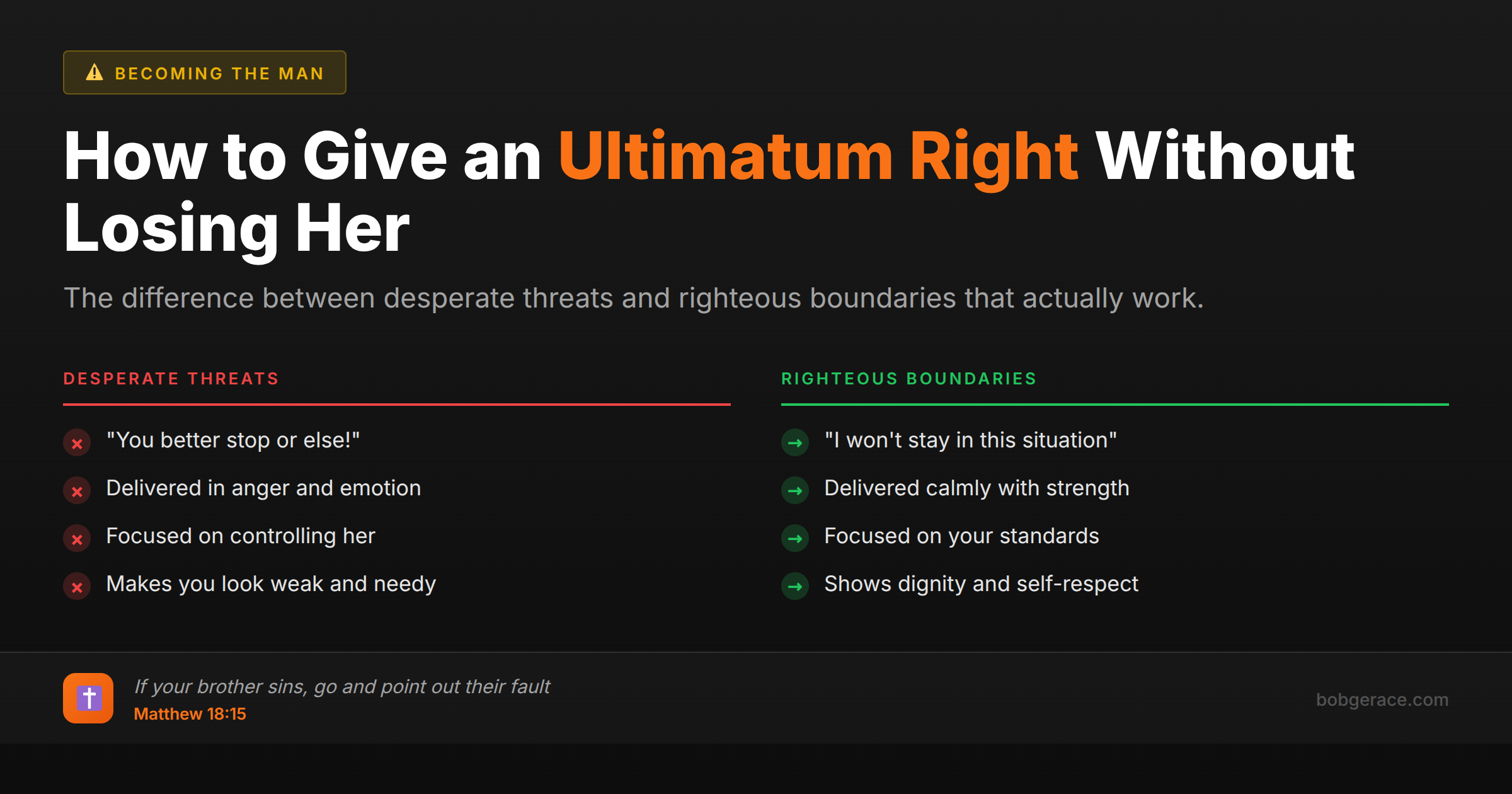
The truth is, you can't control whether she stays or goes - but you can control how you present your boundaries. An effective ultimatum isn't about manipulation or threats; it's about clearly communicating what you will and won't accept in your marriage, along with the natural consequences of her choices. The key is delivering it from a place of strength and love, not desperation or anger. Focus on what YOU will do based on HER choices, not what you're demanding she do. For example: 'I love you and want our marriage to work, but I won't remain in a marriage where there's another man involved. If you choose to continue this relationship, I will begin the separation process.' This puts the choice squarely on her while maintaining your dignity.
The Full Picture
When your wife is involved with another man, you're facing one of the most painful decisions a husband can make. You love her, you want to save your marriage, but you also know that allowing the situation to continue is destroying you both. The question isn't really about giving an ultimatum without losing her - it's about whether you're willing to lose yourself by not setting boundaries.
Here's what most men get wrong: they think an ultimatum is about getting her to choose them. That's backwards. A proper boundary is about you choosing yourself - choosing to honor your values, your dignity, and your worth as a man and husband.
The fear of 'losing her' often keeps men trapped in situations where they've already lost her. She's already chosen another man over you, at least temporarily. Your ultimatum doesn't create that reality - it simply responds to it with clarity and strength.
The paradox is this: the more desperate you are to keep her, the more likely you are to lose her. Women are attracted to strength, decisiveness, and men who value themselves. When you set a clear boundary - even one that might result in separation - you're demonstrating those very qualities.
This doesn't mean being cruel or vindictive. It means being loving but firm. You can say 'I love you deeply, but I love myself and our marriage covenant enough to not accept this situation continuing.' That's not weakness disguised as strength - that's actual strength motivated by love.
Remember: if she leaves because you won't accept her affair, you haven't lost a woman who loved you - you've discovered a woman who didn't value your marriage enough to fight for it.
What's Really Happening
From a psychological perspective, what you're experiencing is called 'approach-avoidance conflict' - you need to address the situation, but you fear the potential outcome. This creates a paralysis that actually makes the situation worse.
When a spouse is involved with another person, they're often living in what we call 'affair fog' - a state where their decision-making is compromised by the neurochemical high of the new relationship. In this state, weakness and desperation from the betrayed spouse often reinforces their justification for the affair.
Contrary to intuition, clear boundaries and consequences often serve as a 'wake-up call' that can penetrate this fog. When you stop pursuing and start protecting yourself, it forces your spouse to confront the real consequences of their choices rather than taking your presence for granted.
The 'ultimatum' you're considering is actually a healthy boundary. The key is in the delivery and timing. Research shows that boundaries work best when they're: 1) Clear and specific, 2) Delivered calmly, not in anger, 3) Focused on your actions, not demands for theirs, 4) Followed through consistently.
Many men worry that setting boundaries will 'push her into his arms,' but psychological research suggests the opposite - affairs often lose their appeal when they stop being secret and consequence-free. Your boundary forces the affair out of fantasy and into reality.
The most important insight: you cannot love someone back from an affair by sacrificing your dignity. Healthy relationships require two people who respect themselves enough to expect respect from others.
What Scripture Says
Scripture is clear about the seriousness of marital faithfulness and the importance of righteous boundaries. God Himself sets boundaries with His people, not out of cruelty, but out of love and holiness.
Matthew 18:15-17 provides the biblical framework for confronting sin: 'If your brother or sister sins, go and point out their fault, just between the two of you. If they listen to you, you have won them over. But if they will not listen, take one or two others along... If they still refuse to listen, tell it to the church; and if they refuse to listen even to the church, treat them as you would a pagan or a tax collector.' This progression shows that consequences escalate when repentance doesn't occur.
1 Corinthians 5:11-13 addresses how to handle persistent sin: 'But now I am writing to you that you must not associate with anyone who claims to be a brother or sister but is sexually immoral... With such persons do not even eat. God will judge those outside. Expel the wicked person from among you.' Paul advocates for separation when someone claims to follow God but lives in persistent sin.
Ephesians 5:11 commands us: 'Have nothing to do with the fruitless deeds of darkness, but rather expose them.' Enabling your wife's affair by accepting it violates this command.
Proverbs 27:5 reminds us: 'Better is open rebuke than hidden love.' Your 'ultimatum' isn't unloving - it's actually the most loving thing you can do. You're refusing to enable sin that's destroying her soul and your marriage.
Matthew 10:37 shows that even Jesus understood the necessity of difficult choices: 'Anyone who loves their father or mother more than me is not worthy of me.' Sometimes love requires us to choose what's right over what's comfortable.
God demonstrates this principle throughout Scripture - He sets boundaries, He has consequences for crossing them, and He follows through. He does this not because He doesn't love us, but because He does.
What To Do Right Now
-
1
Get spiritually and emotionally prepared first - Pray, fast, seek counsel from mature Christian friends or pastors before delivering your boundary
-
2
Write out your boundary clearly - Script what you'll say, focusing on your actions and decisions rather than demands or threats
-
3
Choose the right time and setting - Have this conversation when you're calm, she's sober, and you won't be interrupted or rushed
-
4
Deliver it with strength and love - Speak clearly, maintain eye contact, keep your voice steady, and express both your love and your resolve
-
5
Give her time to respond - Set a specific timeframe (usually 24-48 hours) for her decision, then stick to it regardless of her response
-
6
Follow through completely - Whatever consequence you stated, implement it immediately if she chooses to continue the affair - your credibility depends on consistency
Related Questions
Ready to Set Boundaries That Actually Work?
Don't navigate this alone. Get the specific guidance you need to handle this situation with wisdom and strength.
Get Help Now →