How do I hold boundaries without hardening my heart?
6 min read
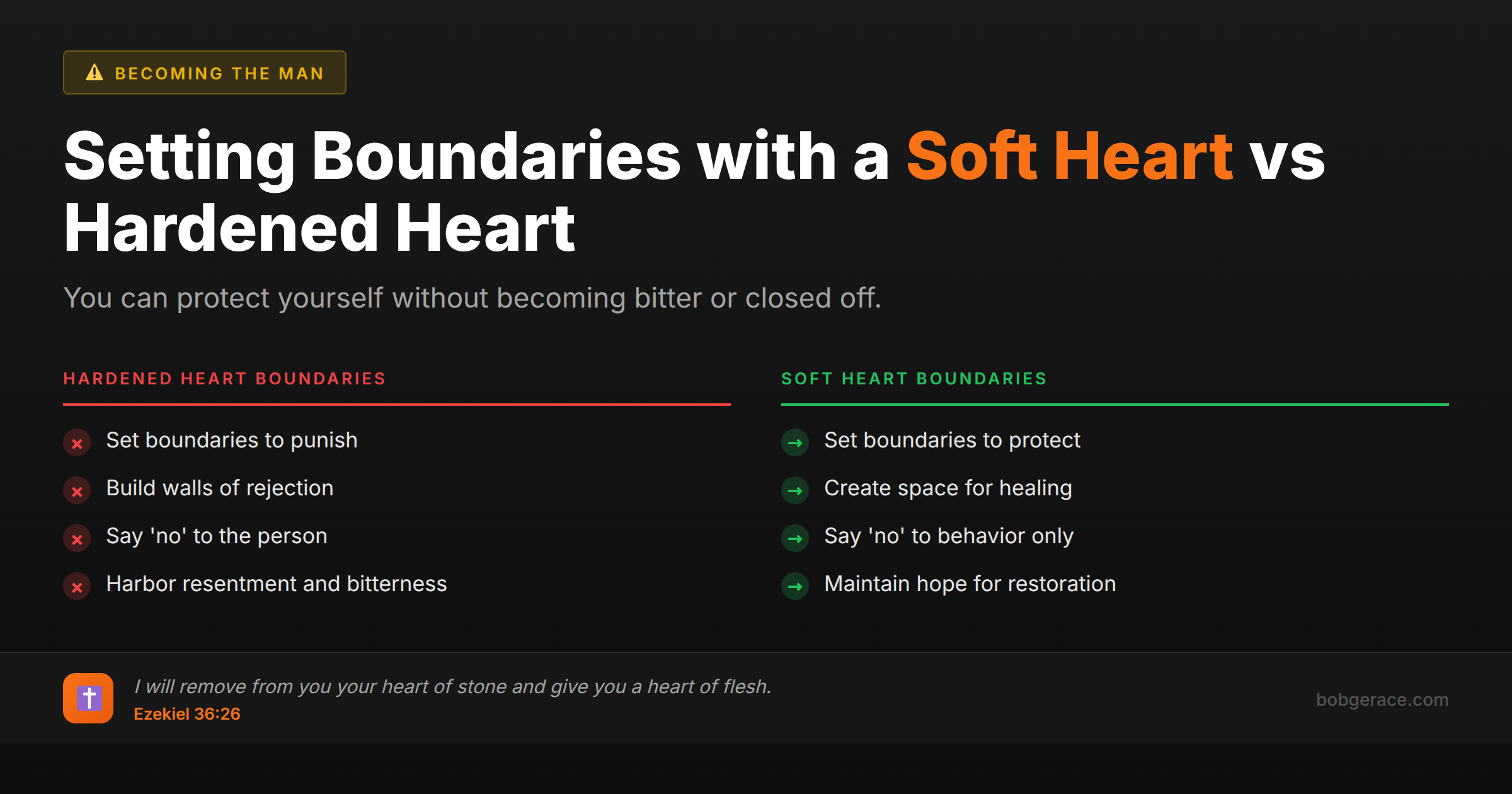
Holding boundaries without hardening your heart requires understanding that boundaries are acts of love, not walls of rejection. A soft heart maintains hope and compassion while still protecting what God has entrusted to you. The key is setting limits on behavior while keeping your heart open to the person. This means you can say 'no' to destructive actions while still saying 'yes' to the possibility of restoration. You protect yourself from harm without becoming bitter or closed off. Biblical boundaries flow from love - both love for yourself as God's daughter and love for others that refuses to enable their destructive choices. When you understand that boundaries actually create space for healing and growth, you can maintain them with a heart full of hope rather than hardened by resentment.
The Full Picture
The struggle between maintaining boundaries and keeping a soft heart is one of the most challenging aspects of dealing with marital betrayal. Many women fear that setting firm limits will make them hard, bitter, or unloving. Others worry that having a soft heart means they must accept mistreatment or lower their standards.
This false dichotomy has trapped countless wives in cycles of either doormat behavior or defensive walls. But God's design offers a third way - boundaries with a soft heart. This isn't about being weak or being harsh. It's about being wise.
A soft heart doesn't mean you have no limits. It means your limits flow from love rather than fear or anger. When you understand that boundaries protect both you and your marriage from further damage, you can hold them with confidence and compassion.
The difference lies in your motivation and method. Hard-hearted boundaries come from bitterness and are designed to punish. Soft-hearted boundaries come from love and are designed to protect and heal. Hard boundaries build walls; soft boundaries create healthy space.
Your heart remains soft when you remember that boundaries aren't about controlling your husband - they're about taking responsibility for what God has placed under your care. You can limit your exposure to destructive behavior while still hoping and praying for his transformation. You can protect your heart without closing it permanently.
What's Really Happening
From a psychological perspective, the fear of hardening your heart often stems from a misunderstanding of healthy emotional regulation. Many women have been conditioned to believe that any form of self-protection is selfish or unloving, leading to a pattern of over-giving and under-protecting.
What we see clinically is that women who struggle with this balance often have anxious attachment styles or people-pleasing tendencies. They equate boundaries with rejection because they've internalized the belief that love means unlimited access and tolerance of harmful behavior.
The truth is that emotional boundaries are neurologically protective. When you set appropriate limits, you're actually preserving your capacity for genuine love and connection. Without boundaries, chronic stress and repeated betrayal trauma can literally rewire your brain toward hypervigilance and emotional numbing.
Healthy boundaries allow your nervous system to regulate, which maintains your ability to respond with wisdom rather than react from trauma. This is why boundary-setting is actually an act of love - it preserves your emotional and spiritual resources for the long-term work of relationship healing.
Women who successfully maintain soft hearts with firm boundaries have learned to separate the person from the behavior. They can feel compassion for their husband's brokenness while refusing to enable his destructive choices. This requires developing what we call 'differentiated love' - the ability to care deeply while not taking responsibility for another person's choices.
What Scripture Says
Scripture provides clear guidance on maintaining both boundaries and a soft heart. God Himself models this perfectly - He loves us unconditionally while maintaining firm standards for righteousness.
Ezekiel 36:26 promises, *"I will give you a new heart and put a new spirit in you; I will remove from you your heart of stone and give you a heart of flesh."* God desires soft hearts, but notice this comes with a new spirit - one that can discern and respond appropriately.
Proverbs 27:5-6 teaches, *"Better is open rebuke than hidden love. Wounds from a friend can be trusted, but an enemy multiplies kisses."* Sometimes love requires saying hard things and maintaining difficult boundaries. True love doesn't enable destruction.
Nehemiah 4:13-14 shows us practical wisdom: *"From that day on, half of my men did the work, while the other half were equipped with spears, shields, bows and armor."* Nehemiah didn't stop the work of rebuilding, but he established protection. You can continue loving while protecting what God has entrusted to you.
Matthew 10:16 instructs us to be *"as shrewd as snakes and as innocent as doves."* This perfectly captures the balance - wisdom in protection combined with purity of heart.
Galatians 6:2 calls us to *"carry each other's burdens,"* but verse 5 says *"each one should carry their own load."* You can offer support without taking responsibility for consequences that belong to your husband.
The key is following Jesus' example - He had perfect love and perfect boundaries. He never compromised truth for the sake of avoiding conflict, yet His heart remained completely open to those who truly sought Him.
What To Do Right Now
-
1
Check your motivation - Ask yourself: 'Am I setting this boundary from love or from anger?' Boundaries from love protect; boundaries from anger punish.
-
2
Pray for his heart daily - Maintain spiritual connection to his wellbeing even while protecting yourself from his poor choices.
-
3
Separate the person from the behavior - Practice saying: 'I love you AND I won't accept this treatment.' Both can be true simultaneously.
-
4
Set limits with hope - Frame boundaries as creating space for healing: 'When you're ready to do the work, I'm here.'
-
5
Guard your heart through Scripture - Regularly read passages about God's love to prevent bitterness from taking root in your thoughts.
-
6
Seek wise counsel regularly - Stay connected with people who can help you discern between appropriate firmness and unhealthy hardness.
Related Questions
- What boundaries should I set?
- What's the difference between boundary and ultimatum?
- What makes boundaries effective vs. empty threats?
- How do I set boundaries without controlling?
- What does 'holding space' while 'holding boundary' look like?
- How do I stay connected while enforcing boundaries?
- What does loving confrontation look like biblically?
- What's the difference between forgiveness and reconciliation?
- Can I forgive and still have boundaries?
- How do I honor her autonomy while fighting for us?
Also find Bob on
Subscribe for weekly videos on Christian marriage.
This Is Hard to Calibrate Alone
A coach who knows your marriage can help you hold the line without losing your heart. Bob works with you on what boundaries actually fit your situation.
Talk to Bob →