How do I make this decision?
6 min read
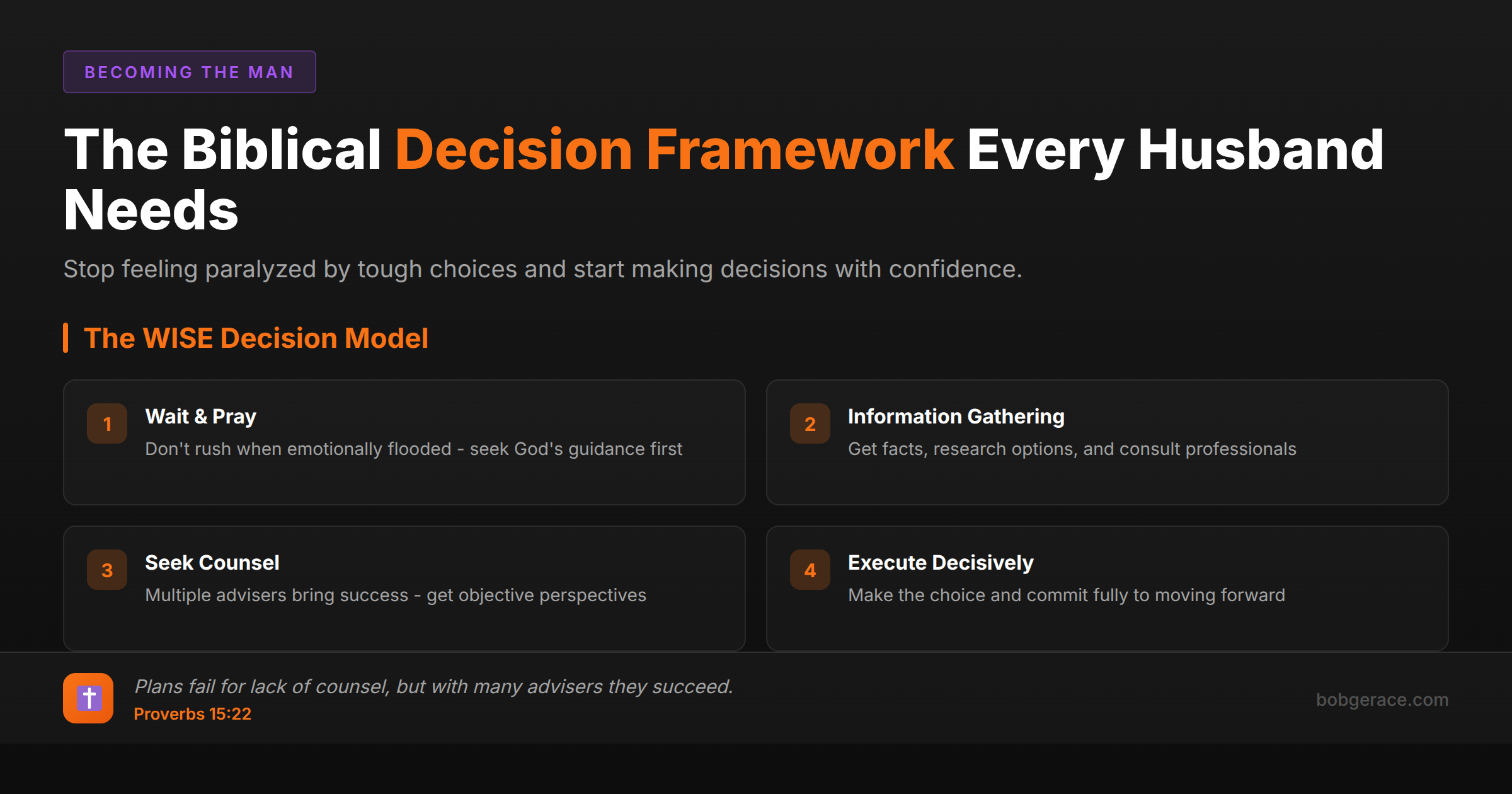
Making difficult decisions in marriage requires a combination of biblical wisdom, practical discernment, and trusted counsel. Start by getting clear on what decision you're actually facing—often we're overwhelmed because we're trying to solve multiple problems at once. Take time to pray and seek God's guidance through His Word, looking for principles that apply to your situation. Don't make major decisions when you're emotionally flooded or under pressure. Give yourself permission to take the time you need to think clearly. Seek wise counsel from trusted friends, mentors, or professionals who can offer objective perspective. Remember that God cares about your decisions and wants to guide you toward what honors Him and leads to flourishing.
The Full Picture
Decision-making in marriage can feel overwhelming, especially when you're dealing with ongoing conflict, betrayal, or uncertainty about your future. The stakes feel high because they are high—your choices affect not just you, but your spouse, children, and extended family. Many women get stuck in analysis paralysis, endlessly weighing options without ever moving forward.
The first step is getting clear on what decision you're actually facing. Are you deciding whether to stay or leave? Whether to confront a behavior? Whether to seek counseling? Whether to set a boundary? Often we feel paralyzed because we're trying to make five decisions at once instead of focusing on the next right step.
Time and emotional state matter tremendously. Major life decisions shouldn't be made when you're in crisis mode, sleep-deprived, or emotionally flooded. Your brain literally can't process information clearly when you're in survival mode. This doesn't mean waiting indefinitely—it means giving yourself enough space to think rationally.
Information gathering is crucial. You need facts, not just feelings. If you're dealing with addiction, infidelity, or abuse, get professional help to understand what you're really facing. If you're considering separation, understand the legal and financial implications. If you're thinking about confronting behaviors, know what healthy boundaries look like.
The decision-making process itself should involve prayer, Scripture, wise counsel, and practical wisdom. God doesn't usually speak through burning bushes, but He does guide us through His Word, the counsel of mature believers, and the wisdom He's given us through experience and common sense.
What's Really Happening
From a clinical perspective, decision-making difficulties often stem from several underlying factors. First, chronic stress and trauma can impair executive functioning—the brain's ability to weigh options and make clear judgments. If you've been living in a high-conflict or unpredictable marriage, your nervous system may be stuck in hypervigilance mode.
Second, many women struggle with decision-making because they've been trained to prioritize everyone else's needs over their own. This people-pleasing pattern makes it difficult to know what you actually want or need, separate from what others expect from you.
Third, perfectionism and fear of making the 'wrong' choice can create decision paralysis. The truth is, most decisions aren't permanently life-altering. Even major decisions like separation can be reversed if circumstances change.
Fourth, complex trauma responses can include difficulty trusting your own judgment. If you've been gaslighted or manipulated, you may doubt your ability to perceive situations accurately.
The antidote involves several key elements: stabilizing your nervous system through self-care and possibly therapy, learning to identify and honor your own needs and values, accepting that imperfect action is often better than perfect inaction, and rebuilding trust in your own discernment through practice with smaller decisions first.
Remember that good decision-making is a skill that improves with practice. Start with lower-stakes choices to rebuild confidence in your judgment before tackling the major life decisions.
What Scripture Says
Scripture provides a clear framework for making wise decisions, especially in difficult circumstances. Proverbs 27:14 reminds us that "Plans fail for lack of counsel, but with many advisers they succeed." God doesn't expect us to figure everything out in isolation—He provides wisdom through His Word and His people.
James 1:5 promises that "If any of you lacks wisdom, you should ask God, who gives generously to all without finding fault, and it will be given to you." This isn't a guarantee that God will give you a detailed roadmap, but rather that He will provide the wisdom you need to take the next right step.
Proverbs 3:5-6 instructs us to "Trust in the Lord with all your heart and lean not on your own understanding; in all your ways submit to him, and he will make your paths straight." This doesn't mean turning off your brain—it means recognizing that your perspective is limited and God's is not.
1 Corinthians 14:33 tells us that "God is not a God of disorder but of peace." Decisions made in chaos, fear, or emotional reactivity rarely lead to God-honoring outcomes. Take time to find peace before making major choices.
Psalm 32:8 offers the promise: "I will instruct you and teach you in the way you should go; I will counsel you with my loving eye on you." God cares about the details of your life and wants to guide you.
Ecclesiastes 3:1 reminds us that there is "a time for everything, and a season for every activity under the heavens." Sometimes the wise choice is to wait; sometimes it's to act decisively.
What To Do Right Now
-
1
Clearly define the specific decision you need to make—write it out in one or two sentences
-
2
Give yourself a reasonable timeframe for deciding, neither rushing nor procrastinating indefinitely
-
3
Gather the information you need through research, professional consultation, or trusted counsel
-
4
Spend time in prayer and Scripture, asking God for wisdom and looking for applicable principles
-
5
List your options and honestly assess the likely outcomes of each choice
-
6
Make the decision and commit to moving forward, trusting God with the results
Related Questions
Need Help Making This Decision?
Don't navigate this alone. Get the clarity and support you need to move forward with confidence.
Get Support →