What factors should I weigh?
6 min read
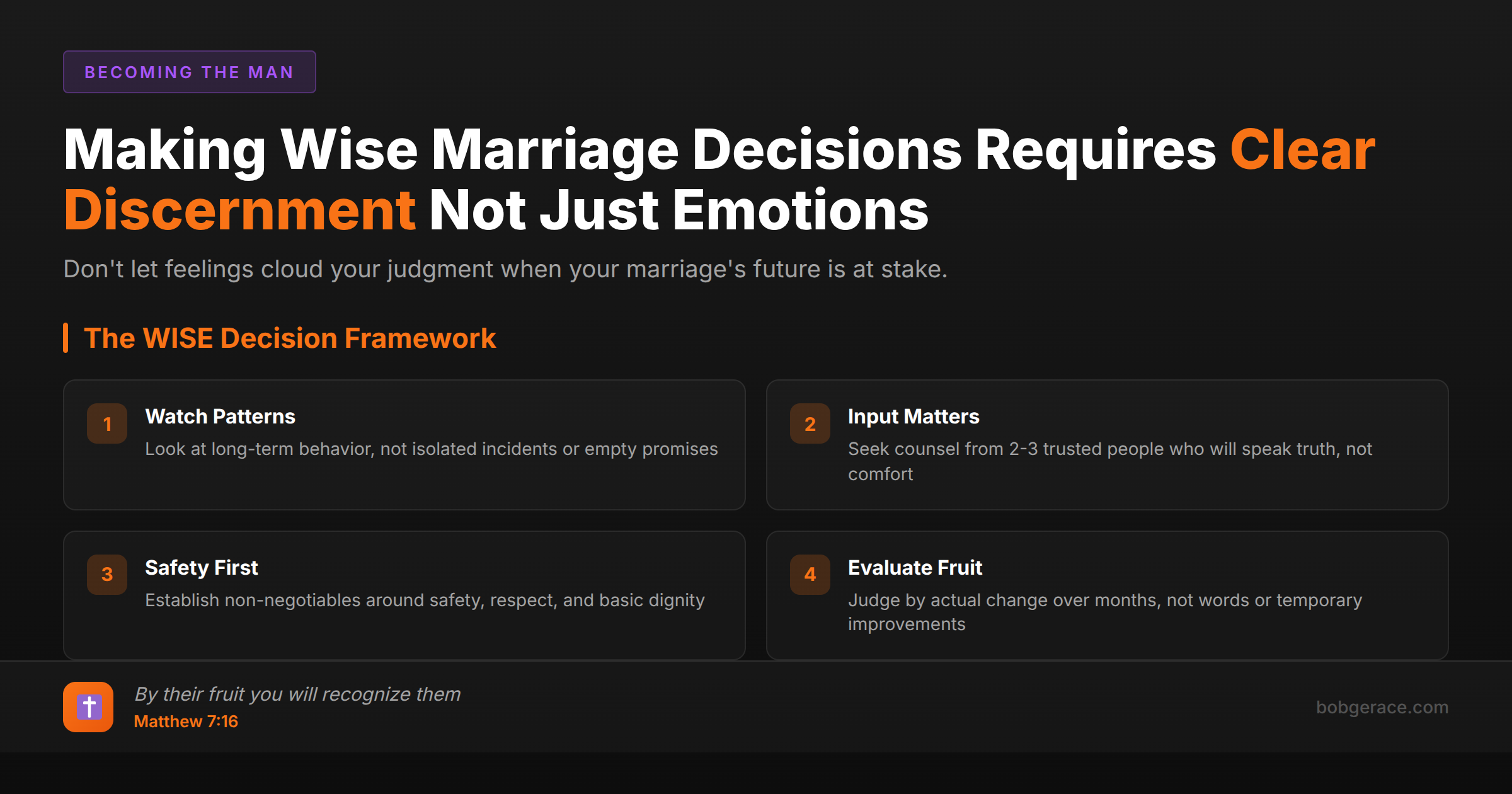
When facing difficult marriage decisions, you need to weigh multiple interconnected factors rather than relying on emotions alone. The key areas include your safety and that of your children, patterns of behavior versus isolated incidents, genuine repentance versus mere promises, your spouse's willingness to engage in real change, and the long-term trajectory of your relationship. Remember that discernment isn't about finding the 'perfect' answer—it's about making wise decisions with the information you have. Consider both the practical realities of your situation and the spiritual principles that guide us. This process takes time, prayer, and often the input of trusted counselors who can help you see clearly through the fog of daily stress and conflicting emotions.
The Full Picture
Making major decisions about your marriage requires looking at the complete landscape, not just the crisis in front of you. Safety comes first—if there's physical, emotional, or psychological abuse, your immediate well-being and that of your children takes precedence over all other considerations.
Next, examine patterns versus incidents. One argument doesn't define a marriage, but a consistent pattern of disrespect, addiction, infidelity, or emotional unavailability reveals character issues that require serious attention. Look at the trajectory: Is your spouse moving toward growth and change, or away from it?
Genuine repentance looks different from damage control. True repentance involves acknowledging wrongdoing, taking full responsibility, making amends, and demonstrating sustained behavioral change. Empty apologies followed by repeated harmful behavior indicate a heart issue, not just a behavioral problem.
Consider your children's wellbeing. Sometimes staying in a toxic marriage does more harm than leaving. Children need to see healthy relationship dynamics, respect, and emotional safety. They're watching how you handle conflict, stress, and your own boundaries.
Your capacity for the long haul matters too. Marriage requires two people willing to do the work. If you're carrying the entire emotional load of the relationship while your spouse remains passive or resistant to change, that's unsustainable. You can't want someone's healing more than they want it themselves.
Finally, examine your support systems and resources. Do you have people speaking truth into your life? Professional counseling? Financial stability? Spiritual community? These factors don't determine your decision, but they affect your ability to navigate whatever path you choose.
What's Really Happening
From a clinical perspective, decision-making under chronic stress becomes compromised. When you're living in survival mode—whether due to conflict, addiction, infidelity, or emotional abuse—your brain's executive functioning is impaired. This is why rushed decisions during crisis often lead to regret.
I encourage clients to create what I call a 'discernment timeline.' Give yourself adequate time to think clearly, gather information, and observe patterns. During this period, focus on stabilizing your emotional state through self-care, therapy, and spiritual practices.
Trauma bonding often complicates decision-making in troubled marriages. The cycle of tension, crisis, reconciliation, and calm creates powerful biochemical bonds that can override logical thinking. If you find yourself constantly making excuses for harmful behavior or feeling like you can't live without someone who consistently hurts you, trauma bonding may be influencing your judgment.
Pay attention to congruence between words and actions. In healthy relationships, what people say aligns with what they do over time. Incongruence—promises that aren't kept, commitments that aren't honored, or values that aren't lived out—indicates deeper character issues that require professional intervention.
Consider your attachment style and family of origin patterns. Sometimes we tolerate unhealthy dynamics because they feel familiar, not because they're actually acceptable. Understanding your own psychological patterns helps you make decisions based on wisdom rather than unconscious programming.
What Scripture Says
Scripture provides clear guidance for discernment, though it rarely offers simple formulas for complex situations. Proverbs 27:14 reminds us that 'the simple believe anything, but the prudent give thought to their steps.' God calls us to be wise, not naive, in our relationships.
Matthew 7:16-20 teaches us to evaluate people by their fruit: 'By their fruit you will recognize them... Every good tree bears good fruit, but a bad tree bears bad fruit.' Look at the long-term patterns and outcomes, not just the intentions or promises.
1 Corinthians 13:4-7 describes love as patient, kind, not envious, not boastful, not proud, not dishonoring others, not self-seeking, not easily angered, keeping no record of wrongs. This isn't just poetry—it's a diagnostic tool. Does your marriage reflect these qualities, or are they consistently absent?
Galatians 6:7 warns that 'a man reaps what he sows.' Enabling destructive behavior by removing natural consequences doesn't show love—it prevents growth. Sometimes the most loving thing you can do is allow someone to face the full weight of their choices.
Psalm 32:8 promises, 'I will instruct you and teach you in the way you should go; I will counsel you with my loving eye on you.' God doesn't leave us to figure things out alone. He provides wisdom through His Word, His Spirit, and His people.
Ecclesiastes 3:1 reminds us there is 'a time for everything'—a time to fight for your marriage and a time to acknowledge when someone has abandoned it through their choices. Discernment helps us recognize which season we're in.
What To Do Right Now
-
1
Create a safe space for honest evaluation—journal your thoughts away from the pressure of daily interaction
-
2
List specific behaviors and patterns, not just feelings or general impressions about your marriage
-
3
Seek input from 2-3 trusted people who know your situation and will speak truth, not just comfort
-
4
Establish non-negotiable boundaries around safety, respect, and basic human dignity
-
5
Set a realistic timeline for observing change—genuine transformation takes months, not days
-
6
Develop your support network and personal stability regardless of what you decide about your marriage
Related Questions
- How do I make this decision?
- What does wise counsel look like?
- How do I separate fear from wisdom?
- How do I separate hope from denial?
- What if I make the wrong choice?
- How do I live with uncertainty?
- Is it okay to still love him and be hurt?
- When is it actually over?
- What does 'godly sorrow' look like in practice?
Also find Bob on
Subscribe for weekly videos on Christian marriage.
Your Situation Has Details a Tool Can't See
Weighing these factors in your actual marriage—not a hypothetical—requires someone who knows your story. A coach calibrates to where you are, not where a framework says you should be.
Talk to Bob →