How do I separate hope from denial?
6 min read
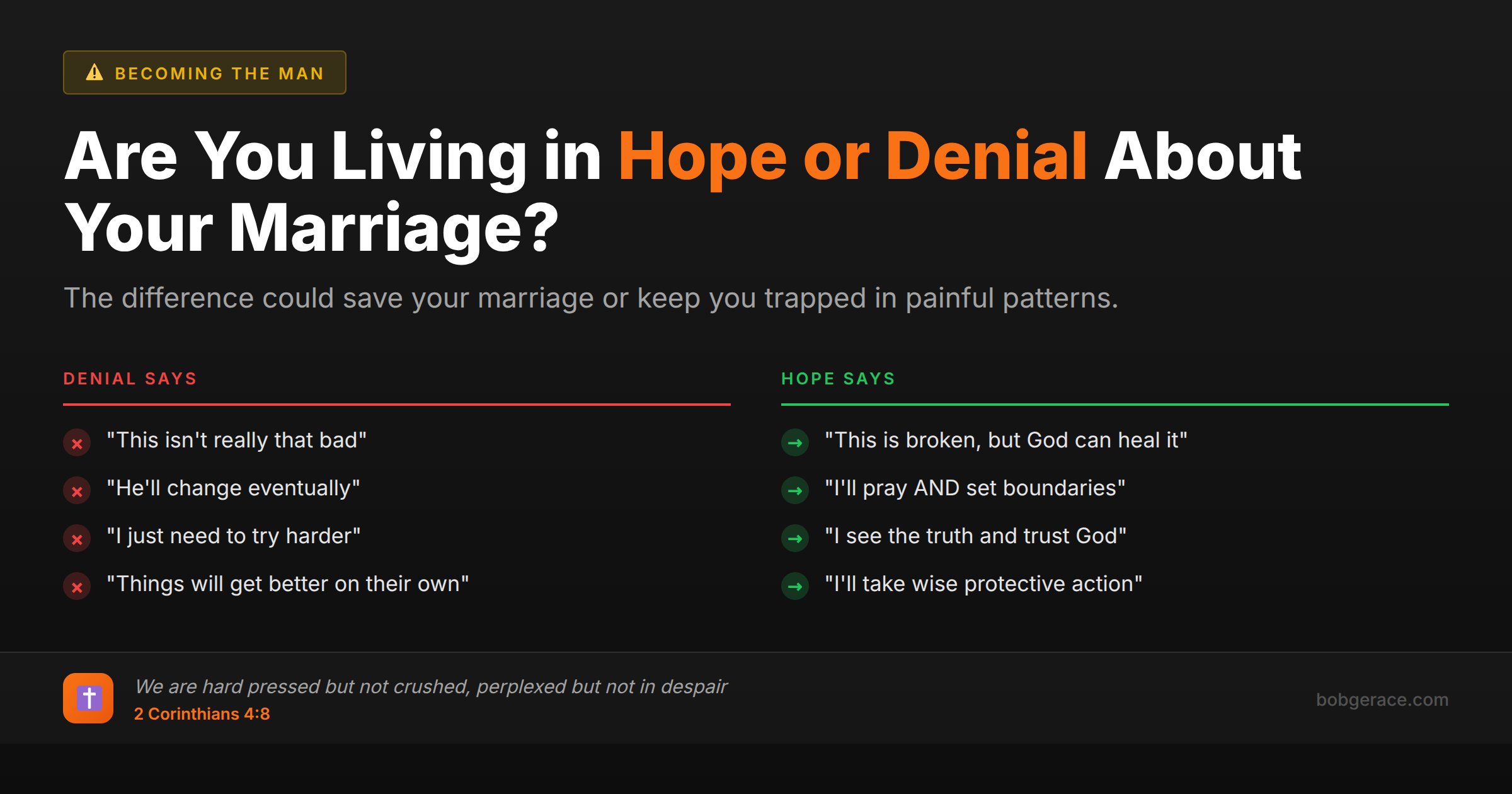
The difference between hope and denial comes down to truth and action. Hope acknowledges reality while trusting God for change - it sees problems clearly but believes in possibilities. Denial ignores or minimizes reality to avoid pain. Hope says 'This is broken, but God can heal it.' Denial says 'This isn't really that bad' when it clearly is. Healthy hope takes protective action and sets boundaries while praying for breakthrough. It's rooted in God's character, not wishful thinking. Denial keeps you stuck in harmful patterns because it refuses to face facts. Ask yourself: Am I taking wise action based on what's actually happening, or am I making excuses to avoid difficult decisions?
The Full Picture
Many women struggle with this distinction because both hope and denial can feel like faith. You want to believe the best about your husband and marriage. You don't want to give up. But there's a crucial difference that can save you years of unnecessary pain.
Hope is faith with eyes wide open. It sees the affair, the addiction, the abuse, or the abandonment clearly. It doesn't minimize or make excuses. Hope says 'This is devastating AND God is bigger than this mess.' It trusts God's character while acknowledging painful realities.
Denial is fear wearing a faith mask. It minimizes problems, makes excuses, and avoids hard truths because facing reality feels too overwhelming. Denial says 'It's not that bad' when friends and family see clearly that it is. It confuses enabling with love and mistake inaction for patience.
Hope takes wise action - it sets boundaries, seeks counsel, and protects what needs protecting while praying for breakthrough. Hope doesn't tolerate harm in the name of love. It creates space for healing by refusing to participate in destruction.
Denial keeps you trapped in cycles of hurt because it won't acknowledge what's actually happening. It mistakes suffering with faithfulness and confuses endurance with wisdom. Denial often leads to burnout, resentment, and spiritual confusion.
The enemy loves denial because it keeps you ineffective and wounded. God calls you to hope because it positions you for both protection and breakthrough. True faith faces facts and trusts God with the outcome.
What's Really Happening
From a clinical perspective, the distinction between hope and denial often centers on your relationship with reality and your capacity for adaptive coping. Hope demonstrates psychological flexibility - you can hold both the pain of current circumstances and the possibility of positive change simultaneously.
Denial, however, represents a rigid defense mechanism that distorts perception to manage overwhelming emotions. While denial can provide temporary emotional relief, it prevents the processing necessary for genuine healing and growth.
Healthy hope correlates with what we call 'realistic optimism' - maintaining positive expectations while accurately assessing situations. This requires emotional regulation skills and the ability to tolerate uncertainty and distress without immediately seeking escape through minimization.
I often see women caught in denial exhibiting specific patterns: repeatedly explaining away concerning behaviors, isolating from people who express concern, and experiencing increasing anxiety when forced to confront inconsistencies between their narrative and observable reality.
Hope, conversely, allows for collaborative problem-solving, seeking support, and taking protective action when necessary. Hope-filled women can articulate both their concerns and their faith without contradiction.
The neurological difference is significant - denial keeps you in fight-flight-freeze mode, while hope activates your prefrontal cortex for wise decision-making. This is why denial feels emotionally exhausting while hope, even in difficulty, can feel empowering.
What Scripture Says
Scripture never calls us to blind optimism or willful ignorance. Biblical hope is always grounded in truth and God's character, not wishful thinking about circumstances.
Hope acknowledges reality: *'We are hard pressed on every side, but not crushed; perplexed, but not in despair'* (2 Corinthians 4:8). Paul doesn't minimize the difficulty - he's 'hard pressed' and 'perplexed' - but he maintains hope in God's sustaining power.
Wisdom requires discernment: *'The simple believe anything, but the prudent give thought to their steps'* (Proverbs 14:15). God calls us to be prudent, not naive. Discernment means carefully evaluating what's actually happening, not what we wish were happening.
Love doesn't enable: *'Better is open rebuke than hidden love'* (Proverbs 27:5). Sometimes love requires confronting hard truths rather than covering them up. Enabling destructive behavior isn't loving - it's harmful to everyone involved.
Truth sets free: *'Then you will know the truth, and the truth will set you free'* (John 8:32). Freedom comes through facing reality, not avoiding it. Denial keeps you bound to cycles of pain and confusion.
Hope has substance: *'Now faith is confidence in what we hope for and assurance about what we do not see'* (Hebrews 11:1). Biblical hope isn't vague wishing - it's confident trust in God's promises and character.
Protect what's precious: *'Above all else, guard your heart, for everything you do flows from it'* (Proverbs 4:23). Guarding your heart means setting wise boundaries, not pretending threats don't exist.
What To Do Right Now
-
1
Write down the concerning behaviors or patterns you've been minimizing - be specific and honest
-
2
Ask a trusted friend or counselor what they observe about your situation - listen without defending
-
3
Identify one boundary you need to set based on actual behavior, not promised change
-
4
Pray for wisdom to see clearly while trusting God with outcomes beyond your control
-
5
Take one protective action today - even small steps matter when they're based in reality
-
6
Connect with other women who've learned to hope wisely in difficult marriages for perspective and support
Related Questions
- How do I know if I'm in denial or in faith?
- What does healthy hope look like vs. fantasy?
- When does waiting become enabling?
- What is 'closure' and do I need it to move on?
- How do I discern between my will and God's will?
- What's the difference between hope and presumption?
- Is there a point of no return?
- How do I know if he's really changing?
- What does real forgiveness look like?
- Can I forgive before I'm ready?
Also find Bob on
Subscribe for weekly videos on Christian marriage.
Bring Your Situation to a Coach
You don't have to keep parsing hope from denial alone. A coach who knows your specific marriage can help you see what's real and what to do next.
Talk to Bob →