How do I receive feedback without counter-attacking?
6 min read
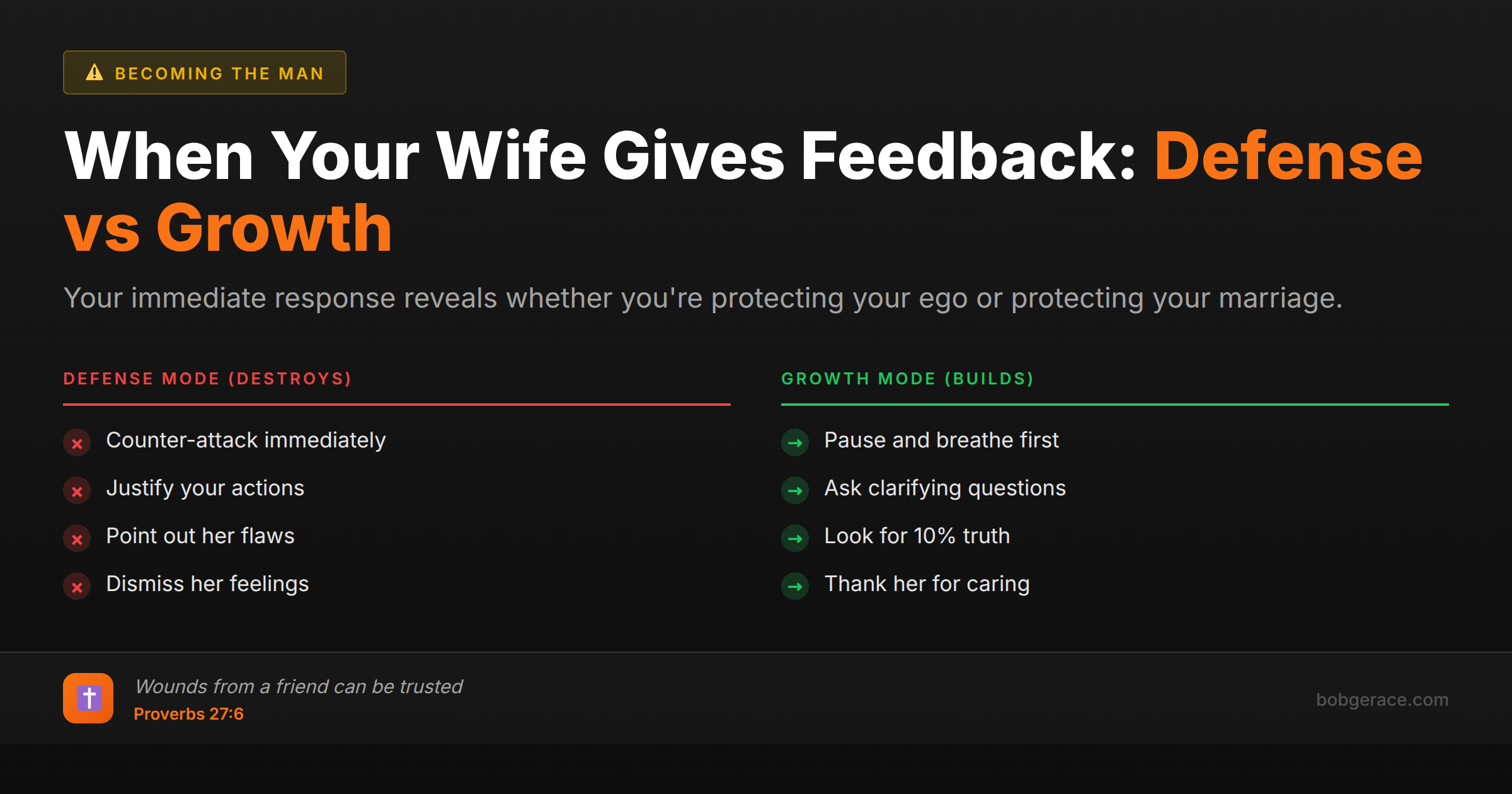
Receiving feedback without counter-attacking starts with recognizing that your immediate urge to defend or strike back is a threat response, not wisdom. The key is to pause, breathe, and remind yourself that your spouse's feedback—even when poorly delivered—contains information that could strengthen your marriage. Before responding, ask yourself: 'What if there's even 10% truth in what they're saying?' This question shifts you from defense mode to learning mode. Remember, you don't have to agree with everything to receive it well. Your goal isn't to win the moment but to understand your spouse's heart and grow in love.
The Full Picture
Counter-attacking when receiving feedback is like throwing gasoline on a fire. Your spouse musters the courage to share something difficult, and instead of receiving it, you immediately launch into why they're wrong, hypocritical, or worse than you. This destroys trust and shuts down future communication.
The counter-attack pattern looks like this: - Spouse shares concern: "You've been really short with the kids lately" - You immediately deflect: "Well, you're on your phone all the time!" - Conversation derails into mutual accusation - Original concern gets buried - Both feel unheard and attacked
This pattern trains your spouse to stop giving feedback altogether. They learn that sharing concerns leads to being attacked, so they shut down or explode. Either way, you lose access to valuable information about how your actions affect the person you love most.
The deeper issue isn't the feedback itself—it's your fear of being imperfect. When someone points out your flaws, it triggers shame, inadequacy, and the fear that you're failing as a spouse. Counter-attacking feels like self-protection, but it actually makes you more vulnerable by damaging trust.
Receiving feedback well doesn't mean becoming a doormat or agreeing with unfair criticism. It means having the strength to hear hard things without immediately defending yourself. This creates safety for honest communication and shows your spouse that their feelings matter to you.
The goal isn't perfection—it's connection. When you receive feedback gracefully, even when it stings, you demonstrate love in action and invite your spouse to keep sharing their heart with you.
What's Really Happening
Counter-attacking during feedback is a classic example of emotional dysregulation—your nervous system perceives threat and activates fight-or-flight before your rational mind can engage. This happens in milliseconds, which is why the urge to defend feels so automatic and overwhelming.
Neurologically, criticism activates the same brain regions as physical pain. Your amygdala floods your system with stress hormones, your prefrontal cortex goes offline, and you lose access to higher-level thinking. In this state, counter-attacking feels like survival, not choice.
The therapeutic breakthrough comes through understanding your attachment wounds. If you grew up in an environment where criticism meant rejection, abandonment, or shame, your adult brain still interprets feedback as existential threat. You're not just defending against your spouse's words—you're defending against old wounds that never healed.
Building tolerance for feedback requires developing what we call 'distress tolerance'—the ability to sit with uncomfortable emotions without immediately acting to make them stop. This involves recognizing your triggers, implementing grounding techniques, and gradually expanding your capacity to stay present during difficult conversations.
The most effective intervention is learning to separate your spouse's feedback from your core worth. Their observation that you were impatient doesn't mean you're a terrible person—it means you had a human moment that affected them. This cognitive separation allows you to receive information without feeling fundamentally threatened.
What Scripture Says
Scripture consistently calls us to receive correction with humility rather than defensiveness. Proverbs 27:5-6 reminds us: *"Better is open rebuke than hidden love. Wounds from a friend can be trusted, but an enemy multiplies kisses."* Your spouse's feedback, even when it stings, comes from love—not from desire to harm you.
Proverbs 15:31-32 teaches: *"Whoever heeds life-giving correction will be at home among the wise. Those who disregard discipline despise themselves, but the one who heeds correction gains understanding."* Counter-attacking shows you're more concerned with being right than growing in wisdom.
Jesus himself modeled receiving difficult feedback. When Peter rebuked him about going to the cross, Jesus didn't counter-attack Peter's character. He addressed the issue directly but maintained relationship. Matthew 16:23 shows correction without character assassination.
James 1:19 provides the practical framework: *"My dear brothers and sisters, take note of this: Everyone should be quick to listen, slow to speak and slow to become angry."* This verse gives you permission to pause, process, and respond thoughtfully rather than reactively.
Ephesians 4:15 calls us to *"speak the truth in love"*—but this requires someone willing to receive truth in love. When you counter-attack, you make it impossible for your spouse to share truth lovingly because you've turned the conversation into a battle.
Ultimately, 1 Corinthians 13:5 reminds us that love *"is not easily angered, it keeps no record of wrongs."* Receiving feedback gracefully is an act of love that builds intimacy rather than destroying it.
What To Do Right Now
-
1
Practice the 6-second pause - When you feel the urge to counter-attack, count to six slowly while breathing deeply. This gives your prefrontal cortex time to come back online.
-
2
Ask clarifying questions - Instead of defending, ask: 'Help me understand what you experienced' or 'What would you like to see different?' This shifts you into learning mode.
-
3
Find the grain of truth - Look for even 10% accuracy in their feedback. Say: 'You're right that I was impatient with the kids yesterday. Tell me more about how that affected you.'
-
4
Acknowledge their courage - Thank your spouse for caring enough to share difficult feedback: 'I know this wasn't easy to bring up. Thank you for loving me enough to tell me.'
-
5
Separate the message from the delivery - Even if they shared feedback poorly, focus on the content rather than attacking their communication style in the moment.
-
6
Schedule follow-up - Say: 'I need some time to think about this. Can we talk more tomorrow?' This prevents reactive responses and shows you're taking them seriously.
Related Questions
- What is defensiveness in Gottman's Four Horsemen?
- What's the antidote to defensiveness?
- What does 'taking responsibility' actually look like?
- What does a non-defensive response sound like?
- How do I stay in prefrontal cortex during conflict?
- What does Proverbs say about receiving correction?
- She says she can't talk to me
- She shuts down when I try to connect
- How do I not lose my mind right now?
Also find Bob on
Subscribe for weekly videos on Christian marriage.
You Don't Have to Figure This Out Alone
A coach who knows your marriage can help you see what's underneath your defensiveness and practice receiving feedback in real time—before the next hard conversation.
Talk to Bob →