What are reasonable timelines for decisions?
6 min read
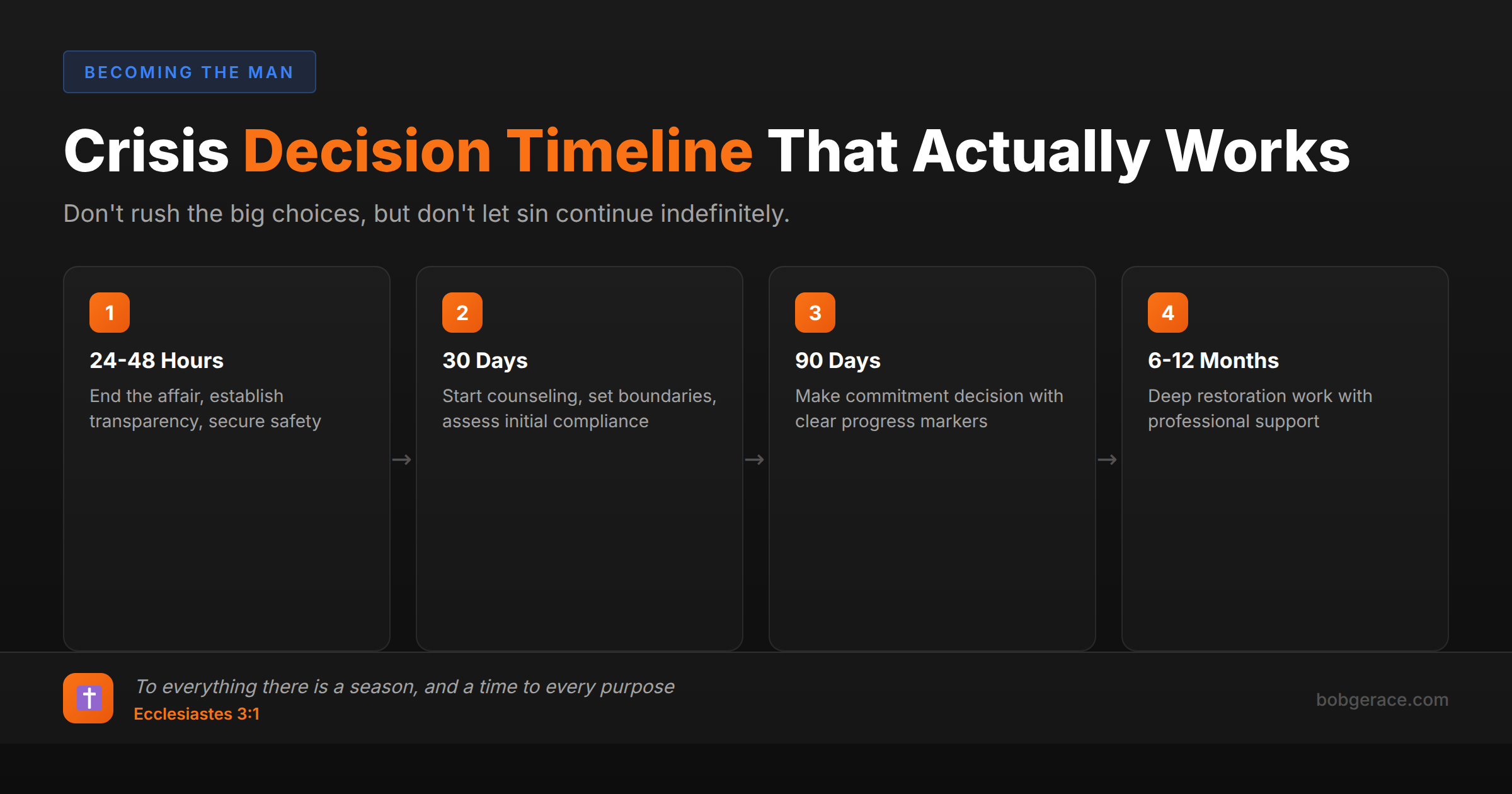
When your marriage is in crisis due to another man, reasonable decision timelines depend on the complexity of choices involved. For immediate safety decisions (ending the affair, transparency measures), expect 24-48 hours. For deeper relationship choices (continuing the marriage, reconciliation attempts), allow 30-90 days with professional support. Avoid ultimatums that create artificial pressure, but don't allow indefinite delay that prevents healing. Most couples benefit from a structured 90-day intensive period to make initial commitments, followed by 6-12 months for deeper restoration work. The goal isn't rushing decisions but creating healthy pressure for genuine change while allowing space for authentic transformation.
The Full Picture
Decision-making during marital crisis requires both urgency and wisdom. When there's another man involved, you're dealing with layers of deception, broken trust, and emotional chaos that cloud judgment. Setting reasonable timelines protects both spouses from hasty decisions while preventing the paralysis that comes from endless delays.
Immediate decisions (24-48 hours) should focus on safety and transparency: ending inappropriate contact, sharing passwords, establishing temporary living arrangements if needed. These aren't negotiable—they're prerequisites for any meaningful conversation about the future.
Short-term decisions (2-4 weeks) involve establishing basic boundaries and support systems: counseling arrangements, communication protocols, financial transparency, and childcare considerations. This phase is about creating stability, not solving everything.
Medium-term commitments (30-90 days) address the bigger questions: whether both parties want to pursue reconciliation, what changes each person commits to making, and what professional help will be engaged. This timeline allows for initial shock to subside while maintaining momentum toward resolution.
Long-term restoration (6-12 months) involves the deep work of rebuilding trust, addressing root issues, and establishing new patterns. Some decisions can't be rushed—genuine repentance, trust rebuilding, and character change require time.
The key is distinguishing between decisions that require immediate action and those that benefit from thoughtful consideration. Don't let fear of making the "wrong" choice prevent you from making necessary choices. Most decisions can be adjusted as new information emerges and healing progresses.
What's Really Happening
Trauma responses significantly impact decision-making capacity during infidelity recovery. The betrayed spouse often experiences symptoms similar to PTSD, including hypervigilance, intrusive thoughts, and decision paralysis. Meanwhile, the unfaithful spouse may be dealing with shame, guilt, and their own emotional dysregulation that impairs judgment.
Neuroscience research shows that high-stress situations activate the amygdala (fear center) while suppressing the prefrontal cortex (rational thinking). This is why couples in crisis often make poor decisions when rushed, yet also struggle with decision avoidance when overwhelmed. Appropriate timelines help regulate the nervous system and restore cognitive function.
The concept of "good enough" decisions becomes crucial here. Perfectionism in decision-making often masks fear of commitment or responsibility. Many marriage decisions don't require perfect information—they require courage to act on sufficient information with a willingness to adjust course as needed.
I often see couples get stuck in analysis paralysis, believing they need certainty before making commitments. However, commitment often precedes clarity. Setting reasonable timelines creates healthy pressure that forces movement through the decision-making process while allowing adequate time for processing.
Individual factors also matter tremendously. Some people are natural processors who need more time, while others are decisive but may rush important choices. The timeline should account for personality differences while maintaining forward momentum toward resolution.
What Scripture Says
Scripture emphasizes both the urgency of addressing sin and the patience required for genuine transformation. When Jesus confronted the woman caught in adultery, He offered immediate grace but also clear direction: "Go and sin no more" (John 8:11). There was no extended timeline for the decision to abandon sinful behavior—it was immediate.
Ecclesiastes 3:1 reminds us that "To everything there is a season, and a time to every purpose under heaven." This includes a time for decisive action and a time for patient restoration. Wisdom lies in discerning which decisions require immediate action and which benefit from careful consideration.
Proverbs 27:14 warns against hasty decisions: "Plans fail for lack of counsel, but with many advisers they succeed." Major marriage decisions benefit from godly counsel, prayer, and community input. However, this doesn't justify indefinite delay when sin is causing ongoing damage.
Matthew 18:15-17 provides a framework for addressing sin that includes escalating timelines. First, private confrontation should happen immediately. If there's no response, involve others. If there's still no repentance, involve the church community. Each step has natural timelines that create appropriate pressure for change.
2 Corinthians 6:2 declares that "now is the day of salvation," emphasizing the urgency of responding to God's conviction. When the Holy Spirit is calling someone to repentance and change, delay can be dangerous—not because God's grace expires, but because hardened hearts become less responsive to His voice.
James 1:5-8 encourages us to ask God for wisdom while warning against double-mindedness. Setting reasonable timelines helps combat the instability that comes from endless vacillation between choices.
What To Do Right Now
-
1
Identify immediate safety decisions that cannot wait—ending inappropriate contact, establishing transparency, securing emotional and physical safety for yourself and children
-
2
Create a 30-day assessment period with specific goals: engage professional counseling, establish basic boundaries, and evaluate initial compliance with agreements
-
3
Schedule a 90-day decision point to evaluate whether sufficient progress is being made to justify continued reconciliation efforts, with specific measurable criteria
-
4
Build in regular check-points every 2-4 weeks to assess progress, adjust expectations, and prevent drift without accountability or forward movement
-
5
Engage professional support immediately—don't try to navigate these decisions alone, and ensure both individual and couples counseling are part of the timeline
-
6
Document agreements and deadlines in writing, shared with your counselor or pastor, to maintain clarity and accountability as emotions fluctuate throughout the process
Related Questions
- What boundaries should I set?
- What's the difference between boundary and ultimatum?
- What makes boundaries effective vs. empty threats?
- When does patience become enabling?
- How do I give an ultimatum without losing her?
- What does 'holding space' while 'holding boundary' look like?
- Should I give her space or fight for her?
- How much space is too much?
- How long do I wait before giving up?
- When is it actually over?
Also find Bob on
Subscribe for weekly videos on Christian marriage.
Setting Timelines in Your Marriage
A coach who knows your story can help you calibrate pressure and patience for where you actually are—not generic advice, but what makes sense for your wife, your kids, your situation.
Talk to Bob →